CU1128 Reference Clock Placement: Keep Distributed Time Off Removable Branches
A removable EtherCAT branch can take more than its own I/O offline.
If it contains the selected distributed-clocks reference, removing it
also removes the time reference used by the wider system. A permanently
installed CU1128 can provide a better location, but only when the actual
topology and clock selection support that design.
The decision is about failure boundaries: which equipment must remain
present for the rest of the machine to retain its distributed time? It
is not a reason to force every junction into the reference role or
change timing settings during production.
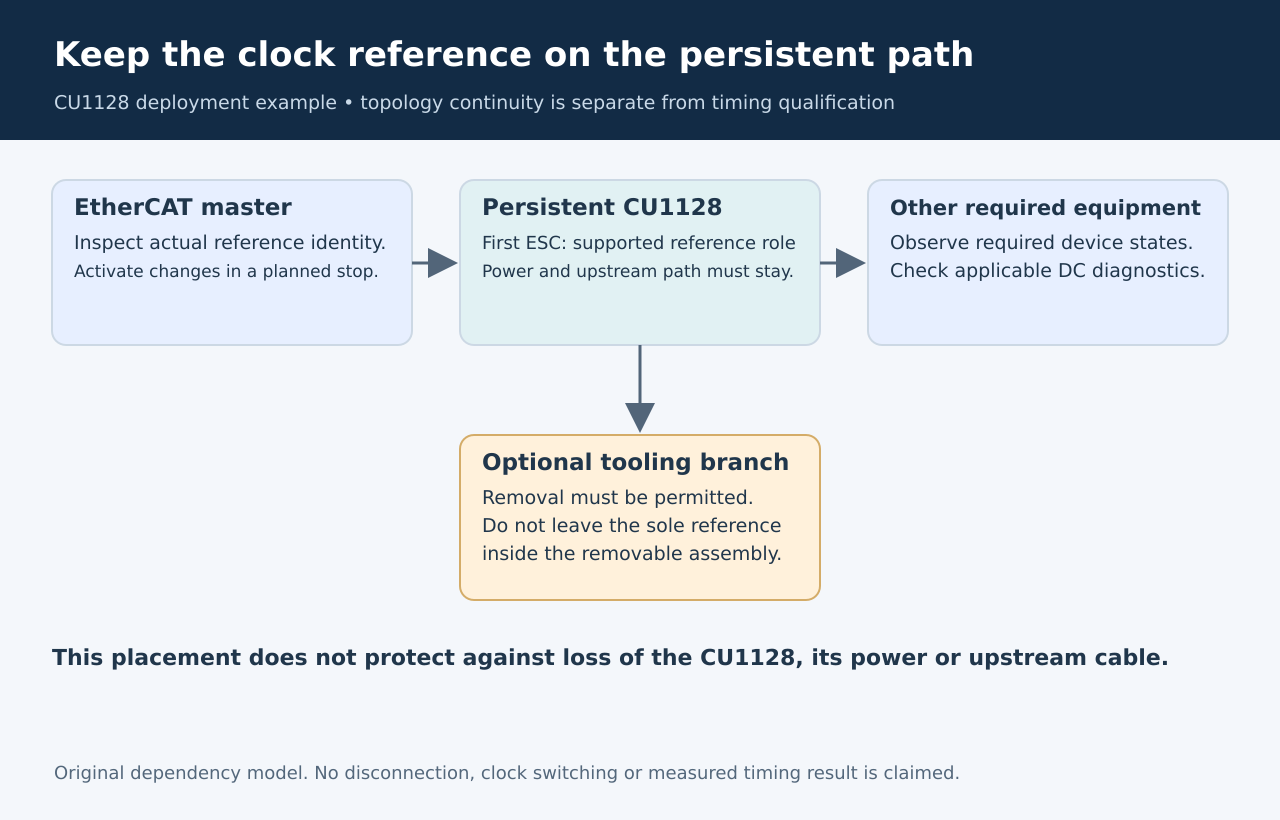
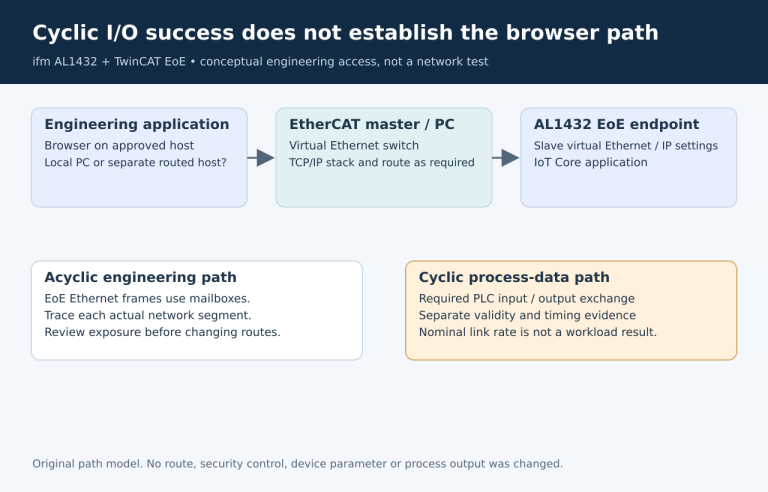
Original diagram. No measured topology or timing result is
represented.
Inspect the
selected reference before changing it
Beckhoff’s CU1128 example places the reference near the beginning of
the hierarchy, before flexible Hot Connect components. It shows the risk
of leaving the reference on an EL7201 branch that can be disconnected.
The documented alternative marks the first CU1128 ESC as a potential
reference clock, allowing TwinCAT to select that central component. CU112x
reference-clock guidance
First identify the device currently selected by the installed master.
Then trace its physical dependencies: power feed, upstream connection
and any removable assembly between it and the controller. A device with
a central-looking project name may still receive power through the
module that maintenance disconnects.
Consider a hypothetical junction that remains powered while one
downstream tooling branch is exchanged. Keeping the reference in that
junction removes the tooling branch from the reference’s dependency
path. It does not protect against loss of the junction itself, its power
supply or its upstream cable.
Distinguish
capability from configuration
The CU1128’s documented DC capability makes it a candidate. Its
support for connecting and disconnecting branches also depends on
TwinCAT or another suitable EtherCAT master; the product page does not
promise that every controller and arbitrary project can hot-connect
branches without preparation. CU1128
product information
The generic TwinCAT guidance adds an important limit: marking
unsupported hardware as a potential reference does not create clock
hardware. It can leave the system without a usable reference and prevent
slaves from reaching OP. The same guidance says DC configuration changes
require activation and an EtherCAT restart. Schedule that work as a
controlled configuration change. EtherCAT
DC default settings
Avoid interpreting the checkbox alone as the acceptance result. After
the planned restart, confirm which device the master actually selected.
Also confirm that the required downstream devices reached their expected
states. A stored configuration and an operating clock domain are
different observations.
Separate
branch continuity from synchronization quality
Reference placement addresses where time comes from. It does not
establish the resulting application’s timing accuracy, sampling
alignment or motion performance.
TwinCAT’s DC description separates delay measurement, offset
compensation and ongoing drift correction. Its diagnostic facilities
include synchronization-window monitoring. These mechanisms explain why
a live reference and the absence of a cable fault are only part of the
timing evidence. TwinCAT
distributed-clocks overview
For an isolated commissioning fixture, define observations for three
cases: ordinary startup; the permitted removal of the selected optional
branch; and restoration of that branch. Record reference identity,
relevant device states and applicable synchronization diagnostics. Let
the machine’s approved operating procedure determine whether any
disconnection is allowed. A topology example is not authorization to
interrupt a running process.
Keep the results scoped. Showing that one removable branch no longer
contains the reference does not demonstrate redundant clocks,
uninterrupted operation under all faults or a measured timing guarantee.
It demonstrates a specific dependency improvement only after the
observations support it.
The review should finish with a simple statement: this physical
CU1128 and its first ESC supply the selected reference, these
dependencies must remain available, and these optional branches may
disappear under the qualified configuration. That statement is more
useful than “DC enabled” without a device identity. No EtherCAT system
or timing behavior was tested for this article.