Node-RED Persistent Context: Qualify the Commit Boundary Before Acknowledging Telemetry
A gateway can acknowledge a telemetry update after saving it to Node-RED context, then recover an older value when it starts again. Before promising restart recovery, identify what the context operation actually completed and what the downstream acknowledgement means. This matters when a flow holds production counts, replay positions or outstanding work.
The implementation review below pins Node-RED 4.0.9, without claiming it is the newest release. Five deterministic module-level cases were executed under Node.js v24.19.0. They establish selected callback and file-operation ordering; they do not establish full-runtime behavior or survival of a physical power cut.
Start with the state the product needs back
Make an inventory of the values a gateway must reconstruct. A latest-temperature display may be rebuilt from fresh observations. A cumulative count may allow a documented rollback. A completed-work marker may need to remain consistent with a separate business record. These requirements deserve different recovery decisions.
For each item, record its owner, context scope, selected store, reconstructability and permissible loss. Include the action taken when recovery finds no value. An absent counter should not silently become zero if that makes an unknown production total look authoritative.
Node-RED supports memory and file-backed context stores, including several stores in one runtime. The context guide describes their configuration. The Function-node guide documents the optional store name on context get/set calls. Record that selection beside the actual call site; configuring a file store somewhere does not establish which store a particular call uses.
Follow the cached write path
The local-filesystem store documentation gives caching as the default and a default minimum write interval of 30 seconds. Unexpected termination can lose changes not yet flushed. Treat the interval as a scheduling setting, not a maximum guaranteed recovery age under storage faults or scheduling delays.
In the 4.0.9 implementation, a cached set delegates to the memory store, including its callback, and then marks the scope for a later write. The write helper creates a temporary file and renames it to the destination. In uncached mode, the callback follows that file-operation promise chain. The helper contains no explicit file or directory fsync operation.
The practical review question is precise: if a flow sends an application acknowledgement from the cached callback, which component has accepted responsibility for recovering that update? The callback alone does not supply an answer about disk persistence.
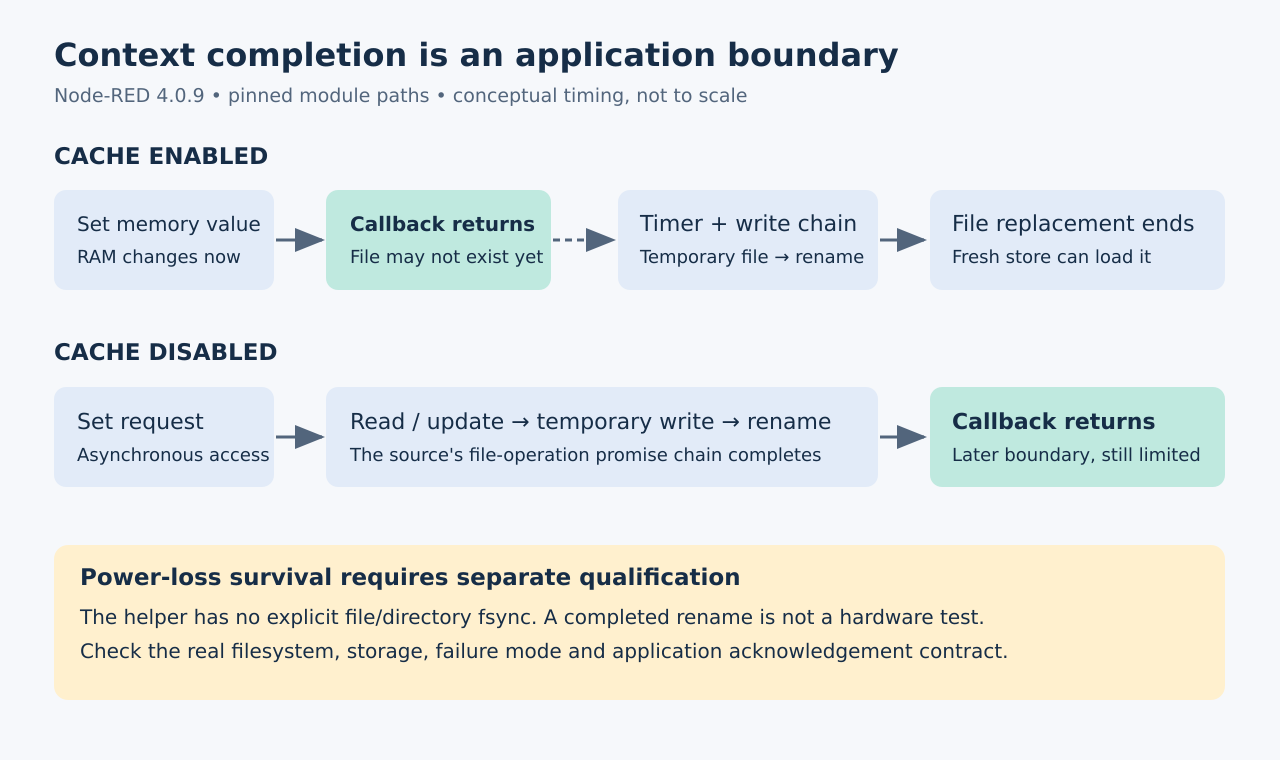
Original implementation-boundary diagram. Module ordering was exercised; physical persistence was not measured.
Examine the five executed cases
The harness loaded the pinned local-filesystem and memory-store modules. It used real temporary files through a filesystem adapter, manually serviced timers, simple property-name helpers and an acyclic JSON serializer. Those substitutions deliberately limit the finding to the operations shown.
- Cached set: the callback completed and memory contained the new value before a context file existed. A freshly opened store recovered no value.
- Cached set followed by its timer: the recorded order was callback, file write, then rename. A fresh store loaded the saved value.
- Uncached set: the callback occurred after file write and rename completed.
- Cached write failure: an injected ENOSPC-style error was logged after the earlier callback had succeeded. A fresh store still recovered no value.
- Orderly module close: closing with a pending cached write flushed the value, which a fresh store loaded.
Fresh-store opening modeled recovery from the files left by each case. No process was killed, no broker was connected and no power supply was interrupted. The fixture also did not test nested property expressions, circular objects, concurrent flow updates or filesystem crash consistency.
Choose an acknowledgement contract deliberately
For a reconstructable dashboard cache, accepting temporary rollback may be reasonable. Document that the startup display is provisional until fresh source data arrives. For a bounded-loss counter, define the permitted unpersisted work and the fault response when saving stops succeeding.
For work that must survive before it is acknowledged, evaluate a storage or queue design whose documented commit operation matches that requirement. Include the consumer’s acknowledgement and duplicate-handling behavior. Simply changing every context access to asynchronous form does not define such a transaction.
Treat related state as a consistency problem too. A counter and a replay cursor stored through separate operations can represent different progress after interruption. Establish the required invariant before selecting a persistence mechanism. For example, a recovery procedure must explain whether a repeated input is discarded, counted again or held for reconciliation.
Qualify the deployed recovery path
Use a disposable integration gateway and preserve an independent input ledger. Record the runtime version, loaded settings, store name, storage mount and source sequence for every trial. Compare the accepted input boundary with the recovered application state, rather than checking only that a JSON file exists.
Exercise orderly service shutdown, abrupt process termination, storage exhaustion, an unavailable context directory and restart from the actual deployment image. If the product promises power-loss survival, add a separately controlled campaign on the selected filesystem and storage hardware. Process termination leaves the operating system running and cannot substitute for that evidence.
The release artifact should state which values return, which may roll back, how missing state is reported and when the gateway is allowed to acknowledge new work. That contract makes persistent context a deliberate component of the product instead of an accidental promise of durability.