CAN Gateways and Identifier Collisions: Avoid Merging Two Bus Namespaces Blindly
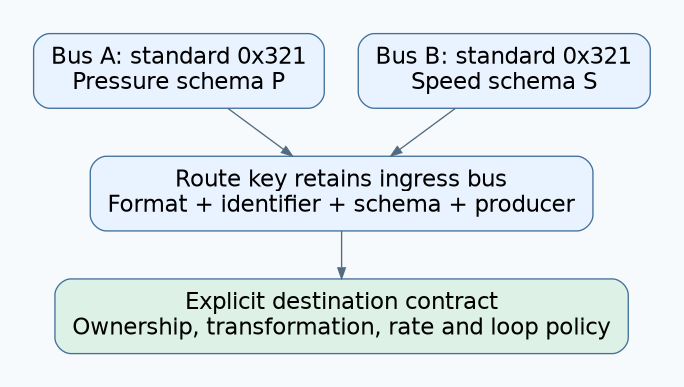
Use the ingress bus, frame format and message schema as part of a gateway route key. Two independent CAN segments can legitimately assign different meanings to the same numeric identifier. Forwarding both unchanged into one destination segment can erase that distinction and create conflicting producers.
This guide uses Linux v6.12 SocketCAN provenance as the implementation boundary. The route tables are an original integration design, not Linux gateway configuration syntax. No forwarding rules were installed, no traffic was transmitted and no physical network compatibility was tested.
1. Define the namespace before merging traffic
The SocketCAN concept guide describes identifiers as arbitration inputs rather than Ethernet-style destination addresses. Their application meaning comes from the network’s message contract.
Inventory each segment separately: stable bus role, current interface mapping, standard/extended format, Classical/FD representation, identifier, producer, payload schema, expected rate and permitted consumers. Include diagnostic and management traffic rather than considering only normal telemetry.
A shared identifier is not automatically a collision when the segments remain separate. The collision arises when a route or downstream data model merges meanings without retaining enough context.
2. Preserve interface provenance at receive time
SocketCAN can bind to all interfaces using index zero; the receive documentation explains how the returned address identifies the originating interface. A payload-only read discards the information needed for a multi-bus route decision.
The RAW implementation stores the received interface index and returns it through the receive-address path. Carry that value into routing before normalizing the message.
Maintain an explicit configuration mapping between interface identity and the product’s bus role. Validate that mapping after startup or device changes. Do not interpret “the first interface” as a permanent physical connector contract.
3. Build an explicit route decision table
Consider the following hypothetical inventory. The labels and identifiers are artificial; they do not describe a real machine.
| Ingress key | Meaning | Proposed destination treatment |
|---|---|---|
| Bus A, standard data 0x321 | Pressure schema P | Route only to a consumer explicitly expecting P |
| Bus B, standard data 0x321 | Speed schema S | Keep distinct; no shared destination identity with P |
| Bus A, extended data 0x321 | Separate schema E | Do not merge with standard 0x321 |
| Unknown ingress bus or schema revision | Unresolved | Reject or quarantine under a visible policy |
| Error notification | Local diagnostic evidence | Do not blindly forward as application traffic |
For each admitted route, record egress bus, output identifier/format, transformation version, allowed producer, maximum rate and loop policy. A missing route must not fall back to the first destination.
If the destination already has a producer for the chosen identifier, resolve ownership before enabling the route. Similar-looking payload bytes do not establish that the two producers share timing, sequence or failure semantics.
4. Choose isolation, translation or rejection deliberately
Keeping namespaces isolated is often the clearest choice when consumers cannot distinguish sources. If translation is required, define a destination contract that gives every accepted source an unambiguous meaning.
Changing an identifier changes arbitration behavior as well as message naming. Review the resulting traffic schedule and destination expectations; do not treat identifier renaming as a purely cosmetic operation.
For a structured protocol such as J1939, the identifier description assigns meanings to priority, PGN and addressing fields. A generic numeric offset can alter those meanings. Use a protocol-aware translation design or decline the route rather than guessing.
Likewise, format or payload-length conversion requires an explicit application contract. This route analysis does not make an FD frame safe for a Classical-only segment or define fragmentation automatically.
5. Prevent feedback without dropping legitimate local sources
Draw the complete directed forwarding graph, including another gateway, local publishers and monitoring sockets. A frame sent to Bus B may return through a second path to Bus A, or appear locally through echo.
The local-origin flags help distinguish some local observations, but “drop every local frame” can also remove legitimate traffic generated by another process. Define which producer and route owns each forwarding action.
Use internal provenance, explicit direction rules and any product-supported loop mechanism. Do not insert a hop field into an existing CAN payload unless the destination protocol explicitly reserves it. A private software tag disappears when a frame crosses an ordinary physical bus.
Rate limits can bound damage from a loop, but they do not prove the routing graph is correct. Preserve loop detections and dropped-route reasons so a quiet destination is not mistaken for successful delivery.
6. Test collisions and loops with an inert fixture
- Send different synthetic meanings on the same identifier from two ingress buses and verify distinct route decisions.
- Use equal numeric identifiers in standard and extended formats.
- Present an unknown bus, schema revision and output-identifier conflict.
- Include local publisher traffic and local echo as separate provenance cases.
- Create a controlled two-route feedback model and require bounded, explained handling.
- Restart the gateway with changed interface mapping and prevent accidental connector reassignment.
These tests are proposed only. A virtual fixture can establish route logic and software provenance, while arbitration, electrical loading and real peer behavior require a separately approved hardware qualification.
Use no actuator payloads or production buses for collision experiments. Preserve the original route configuration and require explicit operational authorization before enabling new traffic paths.
Hypothetical mixed history
A fictional logger keys all incoming data by numeric identifier alone. Pressure from Bus A and speed from Bus B both arrive as 0x321, producing a nonsensical combined trend even before any physical forwarding occurs.
The corrected record includes ingress bus and schema identity. If both streams later need a common egress, the integration must define two unambiguous destination meanings rather than relying on the logger’s internal tags to survive the wire.
7. Deliver a versioned namespace map
Keep source and destination identities, ownership, transformations, rate assumptions, loop treatment and observed fixture outcomes together. A gateway route is acceptable only when its consumer can explain which source meaning arrived and why no other source can silently occupy that same destination contract.