Industrial Gateway Permissions: Diagnose the Correct Greengrass Authorization Boundary
A gateway connecting successfully to the cloud does not prove that every local component can publish through IPC or write to an AWS service. An industrial Greengrass solution crosses several authorization boundaries. Identify which boundary rejected the intended operation before requesting a permission change.
This article maps the documented AWS IoT Greengrass V2 roles and policy locations to an integration review. It does not create credentials, expand permissions, or provide a universal policy to paste into a production account. The appropriate grant depends on the component, operation, resource, and approved deployment scope.
Distinguish the device connection from service access
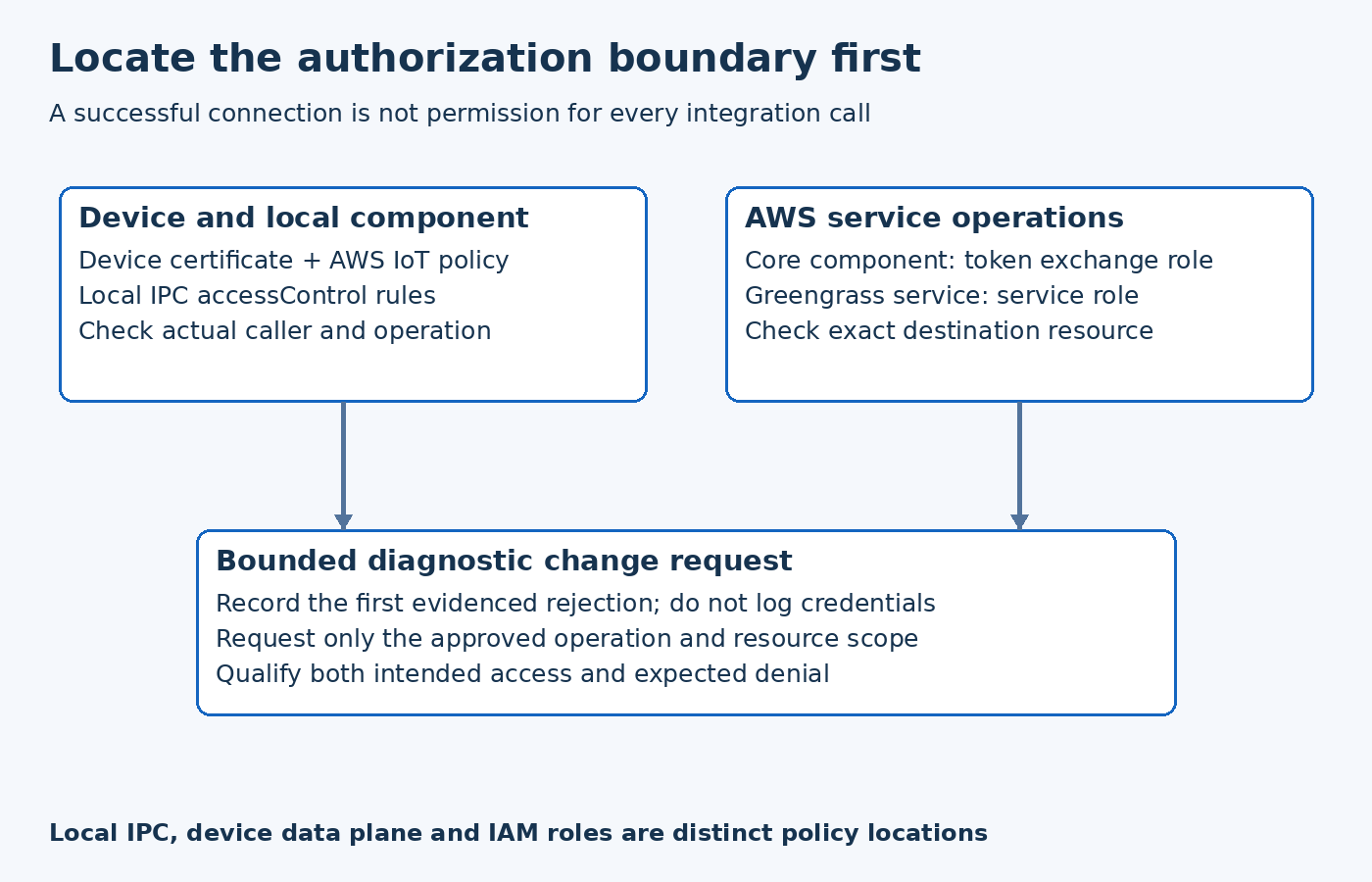
The Greengrass device authentication documentation describes X.509 certificates for device authentication and AWS IoT policies for authorized IoT Core and Greengrass data-plane operations. These cover activities such as connecting, publishing, and resolving deployed components.
Access to other AWS services from the core device uses the token exchange role. An IoT role alias identifies that IAM role, allowing the core to obtain temporary credentials. The default role policy does not include access to component artifacts in S3 buckets; artifact retrieval needs the appropriate separately authorized resource access.
These are related parts of a deployment, but they are not interchangeable policy documents. Adding an S3 action to the wrong policy boundary is not a reason to grant every available action elsewhere.
Include the local component boundary
A component can also be denied before a cloud service evaluates its request. Greengrass IPC authorization uses accessControl configuration for the applicable local IPC services, operations, and resources. Authorization policy IDs must be unique across components.
For example, a hypothetical industrial collector publishes to a local topic consumed by an uploader. The collector's local publish operation and the uploader's cloud storage operation are separate permissions. A local IPC rejection should first be investigated against the collector's deployed identity and IPC configuration, rather than against the uploader's S3 destination.
The Greengrass service role is different again: it allows the Greengrass service to act on resources, including functions involved in client-device verification and connectivity information. Do not confuse that service-level role with the token exchange role used by components on the core device.
Trace one failed operation end to end
Record the component name and deployed version, the attempted operation, the intended destination resource, and the error produced at the failure boundary. Keep account identifiers and resource references in the authorized diagnostic record; keep private keys and temporary credentials out of logs and screenshots.
Then ask a concrete sequence of questions. Did the component connect to the local IPC service? Did the intended local operation pass its authorization check? If it calls an AWS service, did it obtain credentials through the configured path? Which service rejected the resulting request, and which resource was named? Stop at the first evidenced failure instead of assuming that every later permission is also missing.
Network failures and authorization failures need separate evidence. A timeout is not proof of a missing role permission. Conversely, a successful network connection does not establish that the caller has access to the requested object or topic.
Request the smallest justified correction
Prepare a change request that names the required operation and its bounded resource scope. Have the responsible administrator review it against the deployment's ownership and security requirements. Broad wildcard access may hide an incorrect resource identifier while expanding the consequences of a compromised component.
In a disposable qualification environment, test both the approved operation and a nearby operation that should remain denied. An uploader intended for one bucket prefix should not be accepted merely because a test account grants access to everything. Retest under the identity and configuration the deployment will actually use.
The useful deliverable is a permission map tied to real integration calls: device data plane, local component IPC, device-to-service access, and service-level responsibilities. That map turns “the gateway needs more access” into a reviewable diagnosis without weakening unrelated boundaries.