Ignition OPC Read After Write: Avoid the Subscription Race Behind a Stale Tag Value
A successful OPC write and an apparently sensible readback can still leave an Ignition tag displaying a different value from its PLC source. Before adding retries, inspect the tag group’s acquisition mode. Ignition 8.3 explicitly warns against combining Read After Write with subscribed OPC tags because the competing update paths can race.
This investigation uses a simulated writable scalar, not a machine command. Its purpose is to explain a display/cache discrepancy after a write. It does not establish that an actuator moved, an interlock passed, or a production operation completed.
Identify how the tag receives observations
The Ignition 8.3 Tag Groups reference, updated 8 September 2026, distinguishes Subscribed and Polled OPC data modes. Read After Write adds a read following a write. Optimistic Writes instead puts the requested value into the Ignition tag immediately, before source confirmation.
Record those settings together. A note saying only “readback enabled” omits the condition that makes the documented warning relevant. Also identify the exact OPC item, displayed tag and writable source. Two similarly named items can create an ordinary mapping error that looks like a synchronization problem.
For the proposed fixture, use this option review:
- Subscribed, Read After Write off: establish the subscription observation path first.
- Subscribed, Read After Write on: flag the documented warned-against combination for correction in the isolated configuration.
- Polled, Read After Write off: observe confirmation through normal acquisition.
- Polled, Read After Write on: assess the additional read separately, including its traffic cost.
This is a diagnostic matrix, not a blanket recommendation to change a plant from subscriptions to polling. Select the acquisition mode according to the actual application and server requirements.
Keep three records instead of one displayed number
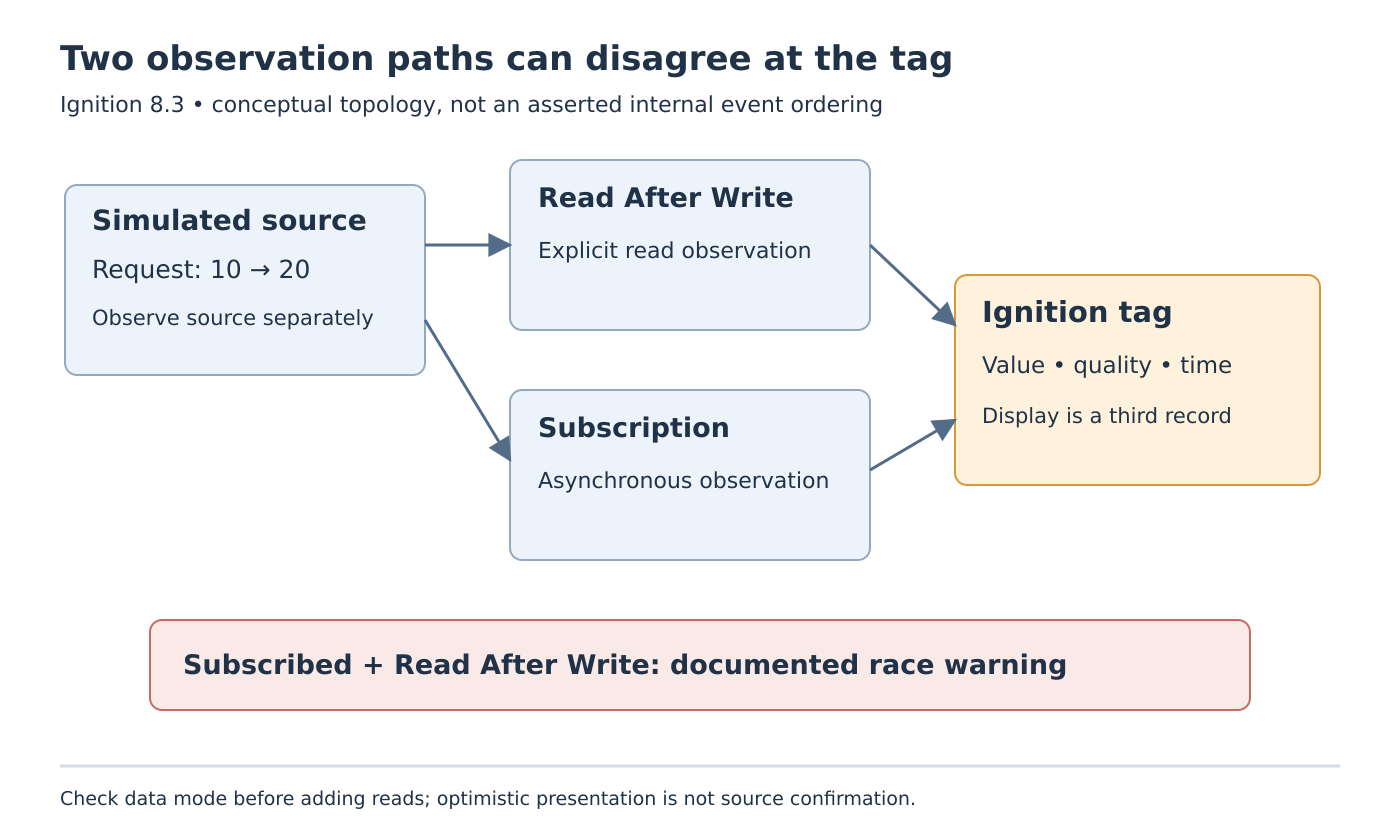
Log the requested scalar and the write operation’s returned result. Separately record the simulator’s current value through a controlled observation. Finally, record the Ignition tag’s value, quality and timestamp. These records answer different questions: what was requested, what the source currently reports, and what the application currently presents.
For an explicitly hypothetical discrepancy, the simulator begins at 10, accepts a request for 20, and reports 20 through the chosen independent observation while the displayed tag shows 10. That establishes a mismatch worth investigating. It does not, by itself, identify a particular packet order or prove which internal cache update won.
Draw the post-write read and subscription notification as two paths converging on the tag. Do not label an invented sequence as an Ignition implementation trace. The manual documents the race and its consequence, but does not specify a universal ordering that every installation will reproduce.
Repeatedly writing 20 until the screen agrees changes the experiment. It adds more traffic and can obscure the first failure. Keep each trial to one deliberate simulated write, then inspect the resulting observations before resetting the fixture.
Do not mistake optimistic display for confirmation
With Optimistic Writes enabled, a displayed 20 can appear before the source has confirmed it. Record that presentation behavior explicitly rather than allowing the screen capture to stand in for write acceptance.
The same manual advises keeping Optimistic Write Timeout above the group’s Rate. Otherwise, a requested value can appear immediately, revert when the timeout expires, and reappear after the later poll. This temporary reversion is a separate explanation to check in a polled fixture; it is not evidence that the source itself performed the same three transitions.
Begin the cache-race investigation without optimistic presentation obscuring the observation path. Once that path is understood, qualify the desired display behavior independently. Do not treat a longer optimistic timeout as a repair for the subscription/Read After Write combination.
Qualify the correction with a repeatable scalar exercise
Preserve the original configuration, then change only the conflicting option in a disposable project. Use distinct requested values, retain source and tag observations, and repeat with the intended server update timing. Compare results after the change without promising that one successful trial proves every possible timing case.
If the discrepancy remains, the recorded boundaries guide the next question: did the source accept the request, did the expected observation arrive, and did the displayed item reference the intended tag? Investigate the first evidenced disagreement instead of adding another read path.
No Ignition gateway, OPC server or simulator was run for this article. The deliverable is a source-based fixture and configuration review that separates a write result from an observed source value and an unconfirmed display.