Industrial IoT Remote Requests: Choose Desired State, Immediate Methods or Queued Messages
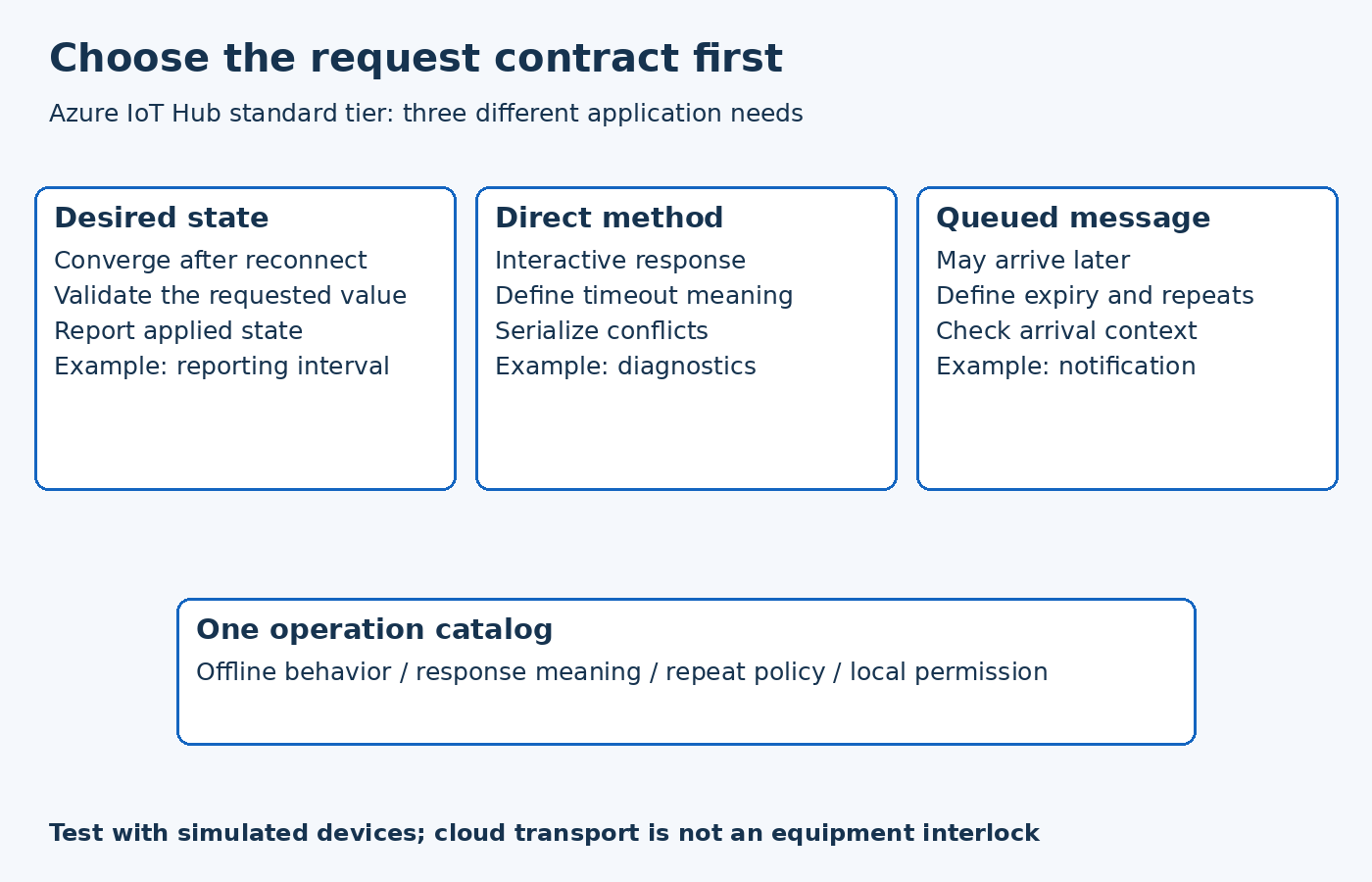
A request to change a sampling interval is not the same operation as a request for an immediate diagnostic response. Decide whether the application needs a persistent target state, an interactive result, or a notification that may arrive later before selecting its cloud-to-device interface. Calling every request a command hides these different obligations.
The concrete platform here is Azure IoT Hub. Its cloud-to-device guidance describes desired properties, direct methods, and cloud-to-device messages as standard-tier features. This is an integration design discussion, not a tested remote-control system or an authorization to operate equipment.
Use desired properties for a state that should remain desired
A hypothetical telemetry device needs to adopt a new reporting interval after it reconnects. The requirement is to converge on the current authorized interval, not to replay every temporary value an operator entered while the device was offline. Desired properties fit that state-oriented requirement because the twin retains their values for reconnection.
Define what the device reports after processing the request: the requested configuration version, the applied value, and any rejection reason needed by the application. An invalid interval should not appear successfully applied merely because the cloud accepted the property update. Device-side validation and useful reported status remain application responsibilities.
Do not encode an irreversible one-shot action as a persistent Boolean that stays true indefinitely. Reconnection or local restart could cause application code to interpret the same state again. A persistent target and an instruction to perform an action once need different application contracts.
Use direct methods when an interactive outcome matters
For an online diagnostic request, the caller may need an immediate structured result. Direct methods provide a request-response path. The direct-method documentation defines timeout behavior and explicitly does not guarantee ordering or concurrency semantics between method calls.
Consequently, do not assume two simultaneous requests execute in the order their buttons were clicked. The device application must serialize conflicting operations or reject them clearly. A timeout also does not supply enough application evidence to declare that a side effect never happened. Design the response and subsequent status inquiry to make uncertain outcomes recoverable rather than blindly repeating a physical operation.
If an operation takes longer than the interactive contract permits, distinguish admission from completion. Returning an application job identifier can establish that work was accepted; it does not prove the job finished. Choose a separate status mechanism and label the result accordingly.
Use queued messages with an explicit late-arrival policy
A notification that can wait for reconnection has different requirements. In IoT Hub cloud-to-device messaging, per-device queues support at-least-once delivery and message expiration. The application must decide whether the information is still useful when received and how repeated delivery is handled.
A queued request should carry the context needed to make that decision, such as an application request identifier and its relevant configuration generation. Retention does not make stale instructions valid. For a maintenance notice, late delivery might be harmless; for an action tied to a particular machine condition, it could be inappropriate. Establish that boundary with the equipment owner.
Check the choices with three separate scenarios
In a simulated device, disconnect it, change the desired interval, reconnect, and verify convergence to the intended current value. For a direct method, delay the response and observe how the caller represents an uncertain outcome. For a queued message, test expiration and duplicate handling without connecting the test to real actuators.
Keep these as separate acceptance cases. A successful telemetry upload proves none of them, and a delivery acknowledgment is not a universal certificate that an industrial action completed. Local authorization, interlocks, and application validation remain part of the equipment integration; choosing a cloud messaging primitive does not implement them.
The design output is a short operation catalog: required state or event, offline behavior, response meaning, repeat policy, and the selected interface. That catalog makes the remote-management scope reviewable before firmware and cloud developers implement incompatible meanings of success.