Zephyr OS Kconfig Assignments: Explain a Requested Option That Remains Disabled
Writing a Kconfig assignment expresses a requested configuration value. It does not guarantee that the symbol's final value will match. When a Zephyr option remains disabled, inspect the merged configuration, symbol dependencies and input provenance before adding the same assignment to another file.
This article uses Zephyr 4.4.0 build scripts. It focuses on diagnosing configuration resolution within a build, rather than migrating defaults between releases. The examples are hypothetical and no product configuration has been evaluated for this article.
Start from the exact diagnostic and final value
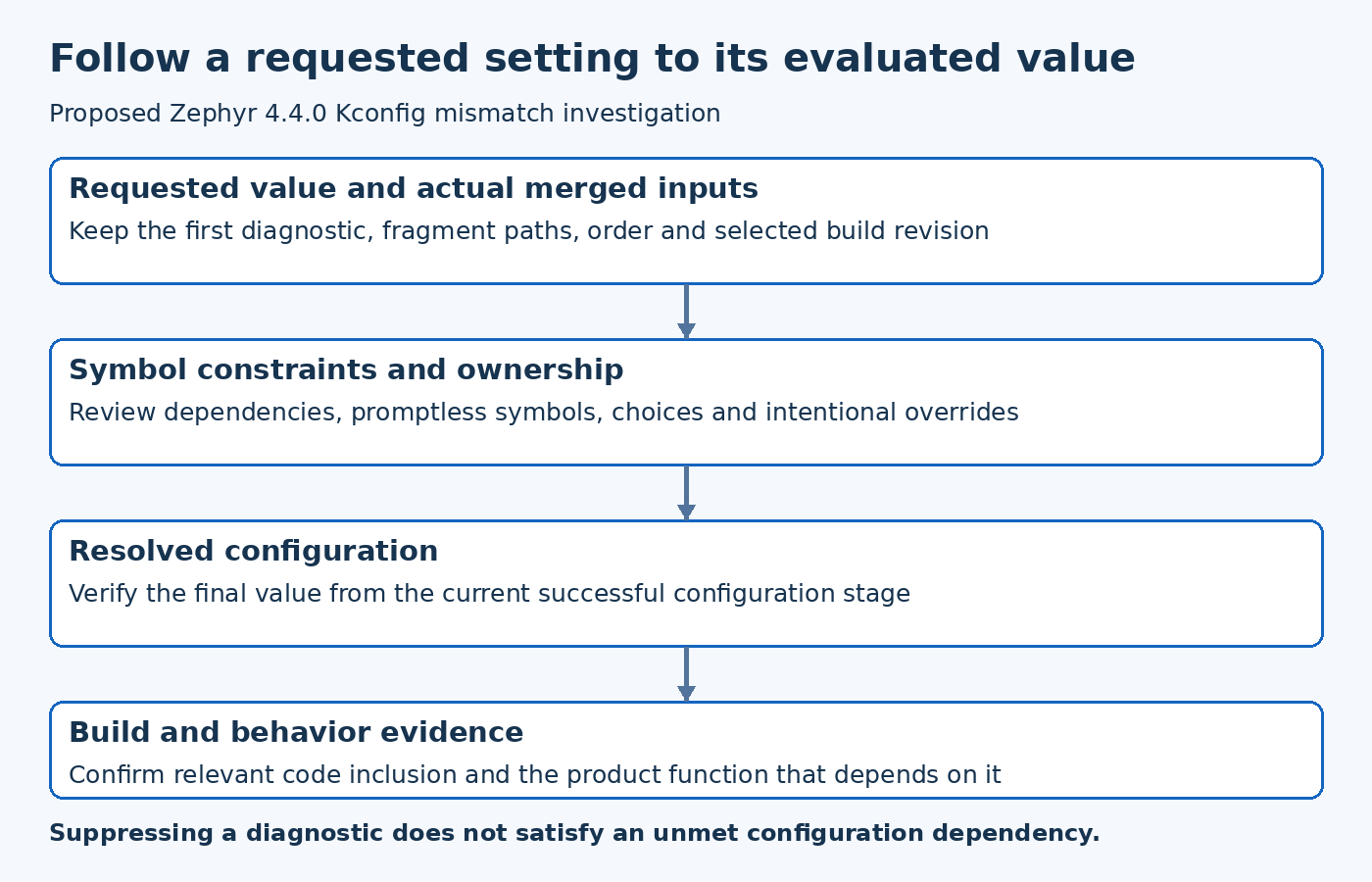
Record the symbol name, requested value and value produced by the build. Preserve the configuration-stage warning or error, not just the later compiler symptom. The earliest diagnostic may already identify an unmet dependency or an assignment that is not user-configurable.
The version-pinned Zephyr Kconfig processing script checks handwritten configuration requests against evaluated values. Its diagnostics are useful evidence of the distinction between a requested setting and the resolved result.
Use the generated configuration from the failing build. A stale file from a previous successful run can make it appear that the requested feature was enabled even though the current configuration stage stopped before generating a new result.
Confirm which configuration inputs were merged
Find the actual input fragments used by the build, including board and application configuration. Record their order and paths. The file a developer intended to use may not be the one selected by a wrapper script, build preset or custom project layout.
The Zephyr 4.4.0 Kconfig CMake module supplies the release-matched build integration reference. Consult the resolved invocation and generated evidence when a product extends the normal configuration flow.
Do not immediately duplicate the requested setting into every fragment. That can conceal which layer owns the policy and create a later override that another maintainer cannot explain. Establish the effective input set first, then change the appropriate source of the setting.
Inspect the symbol's direct requirements
Locate the symbol definition and the conditions that govern its availability. Include dependencies inherited from surrounding configuration structure, not only the lines adjacent to the symbol's own declaration.
A hypothetical driver feature may require a bus subsystem or a compatible hardware capability. Requesting the feature without satisfying that condition does not create the missing dependency. The correction may be to enable a legitimate prerequisite, select supported hardware or accept that the feature is unavailable in this configuration.
Avoid removing dependencies merely to force a requested value to appear. Those conditions may protect code from an unsupported combination. If a dependency is believed to be wrong, treat changing it as a separate implementation review with evidence, not as a configuration workaround.
Distinguish user-configurable and derived symbols
Some symbols are determined indirectly rather than exposed as direct user choices. The 4.4.0 processing script explicitly checks assignments to promptless symbols in handwritten input configurations.
If a diagnostic says that a symbol is not directly user-configurable, inspect the settings intended to control it. Repeatedly assigning the derived symbol in another fragment does not establish a supported way to select the feature.
Document that relationship in product configuration notes. A maintainer should be able to tell whether a line expresses product policy or merely duplicates a value calculated by the configuration system. Keeping only meaningful user inputs reduces confusing requests after dependencies or defaults change.
Examine choices and intentional overrides
A configuration choice can select one alternative while leaving another unselected. Review the choice structure and the effective selection rather than treating every disabled alternative as an independent unmet dependency.
Likewise, a later input can intentionally override an earlier request. Determine whether that override belongs to board defaults, application policy or a temporary experiment. The right correction may be to remove an obsolete request rather than to force the earlier value back into the result.
A hypothetical application can inherit one implementation from a board configuration and deliberately select another. The investigation should explain that choice and verify its consequences, not label the earlier setting silently ignored without examining the final configuration path.
Keep warning handling honest
Read the actual build result and the pinned script's diagnostic handling. Do not assume that every warning is harmless or that suppressing diagnostics makes the requested configuration valid. A configuration stage that aborts has not produced a verified new firmware input set.
If a project customizes warning policy, record that customization and still investigate mismatched values. Changing the reporting policy changes visibility, not the underlying symbol relationships.
Use a bounded regression check for important product requirements. For example, a build can assert that a required feature has the expected effective value before proceeding to later stages. Such a check should verify the resolved configuration rather than search only for text in an input fragment.
Verify the effect beyond configuration resolution
After the final value is correct, confirm that the relevant code is compiled and that the required behavior is present. A symbol value is configuration evidence, not a full functional test.
If the feature affects a driver, interface or resource limit, test the applicable behavior under the intended conditions. State which checks were performed and which remain pending. Avoid claiming a product capability solely because a menu now displays the desired selection.
The completed diagnosis should explain the original request, the effective inputs, the constraint or override that changed the result and the evidence supporting the correction. That explanation is more useful than a collection of repeated assignments. It also provides a clear boundary between configuration policy, build integration and runtime qualification.