STM32F401CCU6 microSD Logging When the Package Cannot Expose SDIO
An STM32F401 family feature list is not enough to choose a storage interface. For the STM32F401CCU6, establish the package's available signals before importing an SDIO example. If the required native interface cannot reach the board, the engineering decision is an SPI logging design or a different package, not another clock configuration.
Scope: STM32F401CCU6 in UQFN48, using ST DS9716 Rev 11. The filesystem discussion uses the official FatFs documentation retrieved on 19 October 2026; the deployed FatFs release and low-level card driver must be recorded separately. This is a proposed architecture and qualification plan, not a tested microSD driver.
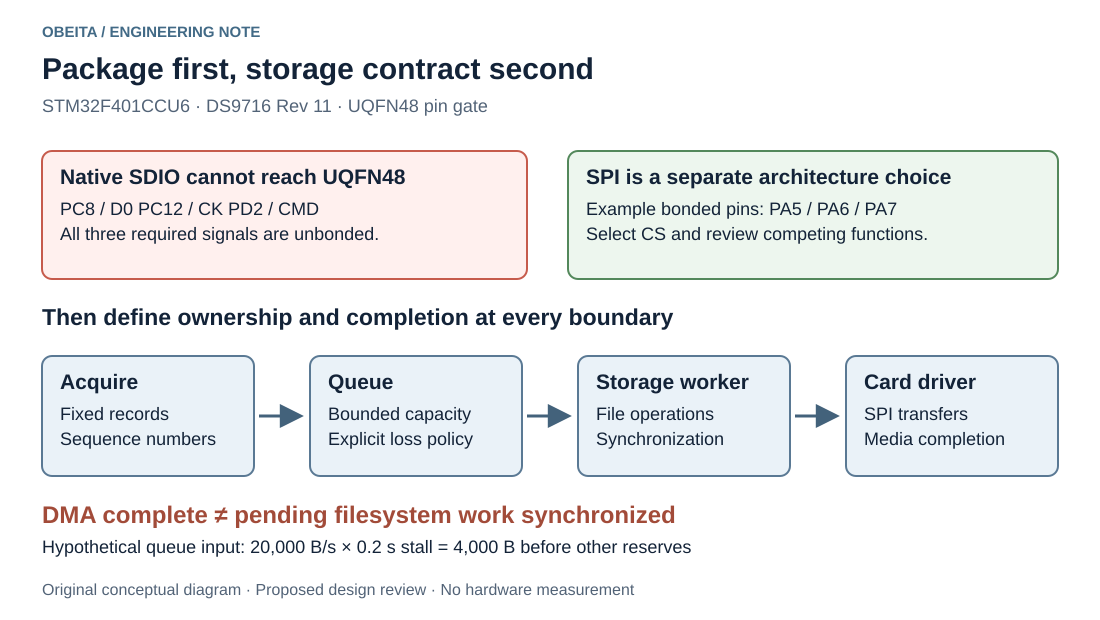
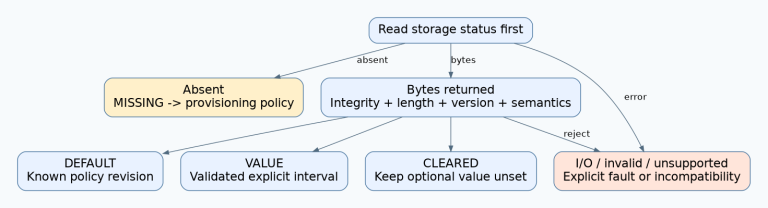
Original engineering diagram. Arrows distinguish software ownership from physical storage completion; no throughput is measured.
Start with the three signals even one bit needs
DS9716's pin-definition and alternate-function tables place SDIO_D0 on PC8, SDIO_CK on PC12, and SDIO_CMD on PD2. None is bonded out in UQFN48. Selecting one-bit operation does not rescue the interface because those minimum signals are still missing. The same datasheet shows SPI alternatives on bonded pins, including SPI1 SCK, MISO, and MOSI on PA5, PA6, and PA7. Check their competing functions against the actual schematic. ST DS9716 Rev 11
Make that finding a design gate. A carrier connector cannot expose an unbonded MCU pad. Likewise, the presence of an SDIO register block or a compiling example does not establish a usable external connection. If native SDIO bandwidth is mandatory, revisit the ordering code and footprint before routing the board. If SPI is acceptable, select a card and driver that explicitly support the intended mode.
Define logging success before selecting a clock
A useful logger has separate milestones: the producer accepts a sample, the RAM queue owns its bytes, the storage layer consumes a block, and the chosen synchronization operation completes. Give each milestone its own status. A DMA callback belongs to a transport implementation; it is not an independent statement that the filesystem's outstanding work has reached the medium.
Use one storage worker to own the mounted file and card state. Producers submit fixed-format records to a bounded queue rather than calling file operations from acquisition interrupts. Each record should contain a sequence number and a defined time basis. Those fields allow later analysis to distinguish lost records from a quiet sensor without inventing continuity.
Decide how logging reacts when the medium becomes slow or unavailable. Possible policies include stopping acquisition, dropping the newest records, or overwriting the oldest queued records. Choose one for the application and expose a loss counter. An unbounded wait hidden inside a sampling path is an undocumented policy.
Budget a stall rather than an average transfer
Consider a deliberately hypothetical workload of 20,000 payload bytes per second. If the design reserves 200 milliseconds of zero storage service, it needs at least 4,000 bytes for that interval alone. This arithmetic excludes the active block, filesystem work areas, record headers, stacks, and scheduling margin. It is not a measured worst-case card latency.
A second condition is equally important: service after the stall must drain the queue faster than new records arrive. Otherwise, a larger buffer merely postpones overflow. Set an explicit maximum supported service interruption, document what establishes that bound, and specify the outcome when it is exceeded. Do not convert an observed maximum from a short run into a guarantee for every card.
Record card identity, capacity, filesystem layout, fill level, write size, and environmental conditions alongside the eventual measurements. Keep long sequential operation and near-full media in the qualification matrix. A short empty-card benchmark answers a different question from sustained product logging.
Preserve the filesystem's buffer contract
FatFs allows a low-level disk driver to delay media completion, but the caller's buffer is no longer valid after disk_write returns. Therefore a delayed implementation must already own any bytes it still needs. The same documentation assigns completion of pending writes to CTRL_SYNC and warns against unnecessarily splitting multi-sector requests into single-sector operations. FatFs disk_write
Review the adapter between FatFs and the SPI card driver with that contract in hand. If it starts DMA from the supplied pointer and immediately returns, identify who preserves the bytes and who observes a later error. A success return without a valid ownership plan is a defect even when a small test file looks correct.
At the application boundary, check both the write result and the number of bytes accepted. Treat partial or failed writes as a logging-state transition, not permission to reuse the same sequence numbers and continue silently. Keep recovery from card removal distinct from ordinary backpressure.
Choose and test the synchronization policy
FatFs documents f_sync as flushing a writing file while leaving it open, making it suitable for periodic synchronization in a logger. That reduces the exposure to unsynchronized work; it does not make arbitrary power removal harmless. FatFs f_sync
Choose a synchronization interval from the acceptable loss window and the observed service cost. Retain the last successfully synchronized sequence number as a separate diagnostic concept, without claiming that a software counter alone proves power-fail durability. The card and board power behavior still require qualification.
Before release, verify the pin gate, queue accounting, multi-sector path, delayed-buffer ownership, error propagation, and synchronization behavior on a disposable card. Use controlled interruptions only in an approved fixture with recoverable test data. The deliverable is a bounded logging contract for this exact package, not a headline SPI frequency or an assumed SDIO capability.