Wi-Fi Country Codes and Channel Availability: Why a Device Cannot See an Access Point
Start with the channel, not the password
When an embedded station cannot see an AP that a phone can use, collect the AP’s operating channel before changing credentials. A regulatory-domain mismatch can remove a channel from the usable set or limit how discovery works on it. The correct engineering question is whether this hardware, firmware and deployment region permit the required operation. It is not whether another country code makes the network appear. This guide uses Linux 6.12 cfg80211 terminology and Linux Wireless documentation checked on 11 October 2026. It is a diagnostic method, not a country-by-country legal table or a substitute for the module supplier’s integration and certification conditions.
Build a reproducible capability snapshot
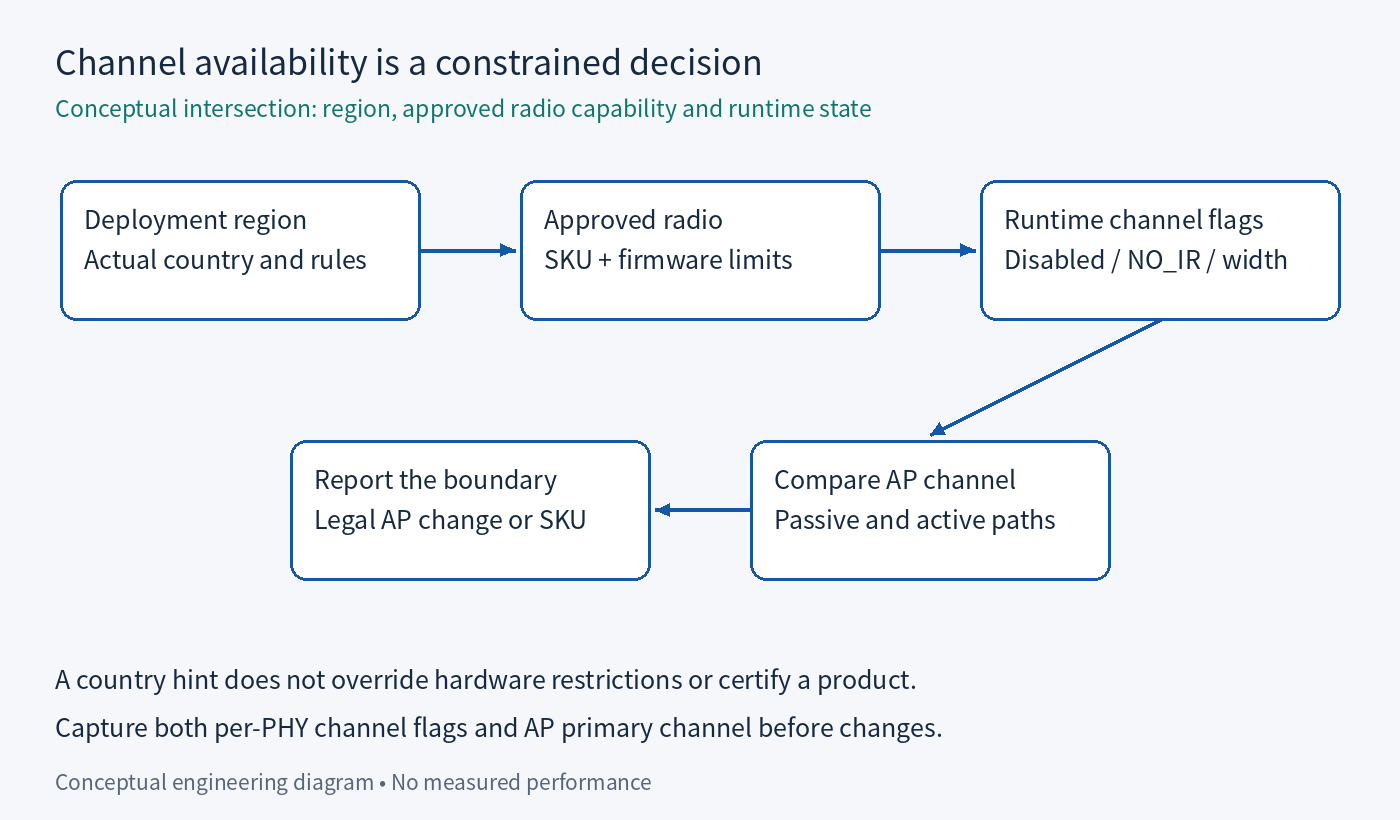
Record the hardware SKU, radio firmware, kernel, driver, regulatory database package and actual deployment country. Keep the AP model, radio mode, channel width and primary channel alongside that snapshot. On a Linux target, read-only tools such as iw reg get, iw phy phy0 info and iw dev wlan0 link can expose useful state; substitute the real interface and PHY names and record iw’s version. Avoid collecting unrelated saved network profiles. The effective per-PHY channel listing matters more than a single global country label, especially with self-managed regulatory devices. If a command fails or the firmware owns the policy, preserve that limitation and obtain the supported vendor diagnostic instead of inventing an equivalent result.
Interpret constraints as different kinds of evidence
Linux 6.12 cfg80211 documentation defines DISABLED for unavailable channels and NO_IR for operations that must not initiate radiation, including probe requests. Radar and channel-width flags express different restrictions. Do not flatten all flags into “unsupported Wi-Fi.” An AP beacon heard passively is not proof that every active operation on that channel is permitted. Equally, a missing directed probe is not automatically a driver defect. Compare the AP’s primary channel and bandwidth against the actual device flags, then inspect the scan’s channel coverage. Keep the initial investigation read-only. A support bundle should make clear which values came from live device state and which came from a supplier’s static capability sheet.
Locate the authority for the restriction
Treat usable operation as constrained by the deployment rules, the device’s approved hardware and firmware capabilities, and the stack’s current configuration. This conceptual intersection is a troubleshooting model, not a complete description of every cfg80211 rule-processing path. Linux Wireless’s implementation review explains that drivers and EEPROM information can impose restrictions; it also notes that CRDA is no longer required from Linux 4.15 because the kernel can load regulatory data through its firmware interface. Therefore, installing an old CRDA recipe is not a universal repair for a modern product. Confirm the target’s actual data-loading path and inspect missing-file or signature-related diagnostics without weakening verification or patching regulatory limits.
Change one approved input at a time
First check whether the AP has an automatic channel-selection policy and whether it changed channel after a reboot. A failure that appears intermittent may coincide with those transitions. In an authorized lab, compare an AP channel known to be legal and supported by both products, keeping SSID and security constant. If that resolves discovery, it narrows the cause to channel-related behavior; it does not identify the exact regulatory layer by itself. Apply a country setting only through the supported product provisioning path and only for the true deployment country. Never advise choosing a permissive region, disabling DFS handling, or editing the database to force visibility. A valid configuration change still requires a fresh capability snapshot.
Separate passive discovery from joining
A test report should have separate columns for beacon observation, scan-result delivery, association attempt, association outcome and IP configuration. Include a broadcast SSID and, if the product supports it, a hidden SSID because active discovery constraints can change their observable behavior. Repeat from cold boot as well as after the product has established its region through its documented mechanism. Include AP channel changes and a restored factory configuration. Record whether the region was explicitly configured or inferred, but do not assume an AP’s country information alone proves a valid deployment. A visible network that later fails authentication belongs in a different investigation from an AP whose operating channel is absent from the device’s usable set.
Define a regional release gate
Approve each shipping SKU and supported region against a documented matrix, with exact software versions and the module integration assumptions attached. Require that an unsupported channel produces an actionable message rather than an endless password prompt. Check that software updates preserve the intended region settings and that regulatory database changes can be traced to the shipped image. Support staff need a safe fallback: ask an authorized network administrator to select a mutually supported lawful AP configuration or supply compatible hardware. They should not promise a software workaround for a hardware or certification boundary. No RF compliance measurements were performed for this guide; final acceptance still needs the product’s qualified validation process and deployment-specific requirements.
Keep the evidence narrow enough to compare
For an escalation, pair one failing configuration with one controlled passing configuration and list only the changed inputs. Attach the two channel snapshots, the scan status and the AP channel record with timestamps. If several settings changed at once, label the result inconclusive and repeat the smallest safe comparison. This discipline prevents a successful router reset from being reported as proof of a particular country-code fix, and gives the firmware or module supplier a specific discrepancy to investigate.