Wi-Fi Power Save and DTIM: Diagnosing Delayed Downlink Commands
Investigate the first command after idle
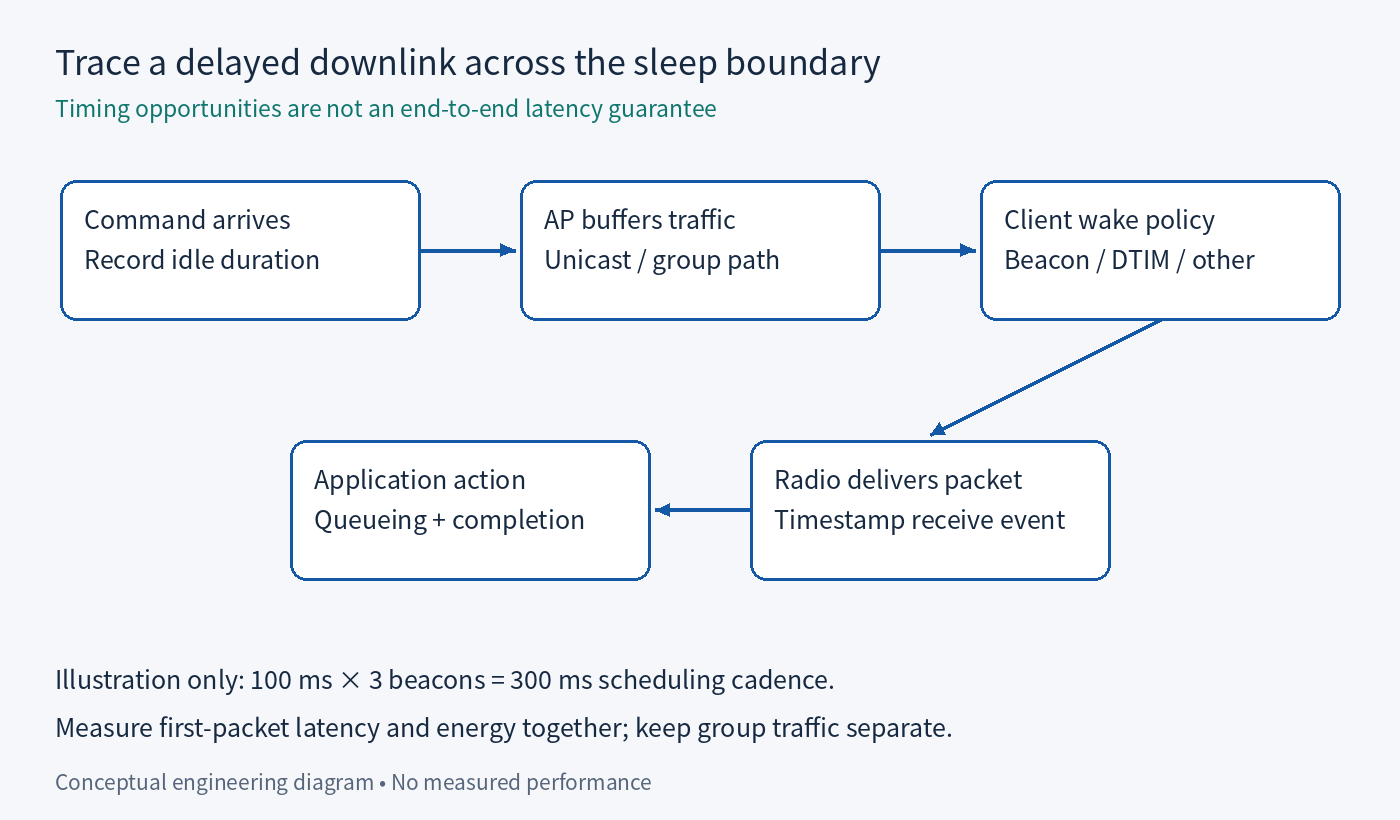
A device that responds promptly during a burst but slowly to the first command after silence may be waiting for a radio wake opportunity. That is a useful hypothesis, not a diagnosis. Start with timestamps at the command producer, AP-facing network path, device receive callback and application completion. Compare those with the period since the last traffic. This article focuses on station power save and buffered downlink delivery, using Linux 6.12 mac80211 and Nordic’s observed nRF Connect SDK 3.4.99 development documentation. It does not attribute every delay to DTIM, and it does not report measured current or latency for a board.
Separate beacon timing, DTIM and client wake policy
A beacon carries timing and traffic-indication information; the AP’s DTIM period identifies the cadence relevant to delivery of buffered group-addressed traffic. A station’s listen behavior and chosen power-save mechanism also matter. Linux 6.12 mac80211 documentation exposes the AP DTIM period and notes that its power saving waits until a beacon supplies that value. Do not turn this into the claim that every unicast packet on every client must wait for DTIM. Legacy retrieval, WMM power save, firmware policy and other mechanisms can differ. First identify which mode is actually active, then use the corresponding vendor description to interpret its receive opportunities.
Read vendor-specific behavior as vendor-specific
The Nordic station power-save page describes DTIM-based, listen-interval-based and TWT modes for its Wi-Fi devices. In its documented DTIM-based behavior, downlink reception is aligned with DTIM wakeups, while longer listen intervals can miss group frames. This is an implementation-specific explanation from a development documentation build, not evidence that the same APIs or defaults exist in your released SDK. Record the actual SDK tag, firmware and AP capability before applying it. A Wi-Fi 6 label alone does not prove an active TWT agreement. Distinguish a configured request, an accepted setting, and the wake behavior observed in a capture or supported radio diagnostic.
Use a timing model without promising a latency bound
For a conceptual example, assume a beacon interval of 100 ms and a DTIM period of three beacons. The resulting cadence is 300 ms. This multiplication describes scheduling opportunities, not a maximum command delay. Packet arrival phase, contention, loss, retry behavior, AP buffering and the application scheduler can all add delay. A command arriving just after a relevant wake opportunity can wait substantially longer than one arriving just before it. Keep that phase in the test design: issue commands at varied offsets after idle rather than at one synchronized period. Do not claim that reducing the DTIM period by a factor guarantees the same reduction in end-to-end latency.
Keep unicast and multicast experiments separate
Test a direct unicast command separately from a multicast discovery query and a broadcast-dependent setup step. A product may receive the former reliably while appearing absent to discovery because group delivery and sleeping policy interact differently. Record destination type, payload size and whether another packet woke the device first. Avoid using a continuous ping as the only control: the probing traffic itself can prevent the idle condition that causes the symptom. Include a quiet baseline, an isolated command after an idle interval, and a sustained burst. If a local device receive timestamp is already prompt but the application action is late, investigate task scheduling or work queues before changing the AP.
Correlate current and packets on a shared timeline
Use a suitable current-measurement setup and an independent network capture, synchronized by an observable marker where feasible. Document sampling rate, measurement insertion effects, radio supply boundary and whether the development probe changes sleep behavior. Integrate energy over a representative duty cycle instead of reporting only the lowest instantaneous current. Compare power save enabled and disabled as a controlled diagnostic on the same hardware, firmware, AP and workload; disabling it is not automatically the shipping recommendation. If the tool cannot observe the radio’s wake state directly, label the conclusion as an inference from current and packet timing. These are proposed measurement steps, not evidence that a particular energy saving has been obtained.
Change the AP matrix deliberately
Hold radio conditions and security constant while varying one supported AP setting, such as DTIM cadence, then restore the baseline. Test each supported client sleep mode with the actual AP models in the product matrix, including idle disconnection policies. A client cannot generally dictate the AP’s DTIM configuration through an ordinary station power-save setting. Check whether a longer listen interval sacrifices required multicast behavior and whether application keep-alives erase the anticipated savings. Separate cold association, steady idle, background traffic and recovery after loss. Do not change production network settings merely to reproduce a lab result; coordinate with the authorized administrator and record the scope of each change.
Choose a policy from service requirements
Set acceptance limits for first-command latency after the relevant idle periods, sustained command latency, group discovery reliability and energy over the real operating cycle. Document percentile methodology and retain failed trials; no numerical success target is universal. A battery sensor that tolerates delayed polling and an actuator requiring prompt commands may need different policies even with the same radio. A temporary responsive mode during a bounded interaction can be considered if the SDK supports it, but verify entry, exit and failure recovery rather than assuming it works. Ship a versioned configuration and a clear trade-off statement. DTIM analysis is valuable when it explains the observed timeline, not when it merely supplies a plausible acronym for an unexplained pause.