Fleet Wi-Fi Reconnect Storms: Jittered Backoff After an Access-Point Outage
A fleet outage is a shared-load event
When an AP restarts, hundreds of devices can lose connectivity together and retry together. A retry loop that works for one development board may create synchronized bursts at association, address acquisition and the application service. The goal is to spread recoverable work while keeping a bounded path back to service. This guide proposes an application-level coordination policy; it does not redefine IEEE 802.11 MAC contention or replace DHCP’s own protocol behavior. AWS’s retry guidance explains why retry load can worsen an overloaded dependency and why jitter helps disperse attempts. Applying that principle to a Wi-Fi fleet requires explicit ownership of each retry layer and validation on the intended network.
Split the recovery state machine into real stages
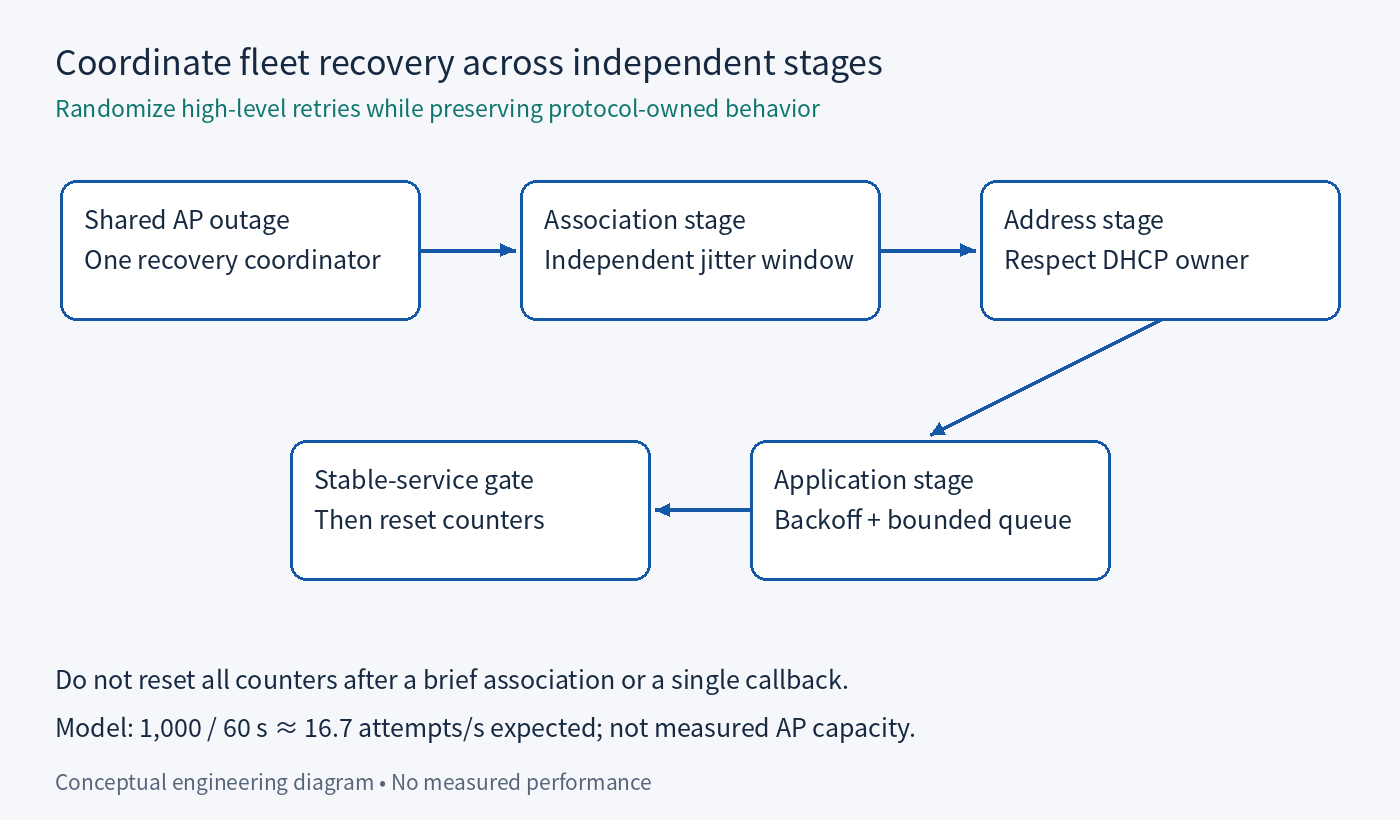
Track radio association, usable address configuration and application-session establishment separately. A station with a working link should not repeatedly disconnect because its cloud endpoint is unavailable. Conversely, an application reconnect timer should pause while the network is not ready, rather than filling an outbound queue with futile attempts. Identify which retries the driver, supplicant, DHCP client and transport library already perform. The coordinator should schedule supported high-level attempts, not manipulate every internal retry or launch multiple owners for the same operation. Record one in-flight operation per stage, an attempt identifier, a deadline and a cancellation reason. On a state change, obsolete callbacks must not restart an old attempt after a newer connection has succeeded.
Choose a capped random delay and an owner
One proposed full-jitter rule is to select a fresh delay uniformly from zero to min(cap, base × 2^attempt). Define the initial attempt index, time units, random source and the event that advances the counter. Clamp the exponent before multiplication to avoid integer overflow. AWS’s full-jitter discussion motivates randomizing within the growing window; its results are not Wi-Fi throughput measurements. Use independent device randomness rather than a fixed seed copied into every image. A device identifier alone is not a secret and does not automatically provide good random behavior. Ensure time-zero draws cannot form an unbounded tight loop: operation duration, a scheduler yield and the next attempt’s window must still be respected.
Do not reset the window at every encouraging event
A brief association followed by another loss should not necessarily reset the fleet to the fastest retry rate. Define stable recovery in terms of an appropriate sustained healthy interval or successful service state, then reset the relevant counter. Keep network and application counters separate so a backend outage does not penalize a healthy radio forever. A deliberate user-initiated setup action can have a different bounded policy from unattended outage recovery, but it must still avoid overlapping operations. Cold boot also deserves a small, product-approved startup spread when many devices share power. Persist only what is necessary: writing an attempt counter to flash on every retry is unnecessary wear and can complicate power-loss recovery.
Classify failures before scheduling another attempt
Transient unavailability, rejected credentials, unsupported security and a local configuration error should not all follow the same endless loop. Stop automatic rapid retries for a locally invalid profile and expose a repair path. For recoverable network loss, retain the last working configuration and apply the bounded policy. After address failure, inspect that stage’s evidence rather than immediately erasing Wi-Fi credentials. At the application layer, protect state-changing requests with suitable idempotency or deduplication semantics before allowing retries, because a missing response does not prove the action was never processed. Limit queued work, expire stale commands, and prioritize fresh state over replaying every observation collected during the outage.
Use a clearly labelled model before the RF experiment
A useful software model creates a chosen number of virtual devices, assigns the same outage time, and draws each retry delay from the proposed policy. Bucket scheduled attempts by time and compare deterministic backoff with independent jitter. For an illustrative single window, 1,000 independent attempts distributed uniformly over 60 seconds have an expected average of about 16.7 attempts per second; individual buckets vary, and this says nothing about AP capacity. Then model brief recoveries, timer quantization and identical random seeds to reveal resynchronization. Record the seed and assumptions for reproducibility. A simulation that ignores airtime, authentication cost and DHCP behavior cannot establish real recovery percentiles or prove the absence of congestion.
Validate fairness as well as aggregate recovery
In an authorized fleet test, restart or isolate the test AP and observe each stage’s offered attempts, successes, failures and in-flight count. Use the actual target radio firmware, security mode, AP, address server and backend, with a representative fleet size. Measure time to first useful service for each device, not only time until the first client connects. Check the tail and devices that never recover: a low average can hide starvation. Include repeated AP flaps, a healthy AP with a failing DHCP service, and a healthy network with a failing application service. These are proposed experiments, not completed tests. Keep the environmental constraints and unsuccessful devices in the report instead of reporting only the recovered subset.
Make the recovery policy reviewable
Acceptance should establish no overlapping reconnect owners, no unbounded queue growth, a cap on scheduling aggressiveness, and a documented stable-success reset rule. Choose recovery-time and fairness objectives from the deployment’s needs, then validate that the selected jitter window meets them without claiming deterministic recovery from a random schedule. Log stage, delay bucket, attempt count and non-secret failure class; avoid credentials or permanent network identifiers. The device should remain locally usable where its product requirements allow it, and the user should see a truthful recovery state. A healthy fleet is one whose retries cooperate with limited dependencies, not one that merely retries as fast as its processor permits.