CoAP Echo Challenges: Prove Request Freshness Before Allocating Expensive State
Use Echo as a narrowly defined admission check: require evidence of request freshness or claimed-address reachability before the server starts the expensive work that depends on that evidence. Keep authentication, authorization, request validation, and resource quotas as separate gates. A valid Echo value does not make an operation permitted.
This guide follows RFC 9175 and assumes a library with documented Echo support. Pin both endpoint versions, the security protocol, proxy topology, challenge policy, and the exact library processing order. It is a qualification method, not a custom challenge-generation algorithm. No credentials, key changes, cryptographic implementation, or network attack tests are provided.
1. Write down which property the challenge proves
RFC 9175 distinguishes freshness from network-address reachability. Freshness uses an application-defined time or event boundary and requires integrity protection between the intended endpoints. Address-reachability checks can be unprotected at the message level. Clients treat Echo values as opaque and return them only to the endpoint that supplied them. See sections 2.2 and 2.3.
Choose one primary purpose for the admission gate. “This request was generated after the required server event” is different from “the requester can receive traffic at this network address.” Do not let a single Boolean called echo_ok erase that distinction in logs or authorization code.
| Gate purpose | Required qualification evidence | Unsupported conclusion |
|---|---|---|
| Time-based freshness. | The supported protected exchange and challenge lifetime meet the resource’s age policy. | The client is authorized for every resource. |
| Event-based freshness. | A challenge issued before the relevant event cannot satisfy the post-event policy. | The challenge is automatically single-use. |
| Claimed-address reachability. | The challenge validation is bound to the applicable address and server policy. | A human or device identity has been authenticated. |
| Admission to costly work. | The intended evidence is checked before the costly allocation or dispatch. | The server is immune to denial of service. |
For a proxy deployment, identify the party actually being challenged. A server observing a proxy-facing endpoint cannot automatically infer the reachability or aliveness of a client behind that proxy. Review end-to-end and hop-by-hop protection separately.
2. Locate the gate before the expensive boundary
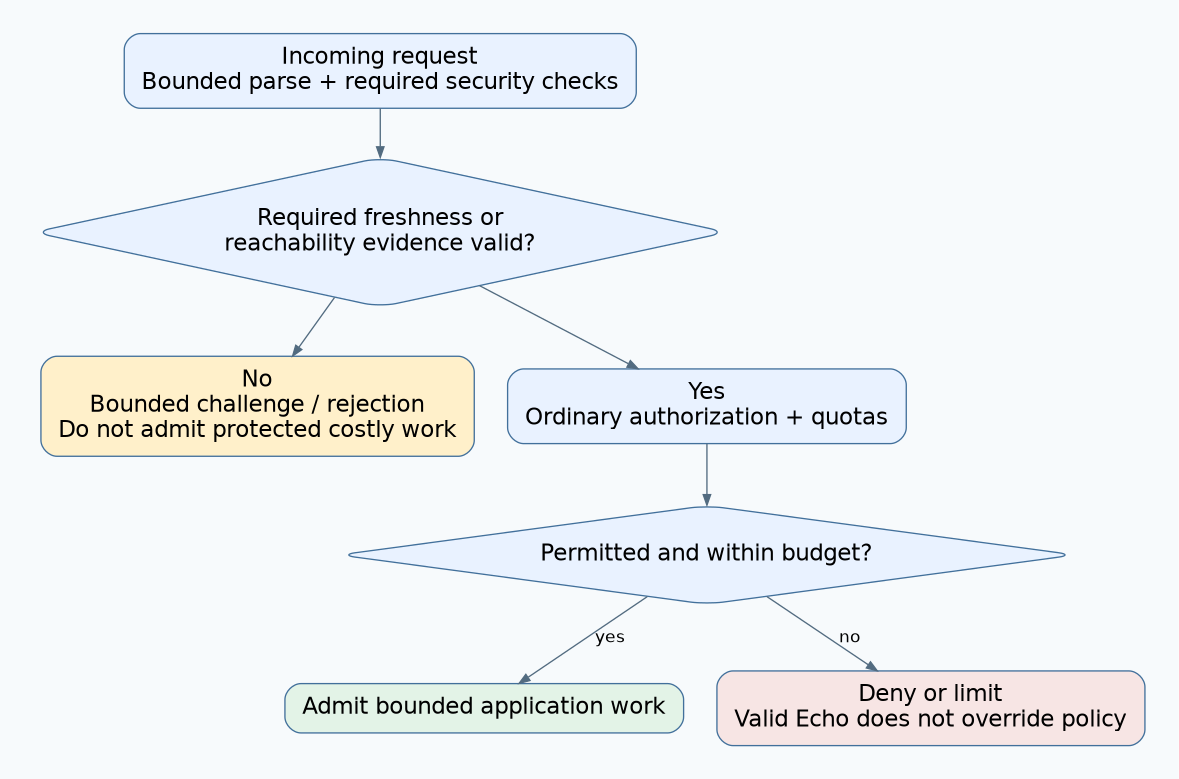
Trace a request through bounded parsing, routing, required security processing, freshness or reachability validation, authorization, resource admission, and application dispatch. The exact order depends on the library and threat model, but the test must identify the first allocation or side effect that the challenge is intended to protect.
RFC 9175 section 2.3 says a request requiring freshness must not be processed further when freshness cannot be verified; the server should respond with 4.01 and Echo. For amplification mitigation, an Echo response must be piggybacked or Non-confirmable, never a separate response. See Echo processing and section 2.4 item 3.
A diagnostic service that constructs a large report before deciding to challenge has already paid much of the cost. Instrument report creation, transfer-buffer allocation, observer registration, and job-queue insertion individually. It is normal to spend some bounded work parsing and validating a request; the claim should be about a specific deferred resource, not “zero work before validation.”
Include the challenge mechanism itself in the budget. If every initial packet creates an unlimited pending entry, the gate merely moves the exhaustion point. Prefer the supported implementation’s documented bounded design, and measure live challenge state, validation cost, response bytes, and expiry behavior during qualification.
3. Keep challenge validation in the reviewed implementation
Ask the maintainer how generated values are validated, what they are bound to, how lifetime or event validity is represented, and what happens after reset or time discontinuity. RFC 9175 sections 2.5 and 5 discuss forgery resistance, authority, and unintended reuse. A short counter is not a general-purpose replacement for the required protection.
Do not implement a new timestamp-plus-MAC format from an article. Use a reviewed mechanism suitable for the selected purpose and verify its supported configuration. For address-reachability admission, specifically test that moving a returned challenge to a different claimed address cannot satisfy the original address check.
Reusing an Echo value is not universally an error. The RFC permits reuse in appropriate circumstances. If the application needs one-time admission, make that an explicit supported event-based policy and test it. Otherwise, test that reuse remains valid only within the intended lifetime and binding, without treating Echo as an application transaction identifier.
4. Bound client challenge handling
Use the library’s challenge-response path to submit a request containing the returned value. Do not modify the bytes of an already active retransmission and assume the existing exchange state still applies. Check the library’s request ownership and identity allocation against the CoAP message and exchange model.
Set a total operation deadline and a bounded challenge retry policy. A client that receives repeated challenges should eventually report a specific inability to satisfy the server’s policy, rather than allocating new requests forever. Distinguish unsupported Echo handling, an expired challenge, a changed endpoint, and a genuine authorization failure.
Retain diagnostic categories rather than raw challenge values when those values could enable cross-request correlation. Do not copy challenge material into another endpoint’s request or include production credentials in test captures.
5. Apply an admission acceptance matrix
| Fixture case | Expected observation |
|---|---|
| Required freshness evidence is missing. | No protected application side effect or expensive job admission occurs before the challenge path. |
| Challenge is altered or expired. | Validation fails and resource use remains within the failure-path budget. |
| Relevant server event occurs after challenge issuance. | The old value cannot satisfy a policy requiring a post-event request. |
| Claimed address changes in a reachability test. | The previous address proof does not authorize the new address. |
| Echo is valid but credentials lack permission. | Authorization still denies the operation. |
| Echo is valid but the job or payload exceeds quota. | Normal resource admission still refuses or limits the work. |
| Challenges repeat until the caller deadline. | The client terminates once, with bounded requests and safe cleanup. |
Run this with synthetic requests and a harmless counter at the application boundary. Record counter changes, allocation high-water marks, and response sizes. The matrix is proposed; no target execution or measured capacity is claimed here.
Hypothetical report service
A server builds a diagnostic report for every incoming request, then attaches an Echo challenge if address reachability is unknown. A packet trace shows short challenge responses, yet memory pressure persists because report construction happened first.
The corrected architecture defers report allocation until the selected admission evidence and ordinary access checks pass. It also caps the work of valid clients and the challenge path itself. Release with the processing-order trace, failure matrix, client retry bound, and exact security-property statement. Echo can strengthen that boundary without becoming a claim of complete product security.