Retiring an Interface Field: Give Downstream Integrators a Measurable Removal Gate
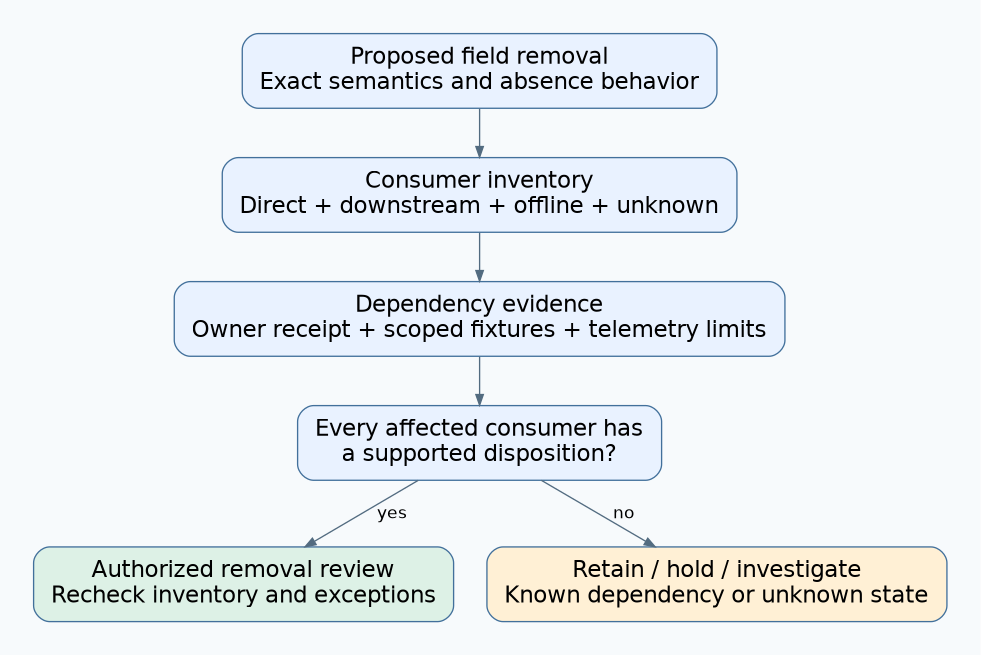
Remove an interface field only after the affected consumer set has an explicit disposition supported by evidence. A deprecation notice, a new alternative field and a quiet usage dashboard do not independently establish that downstream software no longer depends on the old behavior.
This article provides a dependency-retirement review for embedded interfaces. It does not define a wire format, authorize a live interface change or promise that every user can be observed. All consumer names and test cases below are fictional; no field was removed and no client test was executed.
1. Define exactly what is being retired
Name the field or operation, its current semantics, the replacement if any and the proposed absence behavior. Distinguish stopping production of a value from changing its units, returning a constant or removing the operation entirely.
A constant placeholder can preserve parsing while breaking meaning. If the goal is removal, test the actual proposed contract rather than a convenient simulation that leaves the old dependency satisfied.
NASA’s interface and configuration-management guidance emphasizes affected-party coordination. The removal gate here applies that principle to downstream consumers whose dependencies may outlive the producer’s implementation.
2. Build a consumer inventory with explicit unknowns
| Consumer class | Evidence owner | Dependency evidence |
|---|---|---|
| Maintained application | Application team | Versioned code review and relevant behavior test |
| External integration | Named integration owner | Confirmed supported version and scoped test receipt |
| Stored-data reader | Reporting or analysis owner | Historical input and missing-field handling |
| Offline or rarely connected installation | Deployment/support owner | Last confirmed state and unresolved migration status |
| Unidentified consumer | Assigned discovery owner | Explicit gap, not presumed nonuse |
Include scripts, dashboards, gateways, service tools and downstream exports. A producer may have one direct network peer while several applications consume the peer’s stored output. The visible connection graph may therefore understate the dependency graph.
3. Assess what usage telemetry can prove
A server can sometimes observe requests for an operation. It usually cannot infer whether every receiver reads a field delivered inside a larger message. Absence of a dedicated request counter is not proof that the field is unused.
Record the observation window, covered population, instrumentation revision and gaps. A quiet week says little about a monthly maintenance tool or a disconnected installation. Avoid collecting unnecessary customer payloads merely to improve usage visibility.
Combine telemetry with consumer-owner evidence and controlled tests. If important consumers remain unobservable, the decision must acknowledge that uncertainty and use the project’s authorized support policy rather than inventing universal migration completion.
4. Treat deprecation as a signal, not a completed migration
JSON Schema Draft 2020-12 section 9.3 defines a deprecated annotation that discourages use and may indicate future removal. That annotation does not prove any consumer stopped using the property or create a removal date.
Use a notice to explain the replacement, affected versions and required evidence. Keep technical readiness separate from commercial support decisions and actual distribution authorization. This article does not set a universal deprecation period or send a notification.
Track acknowledgements precisely. Receipt of a notice is different from an owner confirming that a particular consumer revision passed the required migration checks.
5. Test the consumer’s actual missing-field behavior
In an isolated approved environment, propose fixtures with the field present, absent and replaced by the new contract where applicable. Include data-path behavior as well as parsing: displayed meaning, calculations, alarms, storage and export.
A parser that accepts omission but substitutes zero may still produce an incorrect application result. The expected behavior must come from the approved interface requirement, not from whichever default the language happens to supply.
Retain the consumer build, fixture revision, expected outcome and actual observation. If a wrapper continues to reconstruct the old field, identify that compatibility dependency; the underlying consumer has not necessarily migrated.
6. Use a fictional retirement matrix
A fictional telemetry producer plans to retire an old status label after introducing a structured status representation. Application A has a reviewed new parser and a scoped missing-label test. A reporting tool B still reads the label from exported records. Installation C has not reported its consumer version recently.
| Consumer | Disposition | Removal consequence |
|---|---|---|
| A | Migration evidence available for named revision | Eligible within that evidence scope |
| B | Known remaining dependency | Block removal for its supported path |
| C | State unknown | Hold or obtain explicit authorized disposition |
A cannot stand in for B and C. A high migration percentage does not answer whether the remaining supported consumers will function. These are illustrative statuses, not measured fleet data.
Keep historical-record compatibility separate from live production. A consumer may stop requesting the field yet still need to interpret archived records that contain it. Retiring a live interface does not automatically justify deleting that reader capability.
7. Define and recheck the removal gate
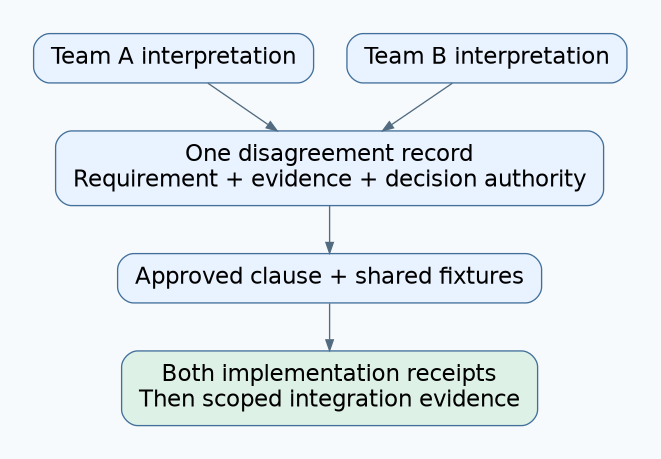
The gate should identify the consumer inventory revision, required evidence per class, treatment of unknowns, unresolved exceptions and authorized decision owner. Recheck it when a supported old consumer returns or a new integration is discovered.
Prepare the approved fallback or containment response if a dependency is missed, without assuming reversal is always possible. Preserving an old field temporarily may be one option, but its feasibility and costs need actual review.
The final record should show why each affected consumer is migrated, deliberately excluded by an authorized scope decision or still blocking the change. This produces a measurable removal decision while keeping unobserved use, protocol mechanics and support commitments honest.