Reading Go Build Information from Delivered Binaries: Verify What Metadata Survived Packaging
Read Go build information from the exact delivered executable before deciding which metadata survived packaging. The recoverable fields can identify the producing Go toolchain, contributing modules and selected build settings. They cannot, by themselves, establish a complete software inventory or authenticate the artifact.
This procedure pins Go 1.24.0’s debug/buildinfo, runtime/debug and go version implementation. No verified Go toolchain was available, so the extraction commands and packaging matrix are proposed rather than executed. The inspection operates on binary files; it does not require launching the application being examined.
Start from the delivered bytes
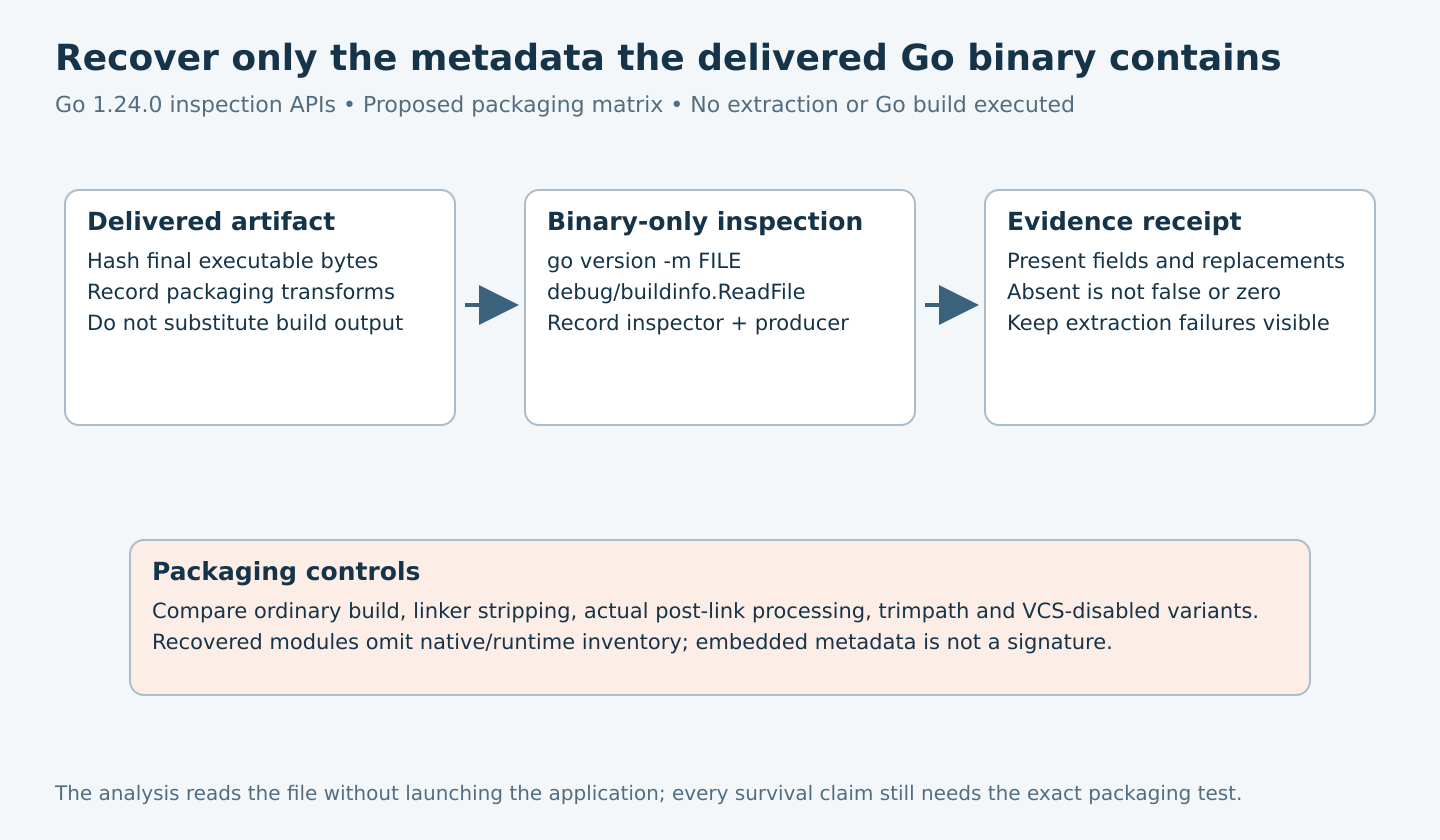
Preserve a copy of the final application after stripping, image assembly and any delivery transformation. Record its digest and path within the image. Reading a convenient unstripped build-tree executable answers a different question from reading the file actually delivered.
On a qualified analysis host, the proposed first command is:
go version -m ./delivered-appThe Go 1.24.0 command implementation reads the named file through debug/buildinfo.ReadFile. Omitting the filename reports the inspection tool’s own Go version instead. Preserve both identities: the inspector version and the recovered producer version.
Prefer an explicit file list for an acceptance check. Recursive directory scanning can skip unrecognized files unless verbose reporting is enabled. Silence for a directory entry is not equivalent to a successful metadata extraction from every expected executable.
Interpret each recovered field narrowly
The BuildInfo definition separates the GoVersion, main package Path, main module, dependency modules and build Settings. Module records can include a path, version, checksum and replacement record. Keep replacements visible in the report; otherwise a familiar module path can obscure a different source selection.
| Recovered item | Supported conclusion | Unjustified conclusion |
|---|---|---|
| GoVersion | Embedded producer toolchain identity. | The currently installed Go tool built it. |
| Dependency modules | Modules that contributed packages to this binary. | Every repository, runtime file and native library is inventoried. |
| Replacement record | A replacement was recorded for that module. | A local replacement has an independently authenticated release identity. |
| Build settings | The specific key/value pairs actually present. | Every effective compiler or packaging input was preserved. |
| VCS fields | Recorded revision/time/modified context, when present. | A signature proving who approved these bytes. |
The dependency list is not simply every line in go.mod. The documented field concerns modules contributing packages to the binary. Conversely, a native library used through cgo, a separately loaded plugin or a runtime configuration file needs its own inventory evidence.
Distinguish absent fields from false values
A missing vcs.modified key is not the same as a present value of false. Likewise, absent module information does not mean there were zero dependencies. The file-reading package states that most information is available only for binaries built with module support.
Use explicit statuses such as present, absent, unreadable and unsupported-by-this-inspection. Avoid filling absent values from filenames or a nearby build manifest without labeling that additional source. A recovered record and an external release claim should remain distinguishable.
For automation, use debug/buildinfo.ReadFile and serialize the resulting fields with error status and the inspected file digest. Do not treat a grep over strings output as equivalent: ordinary strings can resemble module names without belonging to the structured build-information record.
Qualify the packaging options one at a time
Create a small module fixture with a pinned dependency and a known, harmless main function. Build several variants from the same source snapshot and retain their exact commands. The following matrix is proposed; it contains no measured survival result.
| Variant | Comparison question |
|---|---|
| Ordinary module build | Which baseline fields are actually embedded? |
| Go linker -s -w build | Does removing ordinary symbol/debug information preserve the required build-info fields? |
| Actual post-link stripping recipe | Does the exact deployed transformation preserve the same recoverable metadata? |
| -trimpath build | Which path-related fields change while useful module identity remains? |
| -buildvcs=false build | Are VCS fields absent while other recoverable fields remain separately reported? |
| Local module replacement | Does the report preserve the replacement identity and its missing fields? |
The tagged build-command documentation defines -trimpath and -buildvcs. Default VCS stamping depends on repository context; explicitly disabling it omits that information. Do not equate a trimpath choice with an instruction to erase all module metadata.
The tagged linker reference defines -s as omitting the symbol table and debug information, with -w implied. A stripped binary is not one universal format. A Go linker’s stripping flags and an external image-processing tool are separate transformations. Test the actual tool versions and options rather than assuming a result from one covers every later packager.
Make extraction failure actionable
If parsing fails, first verify that the selected file is the expected executable rather than a wrapper, compressed container or wrong image member. Then inspect the binary format and the packaging lineage. The implementation distinguishes recognizable executable formats from files without usable Go build information, but diagnostic details should not be overinterpreted as a complete cause analysis.
Keep the untouched pre-transformation file and compare extraction before and after each step. If the information disappears at a known transformation, decide whether to retain it, preserve a separately bound release manifest or document the metadata limitation. Do not silently replace the failing final artifact with the successful intermediate in the report.
Close with a binary-bound metadata receipt
Record the delivered digest, inspector version, extraction result, recovered fields, explicitly missing fields and comparison against the approved build record. Review embedded paths and settings for unnecessary disclosure before distribution, without assuming build information contains secrets or removing useful evidence blindly.
The useful outcome is a precise account of what the binary reveals. It can corroborate a release inventory and help select follow-up checks, but it is neither a complete SBOM nor proof of provenance authenticity. Those stronger claims require separately qualified evidence.