Hardware-Backed EAP Keys: Validate PKCS#11 Availability Before Unattended Reconnection
A private key stored in a token can still be unavailable when a headless product needs to authenticate. A successful desktop-assisted connection may depend on a logged-in secret agent, an already unlocked token or a provider initialized earlier in the session. Qualify the complete signing path from cold boot, under the identity and service environment used in production.
This guide examines NetworkManager 1.50.0 and wpa_supplicant 2.11, using the latter’s OpenSSL/PKCS#11 integration as the reference path. Exact token hardware, PKCS#11 module, cryptographic engine and TLS build must be recorded separately. A PKCS#11 URI can also name a software token; the URI alone does not establish hardware isolation, non-exportability or certification. Certificate renewal and secure-boot key management are outside scope.
Draw the dependency chain before testing the radio
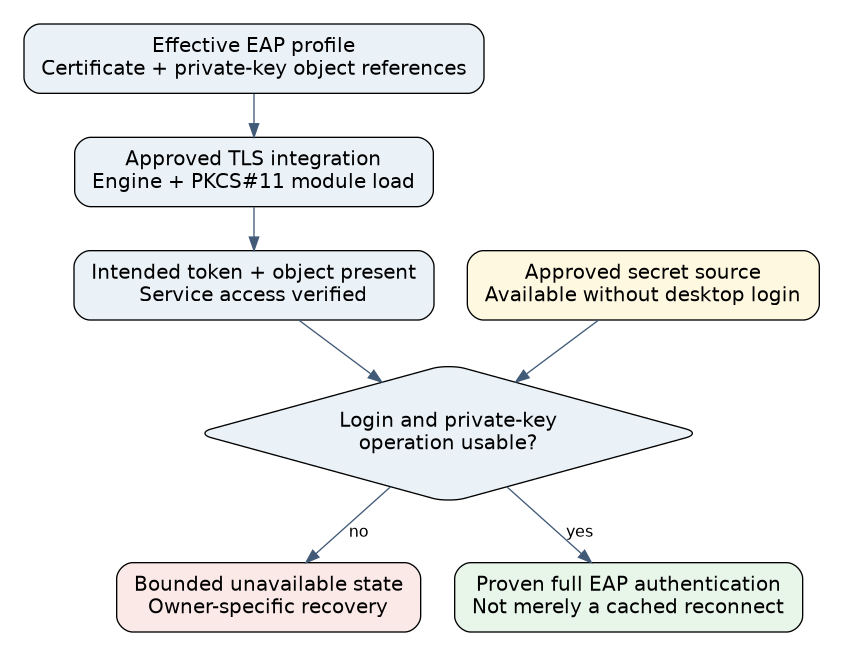
The relevant chain is profile selection, secret availability, supplicant TLS integration, PKCS#11 module loading, token/object selection, login where required, and a usable private-key operation. An EAP failure at the end of that chain may originate before any radio-specific problem. Assign an owner and observable readiness condition to each dependency.
| Dependency | Readiness evidence | Common misleading evidence |
|---|---|---|
| Profile and object reference | Intended certificate/key URI resolves unambiguously | A similarly named object appears in an inventory |
| Module and TLS integration | Production service loads the approved implementation | A developer’s separate command-line tool can load it |
| Token login | Approved unattended mechanism is available at activation | An earlier interactive session remains unlocked |
| Private-key operation | Required algorithm works without exporting the key | The public certificate can be read |
| Full EAP authentication | Server-correlated authentication uses the intended credential | A cached reconnect succeeds after token removal |
Keep the service’s account, filesystem view, device permissions and startup ordering in the record. A successful test as an interactive administrator does not prove that the networking service has the same access. Do not broaden device permissions as a shortcut; resolve the intended access boundary through the product’s security design.
Understand what the reference versions pass downstream
NetworkManager 1.50.0 has an explicit PKCS#11 private-key scheme branch in its supplicant configuration builder. It obtains the private-key URI, private-key password and associated secret flags, then passes them through its PKCS#11 URI/PIN helper. This is stronger implementation evidence than assuming every key-reference field is simply a file path. The helper hides the PIN in its normal log representation. Do not infer that every downstream diagnostic is equally redacted. NetworkManager 1.50.0, nm-supplicant-config.c
Its secret flags distinguish an agent-owned secret from one that should not be saved and must be requested when needed. A headless system cannot rely on an interactive prompt that nobody can answer. Conversely, marking a secret “not required” does not unlock a token that actually requires login. Establish which approved agent or protected authentication path supplies the needed operation, and whether it exists before the connection starts. NetworkManager 1.50.0, NMSettingSecretFlags
Wpa_supplicant 2.11 documents PKCS#11 URIs for client certificates and private keys, with automatic PKCS#11 engine loading when those references are recognized. Its OpenSSL implementation conditionally compiles engine support. Therefore, “OpenSSL installed” or “the URI parses” is insufficient: verify the actual TLS build and supported engine/module combination. Do not assume that an arbitrary OpenSSL provider configuration is interchangeable with this release’s engine path. wpa_supplicant 2.11, wpa_supplicant.conf and tls_openssl.c
Keep identification separate from secrets
RFC 7512 defines the PKCS#11 URI scheme, including object-selection attributes and optional PIN-related query attributes. A selector may be insufficiently specific when multiple tokens expose similarly named objects. Record how the deployment distinguishes the intended token and key without publishing sensitive identifiers unnecessarily. Avoid putting a PIN into a demonstration URI, shell history or support bundle; the RFC’s security considerations specifically address the exposure risk of PIN values. RFC 7512, sections 2 and 6
The public certificate must correspond to the private key actually selected. Verify that association through the supported provisioning or token-validation mechanism, using a test credential first. Reading the certificate is not proof that the token permits the required signing operation or algorithm under the service’s login state.
Use a cold-start and failure matrix
- Cold boot without a desktop login. Begin from the documented token power/login state. Start only production services. Require an observable provider-ready and secret-ready path, followed by full EAP authentication. Record any dependency that appears only after a human signs in.
- Delay the provider or token. In an authorized test fixture, make it unavailable at initial activation, then restore it through the supported mechanism. Verify bounded retry, explicit status and eventual recovery. A tight authentication loop can hide a startup-order defect.
- Exercise a locked token safely. Use the vendor’s supported locked-state test. Do not repeatedly submit guessed or wrong PINs; retry limits can make the device unavailable. Require a distinct login-required result and the approved recovery workflow.
- Remove or substitute the referenced object. With disposable test credentials, exercise missing and ambiguous references. The integration must fail closed rather than silently selecting another identity or falling back to an exported key.
- Test removal at different stages. Where hardware supports safe removal, compare before activation, during an authorized test operation and after successful association. Preserve device-specific removal rules. Existing connectivity may survive temporarily, so force no conclusion about future authentication from that alone.
- Repeat a proven full exchange. Coordinate supported cache/resumption controls and server evidence. A warm cached association is not a test of token availability for a new signing operation.
For a hypothetical unattended kiosk, authentication succeeds after a technician logs into the desktop but fails after a power cycle with no login. If the token and module are present while the secret agent is absent, the next investigation is agent lifecycle and startup ownership. Replacing the Wi-Fi module would not address that demonstrated dependency.
Define the release artifact
No physical token, secret agent, PKCS#11 login or EAP authentication was executed for this article. The release-specific configuration paths were source-checked; all target cases above are proposed qualification work.
Deliver the exact provider/TLS/token compatibility matrix, a sanitized object-selection contract, cold-boot evidence, bounded unavailable-state behavior and a recovery procedure that preserves key isolation. Claim unattended operation only for that demonstrated combination. A hardware-backed key is useful only when its authorized use remains dependable at the moment the product needs it.