FreeRTOS on Raspberry Pi Pico: Assign TinyUSB Servicing Before Relying on USB Stdio
USB output can disappear after a Pico application starts using TinyUSB directly, even though its logging calls remain unchanged. The integration may have changed who initializes and services the USB stack.
In a FreeRTOS application, identify that owner before treating missing serial text as evidence that the scheduler stopped. This article examines Pico SDK 2.3.1 source. It proposes checks for the selected integration and does not claim a particular USB configuration has been run on hardware.
Check the effective background-service settings
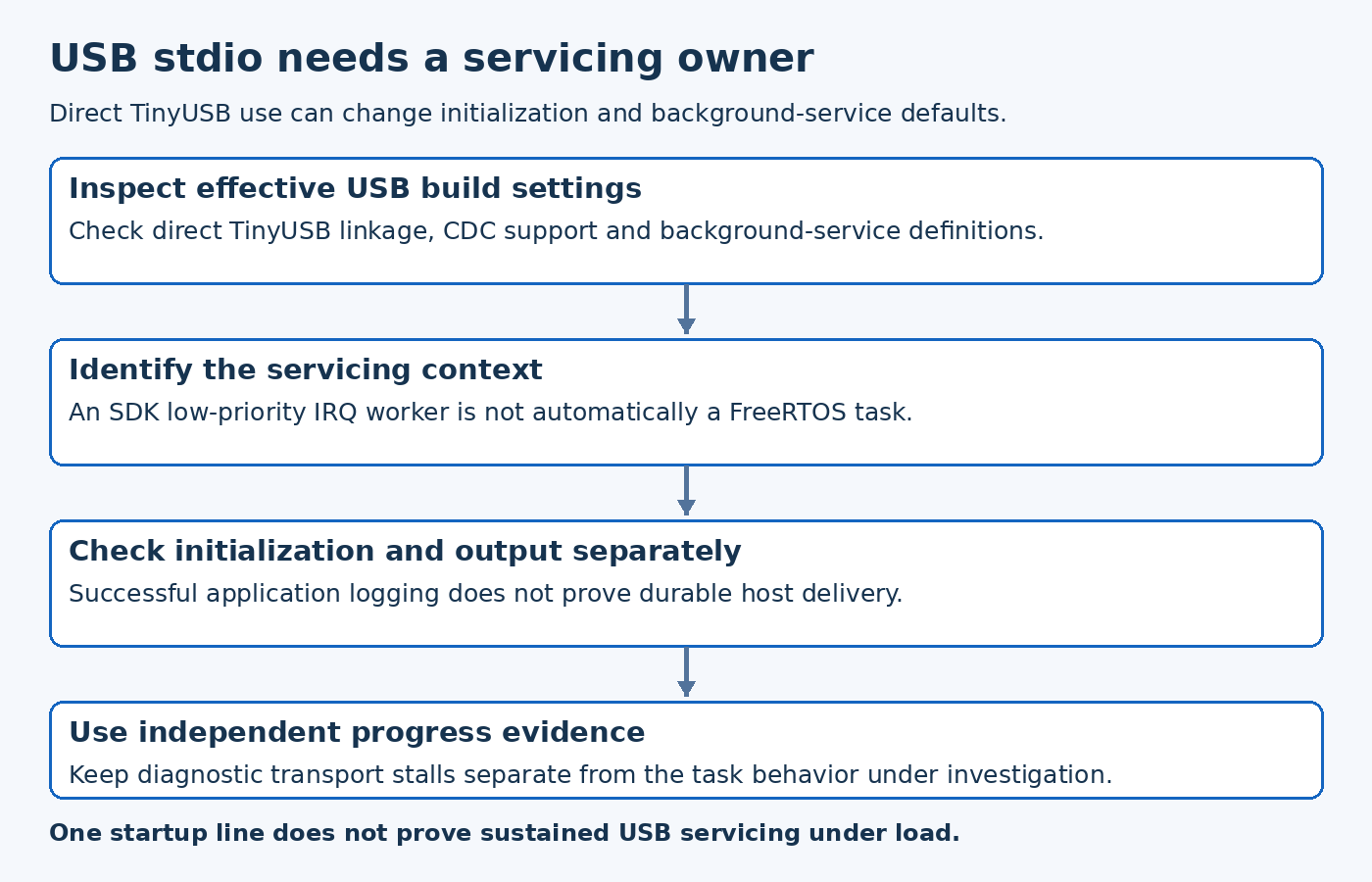
The tagged USB stdio header defaults its internal background servicing and TinyUSB initialization on when the application is not directly linking TinyUSB host or device support. Those defaults change when direct TinyUSB use is present. The header also exposes an explicit notification helper for applications supplying their own servicing arrangement.
Inspect the resulting definitions in the actual build. Enabling stdio in CMake is not sufficient evidence that the same background owner remains active after other USB targets are added.
For a hypothetical device that evolves from debug serial to a custom USB interface, make the ownership change deliberate. Decide which task or supported context handles USB work, which code initializes TinyUSB and which code owns descriptors and CDC configuration. Do not leave these responsibilities split between assumptions inherited from two different examples.
Follow the implementation rather than the word “task”
In the tagged stdio implementation, the optional background path calls `tud_task()` from a low-priority interrupt worker guarded by a try-lock. Depending on setup, an alarm or shared USB interrupt schedules that worker. The stdio read and write paths also contain TinyUSB servicing calls.
Consequently, a reference to a background “task” in documentation does not necessarily mean a FreeRTOS task with an independently selected priority. Determine the compiled path and its context before changing kernel task priorities as a supposed fix.
If the application owns TinyUSB servicing, verify that its owner can continue to run while other tasks wait or produce output. Adding a second uncontrolled caller is not a substitute for understanding the chosen integration's concurrency rules.
Separate initialization, servicing and delivery
The source checks initialization assumptions and returns failure in unsupported compiled combinations, including device stdio without the required CDC support. It also contains bounded mutex acquisition and output handling that can stop when the connection or write capacity is unavailable.
A successful log call at the application layer should therefore not be treated as a durable delivery receipt. During debugging, use an independent observation for application progress where possible, such as a deliberately chosen hardware signal or a separate supported diagnostic channel. That observation is a proposed technique, not a claim that any particular test was performed.
Check the return from initialization before waiting for text. Then test enumeration and connection separately from sustained output. Finally, load the application enough to exercise the servicing owner's actual scheduling or interrupt constraints. A device that prints one startup line has not demonstrated long-running output progress under contention.
Avoid making diagnostics the dependency being tested
Keep USB logging outside latency-critical or interrupt paths unless the selected API and context explicitly support that use. A stalled diagnostic route can change task timing or hide the event you intended to observe.
A useful development experiment holds ordinary application behavior constant while changing only the USB servicing arrangement. Record which owner runs, which initialization path is active and whether the output route survives host disconnect and reconnect. Do not infer scheduler correctness from serial visibility alone.
The actionable result is an ownership map for USB initialization and servicing, followed by evidence that the selected owner makes progress. Once that is established, missing output can be investigated as a transport or buffering issue rather than an assumed kernel failure.