Buildroot Git Reverts: Rebuild the Outputs That the Reverted Change Affected
Reverting a Buildroot commit changes repository content. It does not automatically remove every generated file or reconstruct an output directory as though the change had never happened. When recovering from a regression, review the source reversal and the build-state recovery as two connected tasks.
The central question is whether the image under test actually reflects the intended recovered configuration. A clean Git status can coexist with stale build products. The workflow below is a proposed incident-review method, not evidence that a particular product rollback has been qualified.
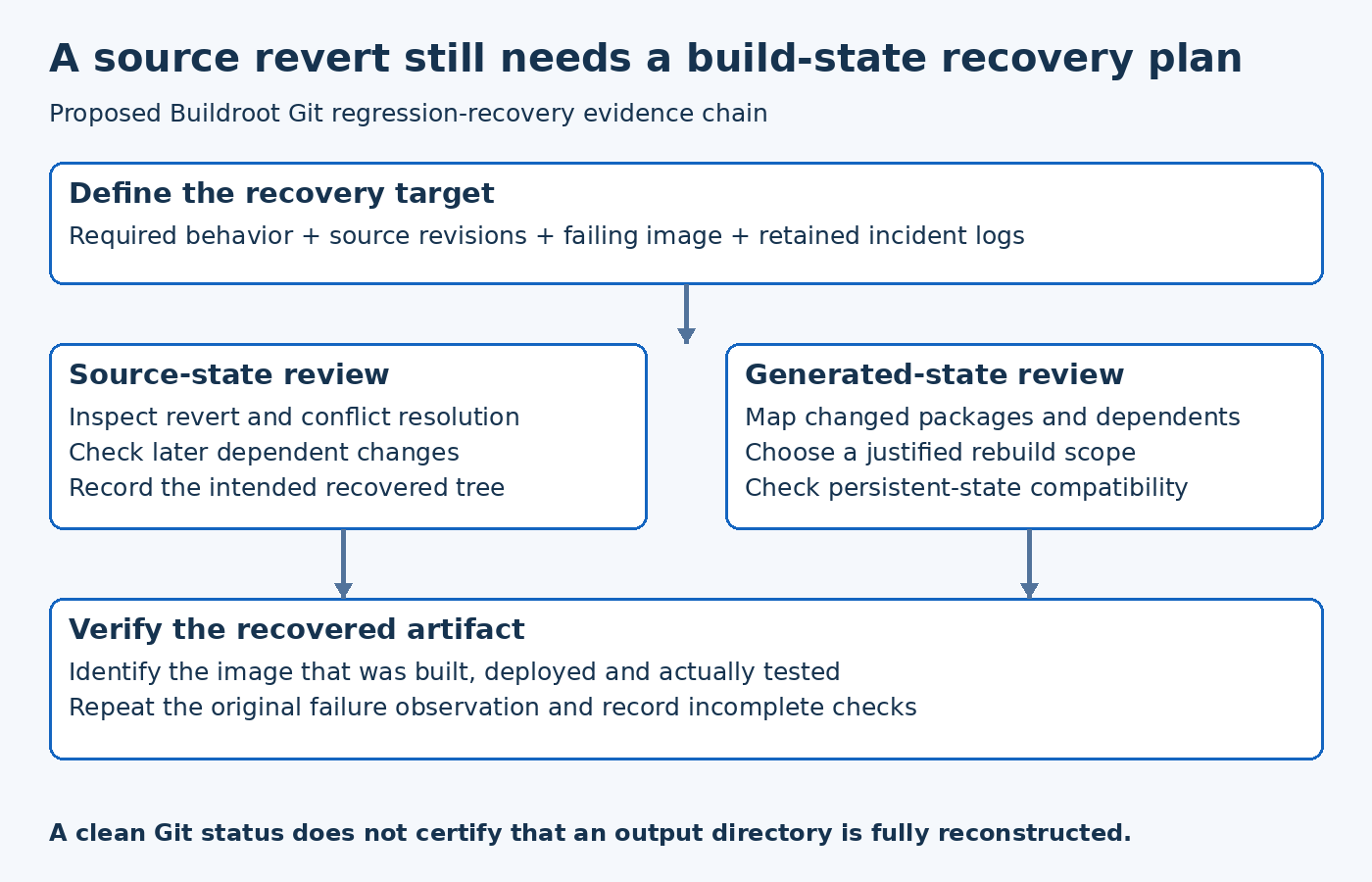
Identify the recovery target precisely
State which behavior must be restored and which change is suspected. Distinguish a full return to an earlier release from reversing one faulty change while preserving later fixes. Those choices produce different source states and different validation responsibilities.
Record the current Buildroot revision, external-tree revisions, effective configuration and the image identifier that exhibited the failure. Preserve the relevant logs before replacing outputs. If the defect has not been reproduced consistently, keep that uncertainty visible instead of treating the suspected commit as a proven cause.
A recovery target should name the required behavior as well as the source operation. Restoring a network interface, removing a broken package feature or returning to a previous toolchain are different engineering tasks even if each begins with a revert.
Review what the Git operation actually changes
The official Git revert reference describes recording new commits that reverse earlier changes. This preserves a visible recovery decision in history. It does not rewind every external effect caused by the original commit.
Inspect the resulting diff and any conflict resolutions. Later commits may depend on the change being reversed, so a syntactically resolved revert can still leave an inconsistent package or configuration. Check related dependencies and product customizations rather than assuming the command's successful exit proves correctness.
Merge commits require particular care because the chosen parent affects what is reversed. For a complex integration, have the maintainer explain the intended result before applying a generic rollback recipe. This article deliberately does not provide a universal destructive command sequence for an unknown repository.
Map the change to generated state
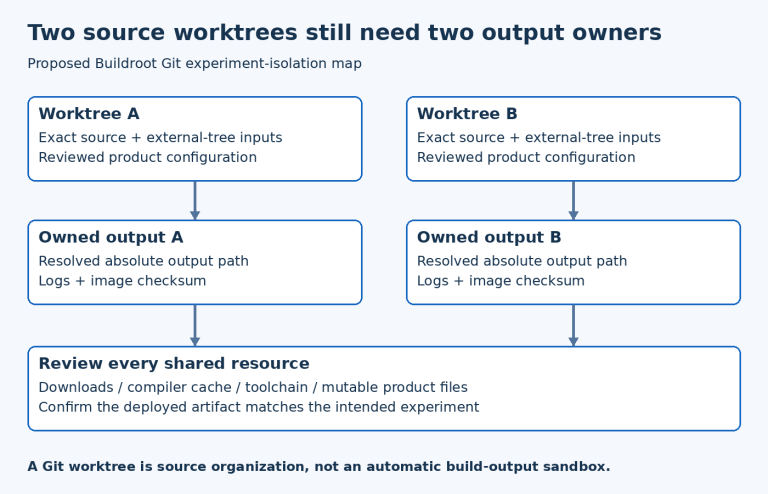
Determine which outputs the original change could have affected: downloaded source selection, patches, configuration, compiled package objects, staging files, target files or final images. Include dependent packages when a library interface or build option changed.
The Buildroot rebuilding-packages documentation explains the limits of partial package rebuilding. Rebuilding one package does not automatically provide complete dependent-package reconstruction or remove all previously installed files. The suitable recovery scope depends on what changed.
A package version revert, a toolchain change and an image-layout change should therefore not share one unquestioned cleanup rule. Where the dependency impact is uncertain, a separate clean output build can provide a clearer recovery baseline than repeatedly manipulating a contaminated output directory.
Preserve the old output without trusting it
Keep an incident artifact or log bundle when useful, but label it as evidence from the failing state. Do not let its presence make it the default source for the supposedly recovered image. Use distinct output locations and traceable image names during the comparison.
For a hypothetical package update that installed a new helper file, reverting the recipe may stop building that helper without necessarily removing the previously installed copy from an existing target tree. A runtime test against that tree can then exercise a mixture of old and new content.
The lesson is to inspect the generated-state boundary, not to assume every revert requires the same expensive process. A narrow rebuild may be justified when its scope is understood and checked. Record that justification and the outputs it intentionally leaves untouched.
Validate the recovered image, not only compilation
Confirm which image was generated, copied and booted. Retain identifiers or checksums that connect the test device to the recovered build record. An operator accidentally booting the previous image can make a successful source correction appear ineffective, or hide a remaining problem.
Run the observation that originally demonstrated the regression, then test the behavior most likely to be affected by the recovery. If the revert removes a newer feature intentionally, include that expected difference in the acceptance notes. Otherwise another team may report the planned behavior as a new defect.
Compilation success is useful but bounded evidence. A change involving startup ordering, storage format or a device interaction can require runtime checks. State which checks were actually performed and which remain unavailable; do not convert an incomplete recovery exercise into a release approval.
Check compatibility outside the repository
Some changes affect persistent state, configuration files or external services. Reverting source does not automatically reverse those changes. Identify whether the older software can safely read data written by the newer version before attempting deployment on valuable devices.
Where such compatibility is unknown, use a representative test environment and an approved recovery plan. Avoid presenting a firmware downgrade as routine merely because the source diff is small. The relevant risk follows the product's state transitions, not the number of changed lines.
Leave a reproducible recovery record
Record the original incident, the recovery commit, the build-state strategy, the resulting image and the observations used to accept it. Keep unresolved limitations and follow-up fixes visible. If a later forward fix replaces the revert, the same record helps explain which behavior must remain protected.
The finished recovery is a chain of evidence: intended source state, suitable reconstruction of affected outputs, identified deployed artifact and verified behavior. Git supplies the history operation. Buildroot's output model and the product's runtime state determine the rest of the work. Reviewing those boundaries explicitly makes the next recovery easier to understand and less dependent on whoever remembers the incident.