Zephyr OS Deferred Device Initialization: Make Explicit Startup Failure Observable
Deferring a Zephyr device's initialization transfers responsibility to an explicit startup path. The application needs to know who starts the device, when dependencies are ready and what happens if the attempt fails. Treating every unready device as something to initialize repeatedly can hide a broken lifecycle.
This guide is scoped to Zephyr 4.4.0. It examines the deferred initialization contract and a version-specific retry pitfall. It does not recommend changing device lifecycle state directly, and no real device startup or recovery sequence has been tested here.
Name the owner of the deferred startup
Record why the device is deferred and which component is authorized to initialize it. A reason might involve a product-controlled startup sequence, but the actual dependency and timing must be stated. Deferral without an owner leaves every caller unsure whether an unready result is expected.
The Zephyr 4.4.0 device API header documents manual initialization for a device marked with the deferred-init devicetree property. Review the selected driver's behavior and the final hardware description alongside that API contract.
Define when ordinary consumers may begin using the device. A consumer should not independently start it simply because its first request arrives early. Centralizing the startup decision makes it possible to report progress and failure consistently.
Distinguish three application-visible conditions
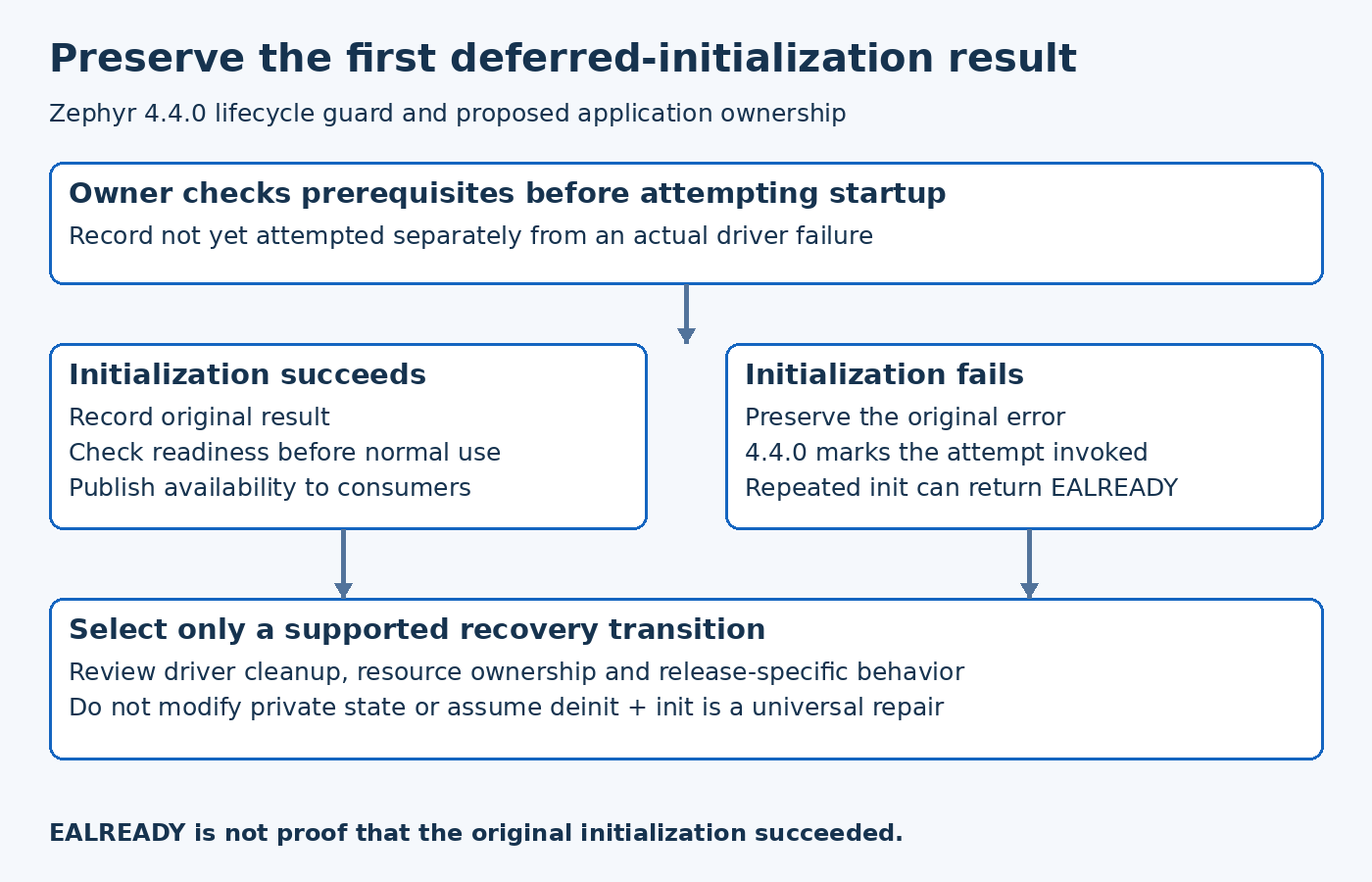
The application should distinguish a device whose startup has not yet been attempted, an attempt that failed and a device ready for its standard API. A single boolean message saying unavailable can be adequate for a user interface, but it is insufficient diagnostic evidence for the startup owner.
Keep the intended lifecycle in application-owned state with suitable synchronization. Do not modify private kernel device fields to manufacture a desired result. The lifecycle record should describe what the application observed and requested, not override the driver's state model.
For a hypothetical optional sensor, the system might remain functional while that sensor is unavailable. The startup owner should record the failed attempt and make the degraded capability explicit. It should not silently report a valid measurement or claim the sensor was never requested when initialization actually failed.
Preserve the first initialization result
Capture the return value from the explicit initialization call and associate it with the device, attempt and relevant dependency conditions. A later readiness check cannot necessarily reconstruct why the first call failed.
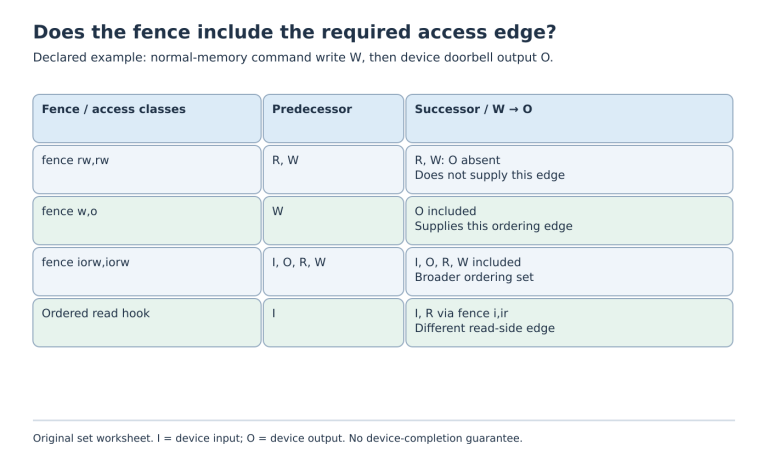
The Zephyr 4.4.0 device implementation marks initialization as invoked even when the driver returns an error. Its device_init path rejects an already-initialized state with EALREADY. Therefore, an immediate second call after a failed attempt is not a generic retry mechanism in this version.
Do not interpret EALREADY as proof that the original initialization succeeded. It describes the lifecycle guard reached by that call. Retain the original error and evaluate readiness separately before declaring the device usable.
Make dependency readiness an explicit precondition
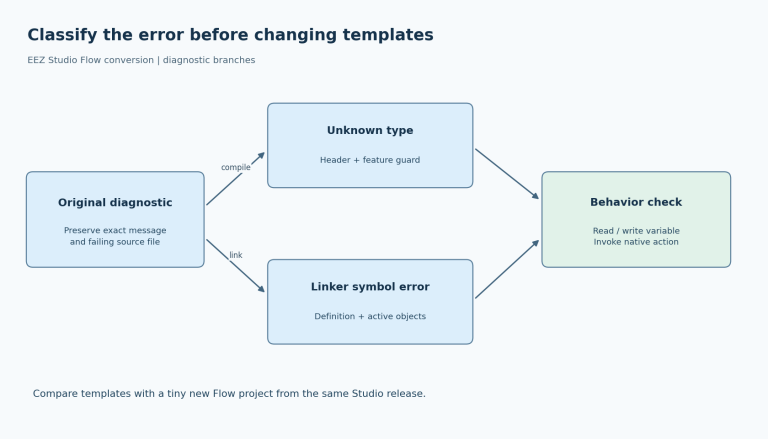
Before the startup attempt, verify the required providers and product-controlled prerequisites using supported interfaces. Identify which conditions are checked and which remain assumptions. A generic delay is not equivalent to evidence that a dependency became ready.
If a prerequisite is absent, report that the startup has not yet been attempted or has been deliberately withheld, according to the application's actual state. This is different from calling into the driver, receiving an error and later rewriting the history as a waiting condition.
A hypothetical bus-dependent device illustrates the distinction. If the bus is unavailable, the owner can defer the attempt and expose that dependency. If the driver was already called and failed, the recovery decision must account for the resulting driver state rather than merely waiting and issuing the same call again.
Design recovery from the driver's actual contract
Recovery may require a supported driver operation, a controlled deinitialization path, a device reset or a wider product restart. None should be inferred solely from the existence of a generic initialization API. Inspect the driver, enabled features and resource ownership before selecting a sequence.
In particular, do not assume that deinitialization followed by initialization is universally supported or safely clears every failure condition. Support and cleanup behavior depend on the implementation and release. A proposed recovery path needs targeted verification, including what happens to resources acquired before the original failure.
If no supported recovery path exists, report that limit and use the product's approved failure policy. An honest degraded state is safer than a loop that alternates error codes while presenting itself as active recovery.
Gate consumers and concurrent requests
A startup owner should serialize competing initialization requests and define how consumers wait or fail while startup is in progress. A second caller should not race the first one and interpret the resulting lifecycle error as an independent hardware diagnosis.
After successful startup, publish availability through the application's normal synchronization mechanism and retain the evidence used to establish readiness. If later runtime operations fail, treat those as runtime faults; do not erase the earlier startup result or automatically re-enter initialization without a defined transition.
Test the concurrency and failure paths deliberately. Useful proposed cases include a request before prerequisites are met, one failed initialization attempt, simultaneous consumer requests and a successful startup followed by a runtime error. Record actual results rather than assuming these cases are covered by a normal boot.
Leave a useful lifecycle record
A maintenance record should identify the deferred device, startup owner, prerequisite checks, first result and supported recovery policy. Include the Zephyr and driver revisions because lifecycle details can change between releases.
The key lesson is that deferred initialization is an explicit transition with an observable outcome. In Zephyr 4.4.0, repeating device_init after failure can encounter the already-invoked guard, so the original result matters. Preserving that evidence and defining ownership makes startup failures diagnosable without inventing unsupported retries.