Zephyr OS Flash Areas: Keep Partition-Relative Offsets Inside Their Declared Range
A flash write can target the wrong location even when its numerical offset looks plausible. The flash-area API expects an offset relative to the partition, while the underlying flash device API addresses the device. Adding the partition base twice changes the destination.
For a Zephyr OS storage integration, label every offset by its coordinate system. This review uses the v4.4.0 flash-map API and implementation. Any write or erase experiments belong on designated disposable test storage, not on a live boot or configuration partition.
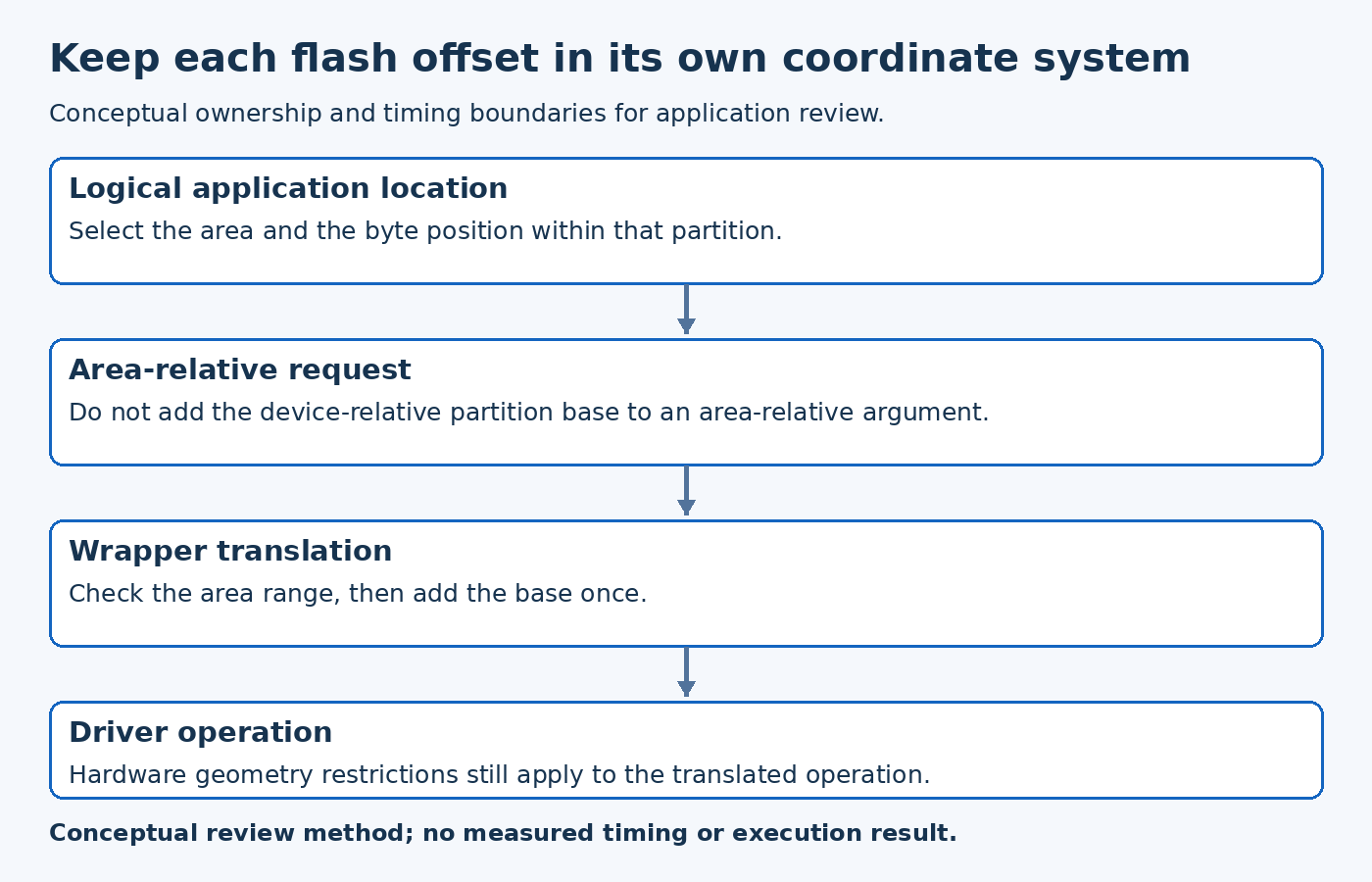
Keep the partition base out of area-relative calls
The tagged flash-map header defines each area using its device, starting offset and size. Its read, write and erase APIs take offsets relative to the area's beginning. They also retain the underlying driver's alignment and size limitations.
Suppose a hypothetical partition starts at device offset 0x20000 and an application wants byte 0x100 within it. The area-relative request uses 0x100. A direct device request would need the corresponding device-relative address, after carefully identifying the same backing device. Passing 0x20100 to the area API would ask for a different location within that area's coordinate system, not select the intended byte.
Avoid ambiguous variable names such as address when values cross these layers. Names that encode area_offset and device_offset make review easier. Keep the backing device identity alongside the number, particularly on boards with both internal and external flash.
Preserve the bounds-checking layer
The tagged wrapper implementation checks the requested range before forwarding read, write or erase, then adds the area's base exactly once. An out-of-area request returns -EINVAL rather than deliberately forwarding a larger range to the driver.
That protection applies when using the wrapper. Extracting the device pointer and calling its raw API is not equivalent to keeping the same partition boundary enforcement. A raw access might remain within the physical chip while crossing into a neighboring area that belongs to another subsystem.
As an application design rule, centralize conversions at the layer that truly needs them. If a component operates entirely inside one partition, pass the area handle and relative offsets rather than distributing raw device addresses throughout the codebase. This reduces the number of places where a later partition-layout change can silently alter behavior.
Check discovery, readiness and geometry separately
Opening an area can fail because the mapping is unavailable, the identifier is absent or the backing device is not ready. Inspect the return value before using the output pointer. Do not assume an earlier pointer remains a valid result of a failed new lookup.
A successful open does not certify that every requested erase geometry is valid. A range can lie within the partition and still violate the driver's erase-block or program-block constraints. Treat partition bounds and hardware geometry as separate checks, with separate error reporting where the interface allows it.
For a hypothetical log partition, record the generated area base and size, the intended logical record location and the resulting operation range. Review a record near the end as carefully as one at the beginning. The arithmetic that works for early records can fail when headers, padding or a final partial record are included.
Verify boundaries without touching neighboring content
Begin with a non-mutating inspection of the generated partition map and the caller's calculations. In a disposable storage test, select cases wholly inside the area, ending at its boundary and deliberately exceeding it. Verify both the returned status and the absence of unintended changes to adjacent test regions.
Keep any hardware-specific alignment tests distinct from range tests so that a rejected unaligned request does not masquerade as proof of partition enforcement. When moving an application to another board layout, repeat the coordinate-system review even if the application-level record offsets are unchanged.
The objective is a traceable chain from logical location to area-relative request to device-relative operation. A numerically valid address is not sufficient without knowing which origin and boundary give that number meaning.