TinyML Operator Compatibility: Diagnose a Model That Runs on the Desktop but Fails on the MCU
A converted model produces sensible predictions in a desktop interpreter but fails during MCU initialization. Conversion success establishes a model artifact for one runtime configuration. It does not establish that the microcontroller firmware contains implementations for every operation in that artifact.
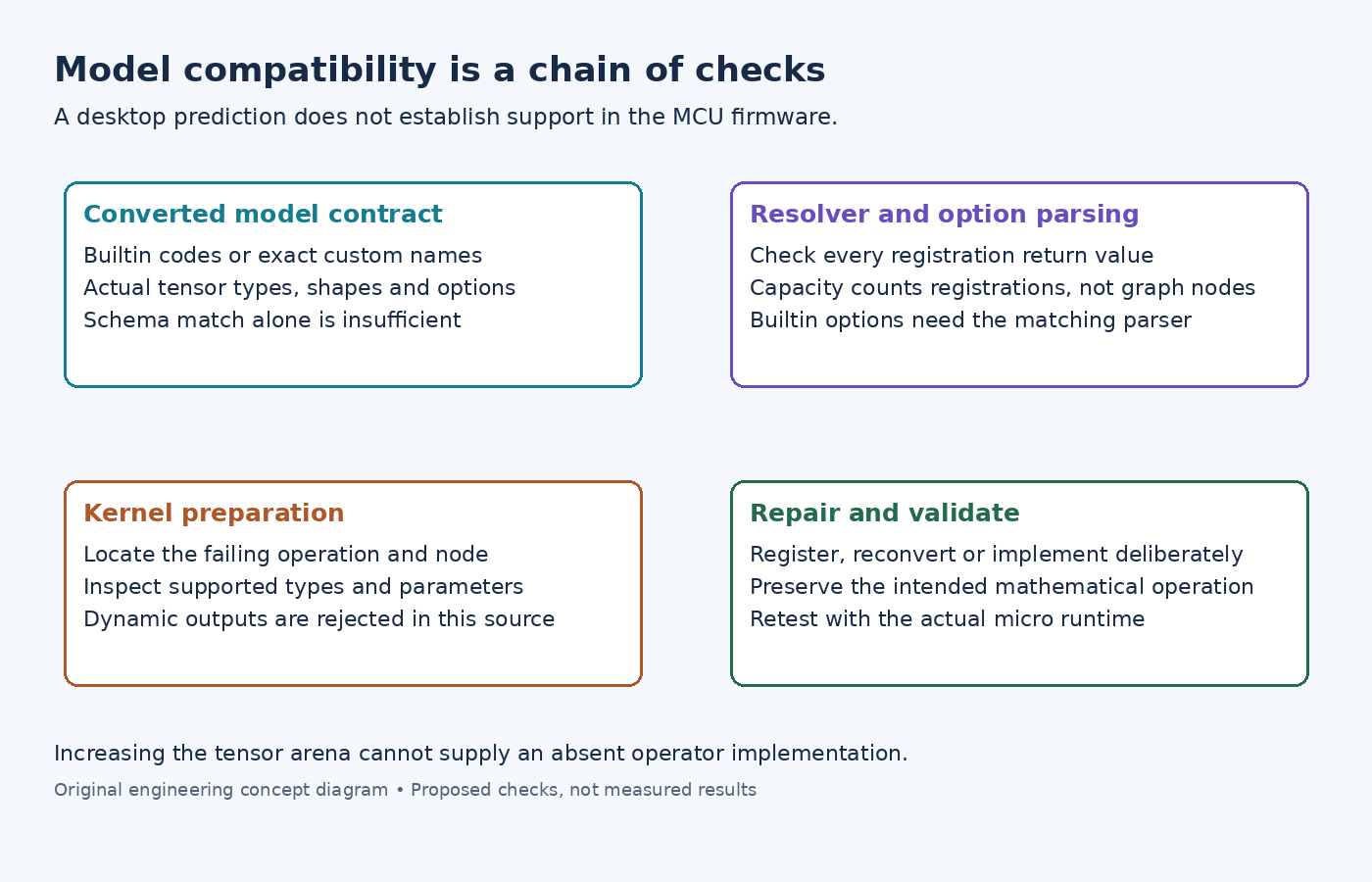
Diagnose the failure as a chain: model operator identity, resolver registration, option parsing, kernel preparation and tensor allocation. A larger tensor arena cannot replace a missing kernel.
Inventory the converted graph, not the training layer names
The LiteRT microcontroller overview explicitly describes a limited operation set and a low-level C++ integration. Start from the exported model's operators and tensor forms, because conversion can introduce operations that were not visible as separate layers in the training code.
For each required operation, identify whether its code is builtin or custom. Record its input and output types, shapes and relevant options. A list saying only “convolution supported” is too broad to establish that the exact converted form is accepted.
Also keep schema compatibility separate. The getting-started guide demonstrates checking TFLITE_SCHEMA_VERSION, followed by resolver setup. Passing the schema comparison does not populate the resolver or prove that each kernel supports the model's parameters.
Check every registration result
In the examined MicroMutableOpResolver implementation, the template argument bounds the number of registrations. Adding beyond that capacity returns an error. Duplicate builtin registrations and duplicate custom names also return errors.
Size this capacity for the distinct registrations needed, not simply the number of nodes in the graph. Several convolution nodes can use one convolution registration. Conversely, one unsupported custom operation cannot be satisfied by increasing the capacity without adding its implementation.
Check the return value from each Add operation, including custom registrations. If an addition failed earlier, a later “missing registration” message is a consequence, not the first failure. Custom-operation lookup compares the model's name with the registered name, so spelling and the selected implementation matter.
Follow the failing node into preparation
The examined interpreter resolves each node's registration and obtains a parser for builtin options. A missing registration and a missing builtin parser are distinct initialization failures. Do not bypass either by treating an unknown operation as a similarly named supported one.
After initialization, the graph implementation calls each kernel's Prepare function. It reports the operation and node number when preparation fails. It also checks outputs for dynamic tensors and rejects that condition in the examined implementation.
Use the node number to inspect the exact converted tensors and selected kernel. For example, a model can find its convolution registration but still fail the kernel's type or quantization checks. Registration proves that dispatch can find code; it is not a blanket capability certificate.
Choose a repair that preserves the model's meaning
A missing existing registration can be fixed in firmware. An unsupported converted form may require changing conversion settings, choosing a supported model structure or implementing a suitable custom kernel. These changes have different validation costs.
Do not silently cast a tensor, remove an operation or substitute another mathematical operation just to pass initialization. Re-run the intended model-level comparisons after a semantic change. For a custom implementation, test its supported shapes, types, parameter limits and error handling before relying on complete-model predictions.
A useful minimal reproduction keeps the failing operation and its necessary tensor parameters while removing unrelated sensor acquisition. Feed known inputs only after setup succeeds. That separates a compatibility defect from later preprocessing or classification-quality problems.
Finally, verify the repaired graph with the actual micro runtime and kernel selection used by the firmware. A desktop-only retest can repeat the original blind spot. The result should identify the repaired boundary, rather than merely state that the model now fits or that conversion completed.