Adding a Sparkplug Host: Plan Rebirth Discovery Before Connecting to a Live System
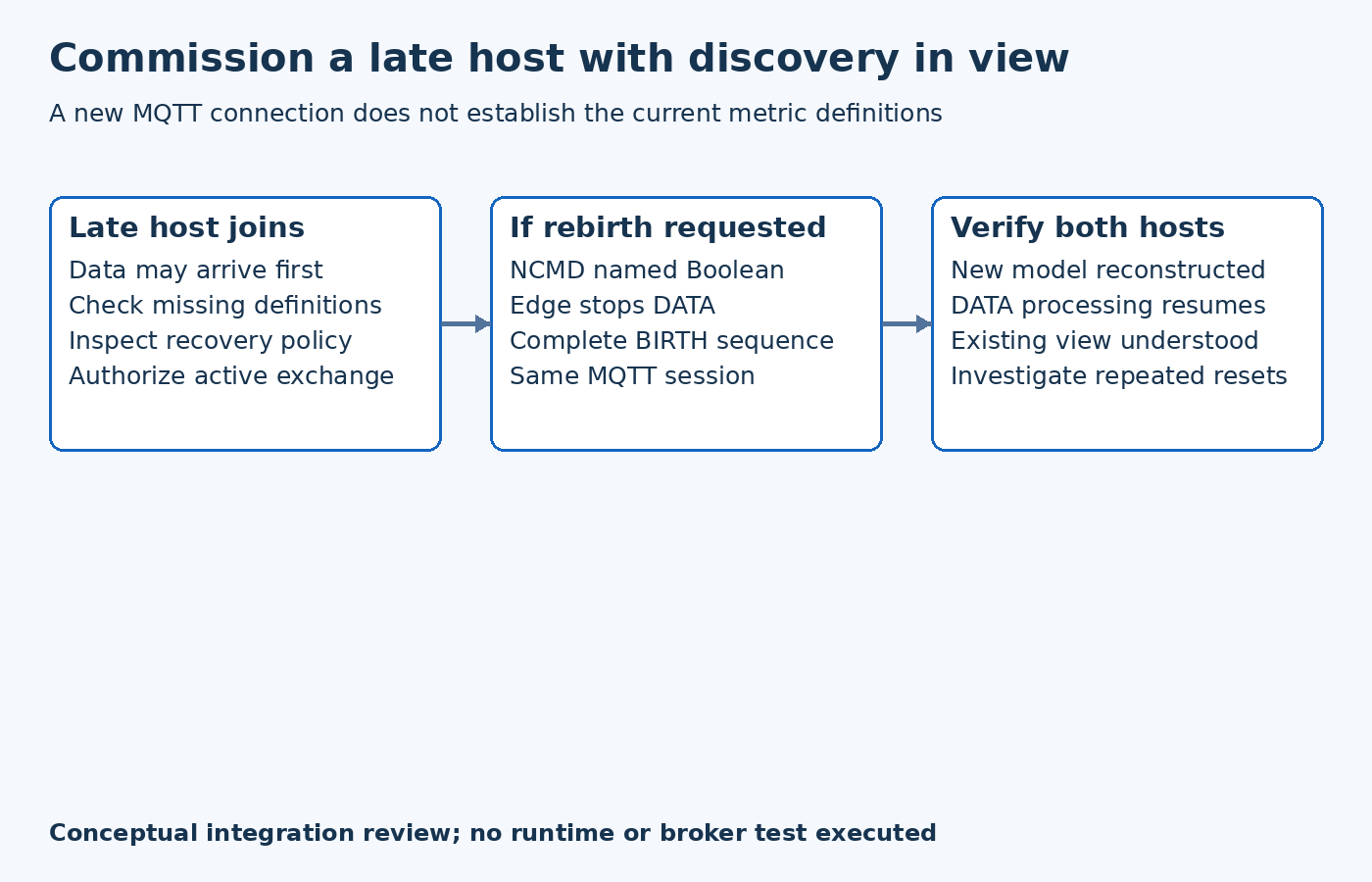
Adding another Sparkplug host to a running MQTT system can involve an active discovery exchange. A host that arrives after the edge node's birth messages may receive data without the definitions needed to interpret it. Plan how the new host acquires those definitions, and whether its recovery behavior can cause a new birth sequence from the edge node.
This is an operational commissioning question. It concerns the effect of introducing a consumer while equipment is already publishing, rather than deciding whether Sparkplug is the right data format for the project.
Establish what the new host actually knows
A hypothetical plant already has one host consuming a gateway's metrics. A second reporting host is added later. Its MQTT connection succeeds, but that success does not prove that it has reconstructed the gateway and device definitions associated with the current data stream.
Before commissioning, identify which birth information the new host can receive and how it handles data arriving without that context. Do not silently create a permanent application mapping from the first unfamiliar number or alias it encounters. Record whether the implementation rejects the message, defers its use or initiates a supported recovery exchange.
The Sparkplug 3.0.0 specification, sections 5.15 and 5.17, discusses late-arriving hosts and rebirth. A rebirth request uses NCMD with the named Boolean Node Control/Rebirth metric set to true. The edge node stops DATA publication, emits its complete birth sequence and can then resume DATA. This exchange does not create a new MQTT session or increment bdSeq merely because rebirth occurred.
Separate protocol rules from product recovery policy
A product may automatically request rebirth for several conditions. Determine which conditions are enabled, what rate limiting exists and how operators can distinguish discovery from persistent decode or configuration failures. Repeated requests should lead to investigation of their cause, rather than being accepted as evidence that the integration is healthy.
For an implementation example, the Eclipse Tahu host payload handler at commit 5736e404 requests rebirth when node data arrives for an absent or offline node. Its request path also contains a per-node timer gate. These are useful implementation details to inspect, not universal timing promises for every Sparkplug product.
Ask the selected host vendor or integration owner how their implementation behaves. Include application configuration and version in the answer. An approved monitoring connection does not automatically imply that every command the client might send is appropriate for the operating site.
Commission one edge node before scaling discovery
Start in a test installation or an agreed commissioning window with one representative edge node. Establish normal operation with the original host, then connect the new host after the edge's initial birth sequence. Observe the new host's first usable metric definitions and any command it sends.
Compare the resulting birth and data sequence with the intended discovery path. If rebirth is requested, verify that the new host reconstructs the full required node and device model before treating subsequent observations as usable. Also inspect the original host's behavior during that exchange; adding a consumer should not leave the existing operator view in an unexplained state.
Only then expand to the intended population. A site with many gateways needs an explicit decision about startup ordering and discovery load. Do not translate a successful single-node test into an unmeasured claim about simultaneous commissioning capacity.
Make failures visible without repeated blind resets
If the new host still cannot interpret the returned birth definitions, preserve the affected identity, implementation versions and diagnostic result. Investigate unsupported metric representations or configuration mismatches before repeating recovery commands. A new birth sequence cannot repair an application that consistently misunderstands the same definition.
This article's sequence is a proposed commissioning exercise; no host or edge-node runtime was executed. The acceptance evidence should show how a late host obtains its model, which active exchanges occur, and whether existing consumers remain understandable throughout. That makes introducing a new reporting application a controlled integration change instead of assuming that subscribing is operationally passive.