MQTT Enhanced Authentication: Keep Reauthentication State Out of the Publish Path
Model MQTT enhanced authentication as a connection-level exchange with its own phase and lifetime. Initial authentication finishes with a successful CONNACK; reauthentication finishes with a successful server AUTH. During reauthentication, other packets can continue under the previous authentication. A publish acknowledgement must not accidentally complete authentication, and a delayed authentication callback must not modify a replacement connection.
This guide pins the OASIS MQTT 5.0 Standard, 7 March 2019, especially sections 3.15 and 4.12. It covers state coordination, not implementation of a cryptographic authentication mechanism or TLS certificate management. An original integration-state model was executed; no credentials, broker or network exchange was used.
Freeze the method for the connection
A client selects enhanced authentication by including Authentication Method in CONNECT. The method defines how Authentication Data is interpreted and what challenge/response steps are needed. MQTT does not make every method interoperable merely because two libraries can encode AUTH packets.
Section 4.12 requires all AUTH packets and a successful CONNACK to carry the same Authentication Method as the initial CONNECT. If CONNECT omitted the method, neither endpoint may introduce AUTH later on that connection. Reauthentication therefore cannot be added as an unrelated token-refresh packet to a connection that never selected enhanced authentication.
Record the supported method, client-library version, server implementation and method-specific limits. Keep a method identifier in ordinary diagnostics when appropriate, but do not log raw Authentication Data, passwords or secret challenge material. Bounds on buffer size and processing work are implementation requirements to qualify, not values supplied universally by MQTT.
Use phase-specific transitions
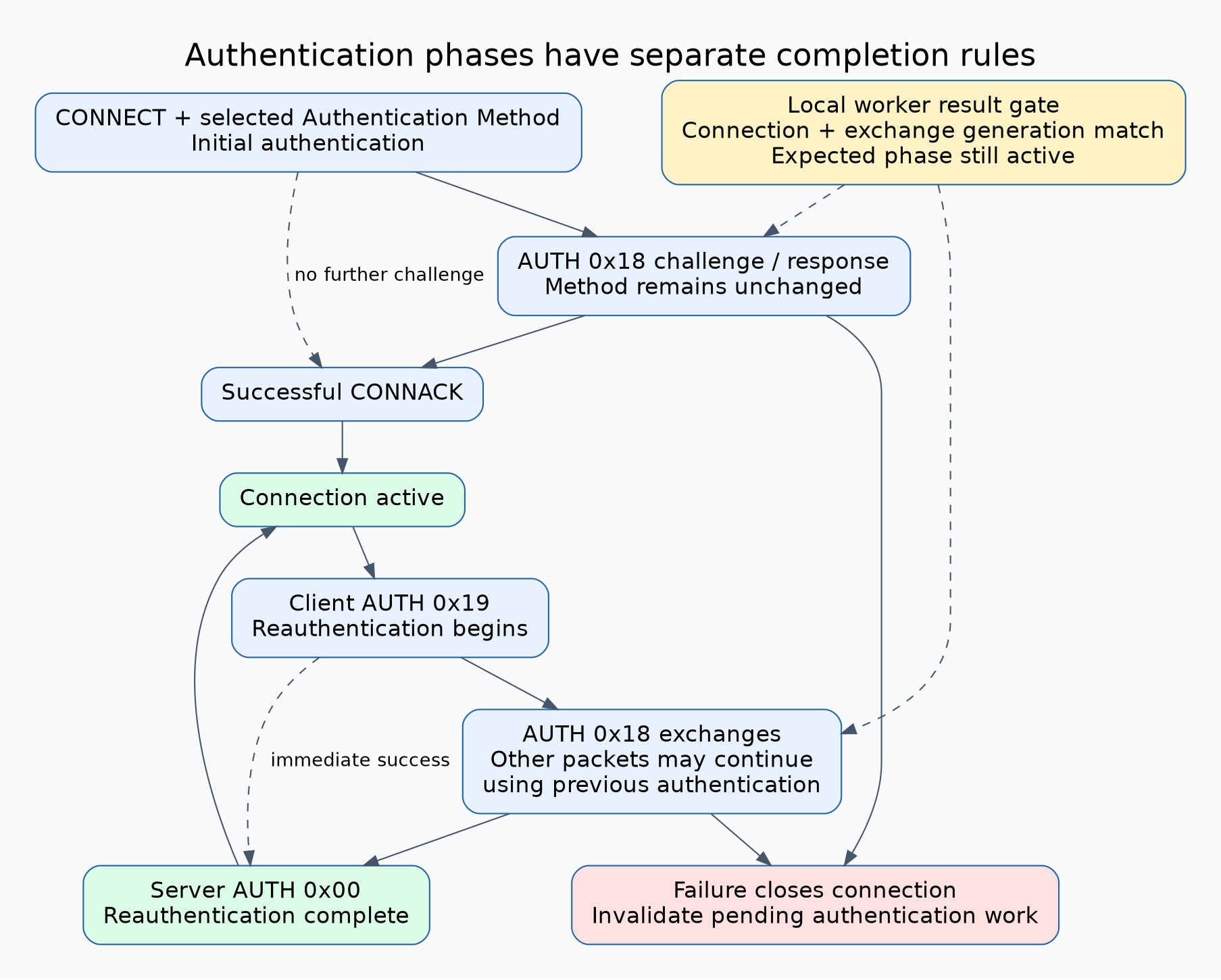
| Phase | Expected event | Result |
|---|---|---|
| Initial authentication | Server AUTH 0x18 | Process challenge; send required AUTH 0x18 response |
| Initial authentication | Successful CONNACK with matching method | Connection accepted |
| Active connection | Client sends AUTH 0x19 | Begin reauthentication with the original method |
| Reauthentication | Server AUTH 0x18 | Continue the selected mechanism |
| Reauthentication | Server AUTH 0x00 | Reauthentication complete |
| Reauthentication failure | Failure determined by either endpoint | Close the network connection; appropriate DISCONNECT is recommended |
AUTH 0x19 is client-initiated. AUTH success zero is server-sent. A server cannot start the same client reauthentication sequence merely by reversing those roles. Likewise, receiving an AUTH success in the initial phase is not a substitute for the required successful CONNACK.
For unsupported initial methods, the server closes the connection and may send a failing CONNACK such as 0x8C or 0x87. Preserve initial rejection separately from an established connection that later failed reauthentication; those incidents start from different operational states.
Keep ordinary traffic progressing deliberately
Section 4.12.1 permits other packets to continue during reauthentication using the previous authentication. Do not globally stop receive processing while an authentication worker waits for a result. That can prevent PUBACK, PUBREC, keepalive and authentication messages from being serviced.
Application policy may pause new business publications while reauthentication is pending. If so, define that as a local admission rule while continuing the required network state machines. It does not authorize traffic under hoped-for new permissions before the server accepts them. Also bound the paused application’s queue rather than moving unlimited backlog behind an authentication flag.
For initial connection setup, this guide recommends holding business publications until successful CONNACK. This is a conservative integration policy, not a blanket MQTT prohibition: section 3.1.4 allows clients to send additional packets earlier, with the associated rejection and unknown-server-capability risks.
Guard asynchronous work with local generations
AUTH does not carry a publish-style Packet Identifier. Its variable header contains a reason and properties, so do not correlate authentication work using an unrelated outstanding PUBLISH identifier. Give the local connection owner a connection generation and an authentication-exchange generation.
When an authentication worker starts, capture both generations and the expected phase. When its result returns, apply it only if all still match. Close, reconnect, completion or cancellation must invalidate old work. These are application-side guards; they do not add fields to the MQTT wire format.
Serialize changes through one connection owner, and allow only the active mechanism step to produce the next AUTH. A late worker must not write directly to a socket that has been reassigned to a new connection. Set an implementation-qualified deadline and work budget; on failure, close rather than silently reverting to an indefinite supposedly authenticated state.
A hypothetical delayed-response failure
Consider a hypothetical gateway that starts reauthentication on connection generation twelve. Its authentication worker is delayed, the network closes, and the gateway establishes generation thirteen. The old worker then finishes successfully.
Checking only a global “connected” boolean would allow that result to affect the new connection. The generation check rejects it, even if the new connection uses the same ClientID and method. A successful computation for old challenge material says nothing about the current exchange.
Qualification and executed model
The original model exercised initial challenge handling, successful CONNACK activation, traffic eligibility during reauthentication, successful completion, failure closure, late results after closure and replacement, changed-method rejection and attempted reauthentication without an original method. It also rejected using reauthentication success to finish the initial phase. The method label was artificial; no authentication proof was calculated.
For the real stack, run those cases with the supported method in an isolated lab. Delay the authentication worker while unrelated QoS exchanges progress, inject a connection replacement, and confirm old callbacks cannot emit packets. Capture packet types, reason codes, phase transitions and redacted generation markers.
Accept the integration when each authentication outcome changes only its own current connection state, failures close cleanly, and publish completion remains correctly classified throughout. The release record should distinguish protocol support, mechanism interoperability and application admission policy instead of treating one AUTH callback as proof of all three.