Zephyr OS Event Bits: Distinguish Reset-Before-Wait from Removal-on-Receipt
Clearing an event object before waiting and removing the events that a wait receives are different operations. Confusing them can discard a notification that arrived just before a consumer started waiting, or leave an already-handled bit repeatedly visible.
For a Zephyr OS design, first decide whether a bit represents a continuing condition or pending attention. This discussion is limited to the v4.4.0 public API contract. It does not claim that event bits are a lossless queue or that a notification selects exactly one consumer.
Identify which set of bits the operation changes
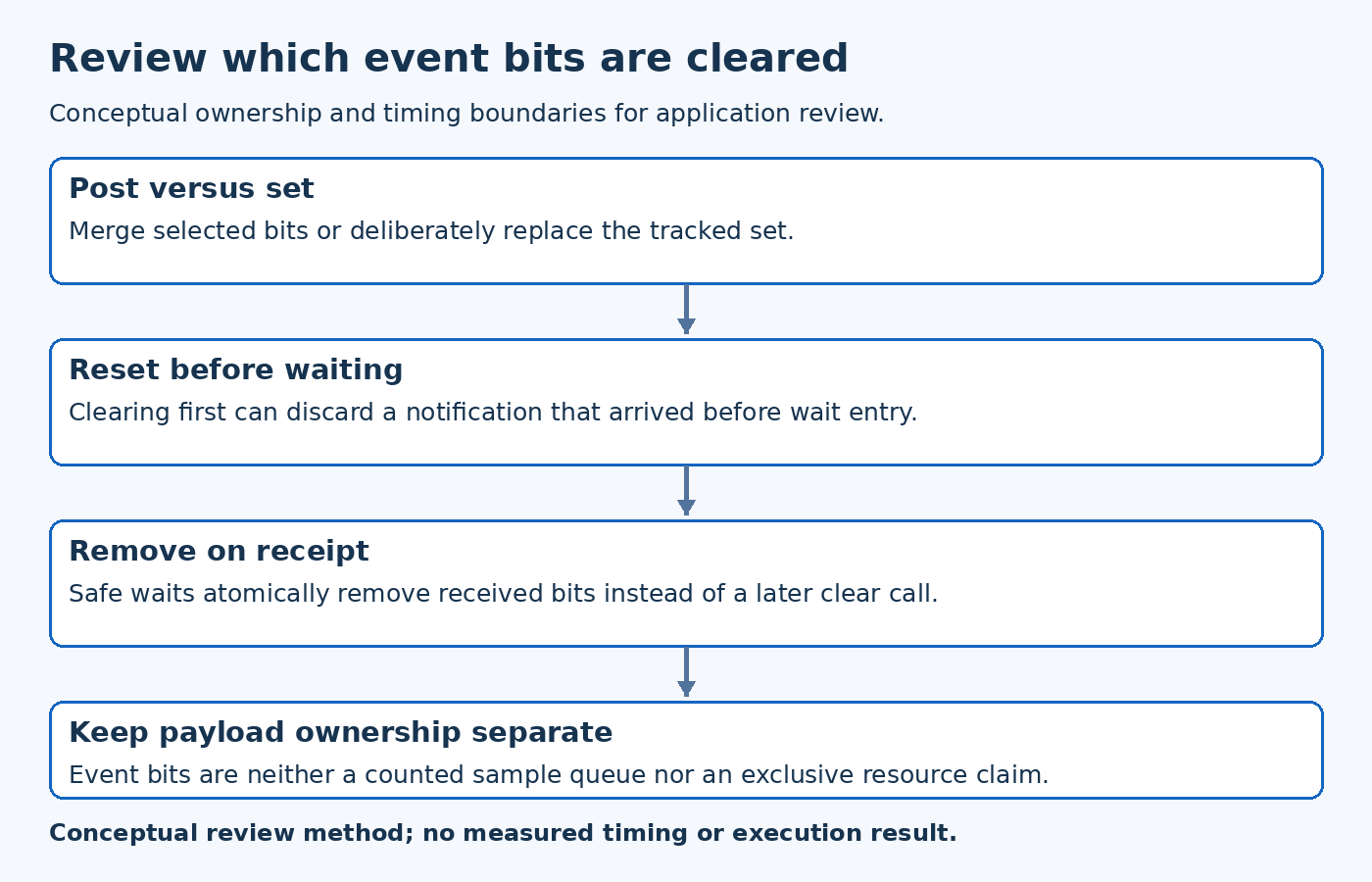
The tagged event API declarations distinguish posting, which merges bits, from setting, which replaces the tracked set. Ordinary waits can reset the entire tracked set before waiting. The safe wait variants atomically remove received events, avoiding a separate receive-then-clear operation.
Suppose a service tracks READY and ERROR in one event object. A producer intending only to announce READY should review whether replacing the complete set would also discard an ERROR established by another producer. Conversely, a deliberate state snapshot may legitimately replace prior bits. The correct API depends on what the producer owns, not merely on whether the new value contains one bit.
Write an ownership table for the hypothetical design: which component may set each bit, which may clear it, and whether another component still needs to observe it. This small table often reveals ambiguity before any timing experiment is necessary.
Do not use reset as an automatic cleanup step
A wait with reset enabled clears tracked events before testing and waiting for the desired condition. If a producer posted the relevant bit immediately beforehand, that notification can be erased by the consumer's entry into the wait. The header explicitly cautions about resetting objects shared by multiple waiting threads.
For a task that wants to process already-pending attention, resetting on every iteration deserves particular scrutiny. A “start fresh” comment is not enough to justify losing events that arrived during the previous processing interval. If the design intentionally ignores earlier activity, specify that boundary as part of the service behavior.
The official event guide illustrates the safe variants as waits with atomic removal on receipt. This live guide is supporting explanation; the tagged header fixes the versioned contract used here. Removing received bits does not make the associated application payload immutable, nor does it define a counted delivery guarantee.
Keep state and event history separate
A bit can record that attention is needed, but repeated posts of the same bit do not encode how many underlying occurrences happened. A hypothetical sensor that posts DATA_READY three times before processing has not thereby stored three sample records in the event object.
Keep samples in separately synchronized storage when each sample matters. The event can wake a consumer that drains that storage. If only the latest state matters, document that coalescing is intentional. Both designs can be valid, but they answer different requirements.
Likewise, an event bit is not ownership of a hardware channel or a buffer. Several tasks may use event conditions to coordinate, while the actual resource still needs its own arbitration. Do not rename a wait “safe” and assume it provides an exclusive claim that its contract does not specify.
Exercise arrivals around each clearing boundary
Propose a test with one notification before wait entry, one while the consumer is blocked and one during payload processing. Record which bits remain and which payload generation the consumer handles. Repeat with another waiter interested in a different bit of the same object.
Then replace ordinary receive-plus-clear with the selected safe wait only where atomic removal matches the intended ownership model. Check the zero-return path as well: absence of a matching event is not evidence that all producers are healthy or that their data is current.
A correct review explains the scope and timing of every clearing operation. That is a stronger basis for reliable coordination than treating reset, clear and receive as interchangeable ways to make a loop stop waking.