Zephyr OS Memory Heaps: Separate Heap Locking from Allocation Geometry
A heap can have enough total free memory and still fail a particular allocation. It can also have perfectly reasonable allocation sizes while concurrent callers corrupt its bookkeeping. These are different faults: one concerns usable block geometry, while the other concerns serialization.
When reviewing a Zephyr OS allocator choice, identify the layer being called before increasing the configured memory region. The implementation observations here are anchored to v4.4.0. Suggested stress tests have not been executed on a target.
Identify who serializes the allocator
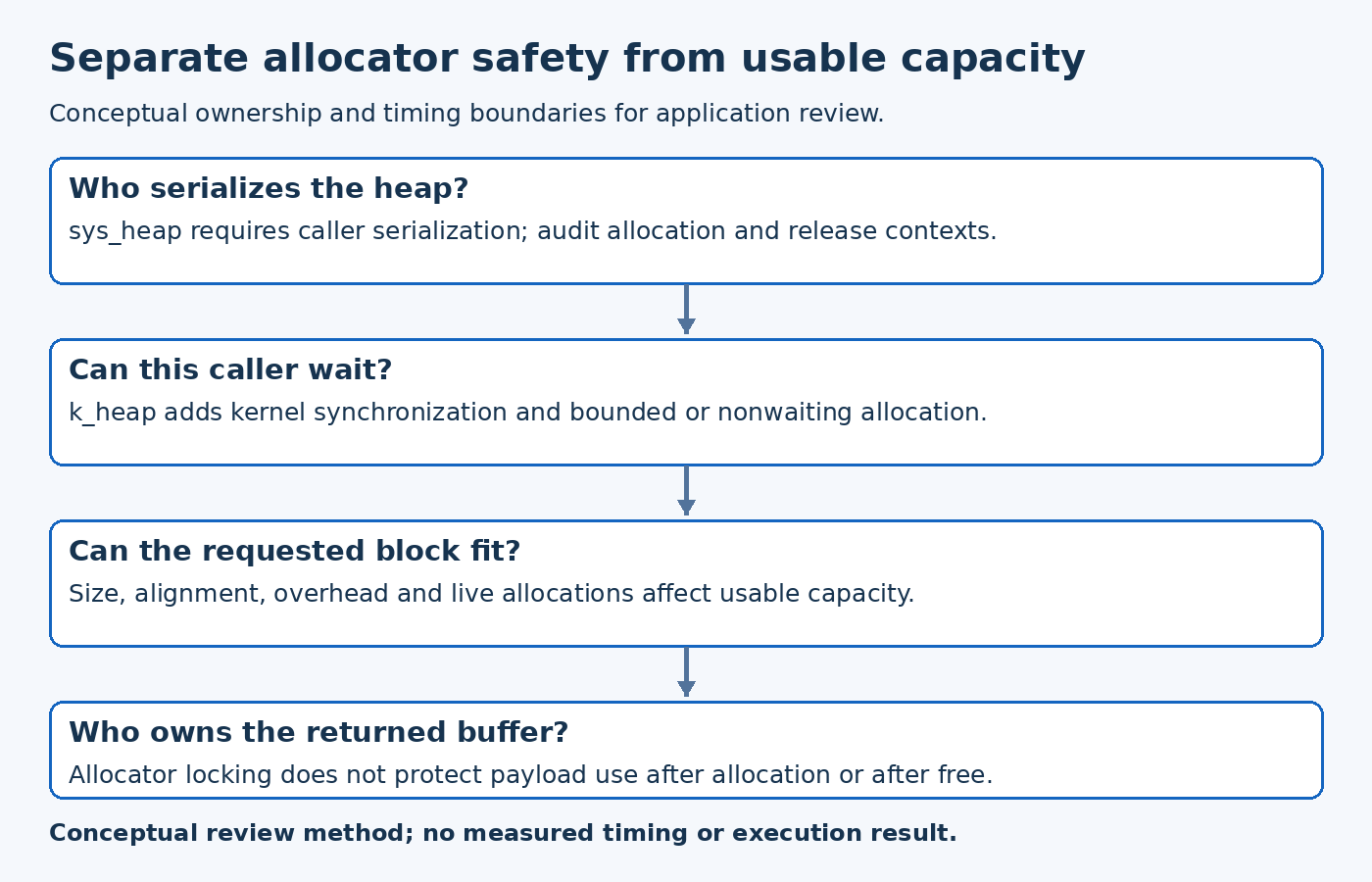
The official heap guide distinguishes the low-level sys_heap allocator from the synchronized k_heap interface. Calls operating on one sys_heap must be serialized by its caller. The low-level allocator does not acquire the kernel synchronization supplied by k_heap.
A hypothetical image pipeline might call sys_heap_alloc() from a processing thread and return buffers from an asynchronous completion path. A review that considers only two ordinary threads would miss that second entry point. Inventory allocation, release and any other accesses to the heap's mutable state, including diagnostic access that requires serialization.
Do not fix that inventory by adding a mutex that an ISR then attempts to take. Choose an ownership and synchronization arrangement compatible with every execution context. Alternatively, route allocation and reclamation through a single appropriate owner when the application's latency and capacity requirements allow it.
Read what the kernel wrapper actually adds
The tagged k_heap implementation acquires the heap's spinlock around low-level allocation. For blocking allocation it can pend the current thread, release and reacquire synchronization, and retry against the requested timeout. An ISR is restricted to K_NO_WAIT.
This wrapper protects allocator operations; it does not protect the contents of every returned buffer for the rest of its lifetime. Two tasks writing the same allocated object still require an application ownership rule. Likewise, a task that frees an object while another retains its pointer creates a lifetime error even when the allocator itself is perfectly serialized.
A timeout also cannot guarantee success. It only permits waiting for an opportunity to satisfy the request. If the application cannot tolerate a missing buffer, define an explicit fallback or admission policy instead of relying on an indefinitely blocking allocation to make capacity adequate.
Diagnose geometry independently from locking
The tagged low-level implementation manages chunks, free lists and neighboring-block merges. Allocation overhead, alignment and the placement of live blocks affect what request can be satisfied. A single free-byte total cannot describe all of those constraints.
For a hypothetical packet-processing workload, retain a mixture of long-lived small objects and short-lived large buffers. If larger requests fail, inspect the actual sequence of allocations and releases rather than concluding that another thread must have corrupted the heap. Conversely, a corrupted free-list assertion should not be explained away as normal fragmentation without examining illegal concurrent access and buffer lifetime.
Keep the requested size and alignment next to each failure report. An allocation suitable for ordinary CPU access is not automatically suitable for a peripheral's DMA reachability, cache or alignment requirements. Those are additional memory-region and device contracts.
Use separate experiments for separate hypotheses
First serialize all allocator access in a controlled test configuration and replay the allocation-size sequence. A failure that remains may indicate capacity or geometry rather than a concurrency fault. Then restore the intended execution contexts and stress overlapping allocation and release while checking ownership discipline.
Use only valid allocations in these tests: release through the matching heap and do not intentionally double-free a live product. If diagnostics are enabled, record their configuration because additional checking can change memory overhead and timing. No particular throughput or latency improvement is implied by selecting one interface.
The useful conclusion names the failed contract. “The caller bypassed serialization,” “the requested aligned block could not fit,” and “the buffer was released too early” lead to different fixes. Increasing heap size without making that distinction can merely make an intermittent defect harder to reproduce.