TinyML Stateful Inference: Reset the Intended State Between Independent Recordings
Replaying the same audio frame twice can produce different features even when the input bytes are identical. A stateful frontend can update noise estimates between calls. The question is whether the application intended one continuous stream or two independent recordings.
Reset at the boundary that matches the model's semantics. Clearing an input buffer does not reset operator state, while resetting after every frame can destroy the history a streaming model needs.
Establish whether repeated calls should preserve history
The pinned audio-preprocessor test deliberately invokes the frontend twice with the same frame and checks that the features differ. It then resets the interpreter and checks that the first feature result is reproduced.
That is an upstream test design, not a measurement performed here. It demonstrates why comparing isolated-frame expected values against an already warmed-up frontend can produce a misleading failure.
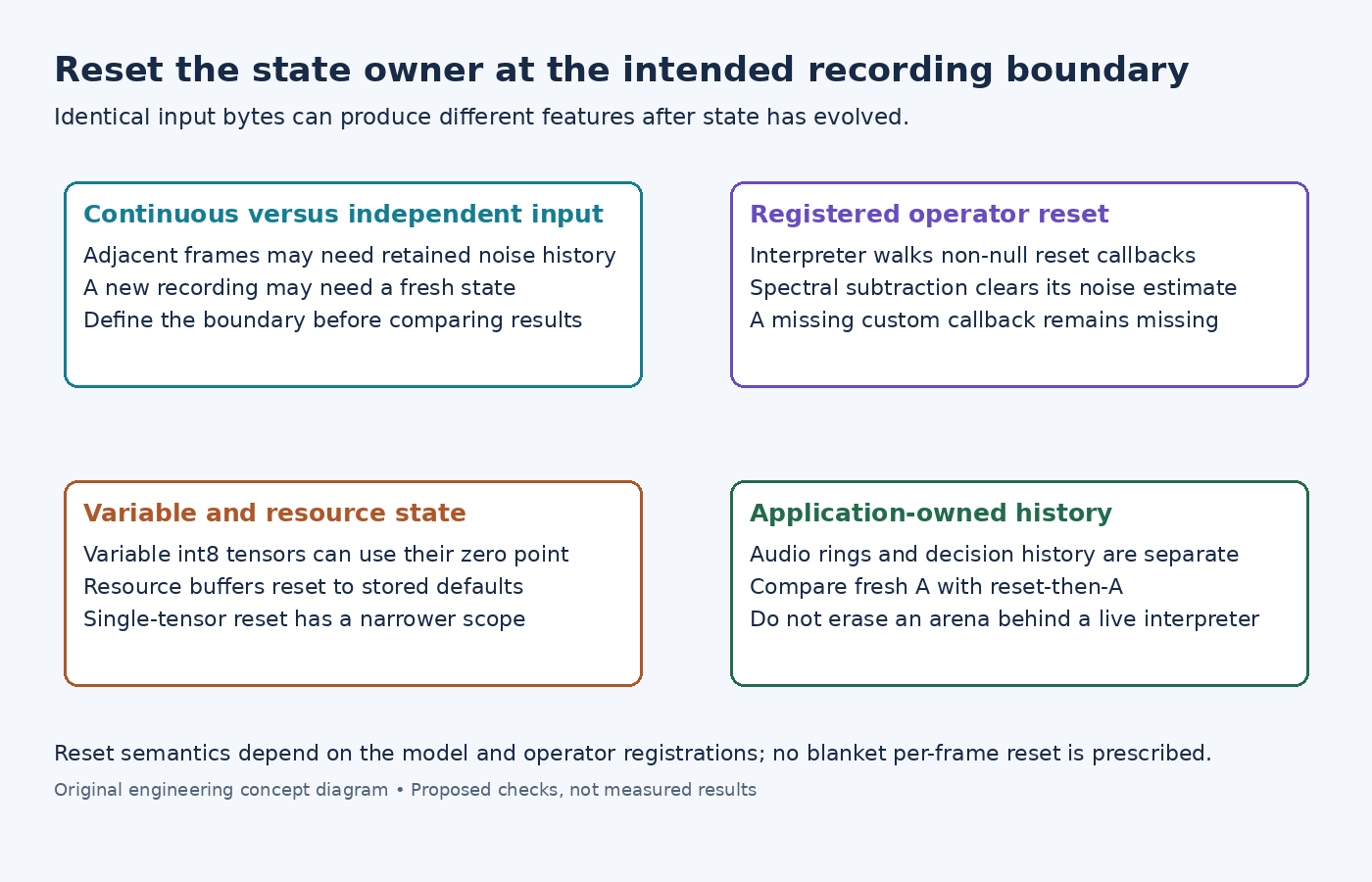
Define the reset boundary explicitly: a new independent recording, a deliberate restart after a data gap, or a continuous session. Adjacent windows in one session should normally retain the history expected by that frontend. Two unrelated recordings should not accidentally share it.
Know what the interpreter’s Reset actually reaches
The examined MicroInterpreter implementation calls graph reset and then variable-tensor reset. It does not recreate the interpreter or rerun the entire allocation process.
The graph implementation walks operator registrations and calls each non-null reset callback with its persistent user data. A custom stateful operator without such a callback does not acquire a reset implementation merely because the application calls Reset().
The graph also resets tensors marked variable. For the examined int8 path, it uses the tensor's quantization zero point when present, rather than assuming that a byte filled with zero represents numerical zero. Calling ResetVariableTensor on one tensor is narrower than resetting the interpreter's registered operator state.
Distinguish operator state from resource variables
The spectral-subtraction kernel provides a concrete operator-state example. It retains a noise-estimate array and registers a reset callback that clears that estimate. Replacing only the input tensor leaves this persistent state intact.
Resource variables use another mechanism. The resource-variable guide describes IDs and persistent buffers shared by subsequent read/assign operations. They are not ordinary scratch activations whose storage reuse implies a reset.
When a resource-variable manager is attached, graph variable reset calls its ResetAll. The manager implementation fills those buffers with their stored default byte value. Do not infer restoration of arbitrary application-assigned values; if the graph needs initialization assignments, preserve the model's intended initialization sequence.
Reset application-owned history separately
A microphone ring, assembled feature window, command-suppression history or recording counter can live outside the interpreter. Interpreter reset does not reach arbitrary application objects. List which state belongs to each owner and reset only the owners implicated by the chosen recording boundary.
For a controlled regression, compare a fresh instance processing recording A with an existing instance reset before processing A. Then run A twice without reset to exercise continuity, and run B followed by reset and A to check independence from the previous recording. Compare intermediate features as well as final outputs; a matching label can hide retained state.
Check reset status and the custom operators included in the graph. Do not clear the entire tensor arena behind a live interpreter: it contains allocator and persistent structures, not just history. A precise reset policy restores the intended inference state while preserving valid runtime ownership. No model execution was performed for this article.