STM32CubeMX Clock Solving: Preserve the Board’s Constraints Before Clearing Errors
A clock tree that passes STM32CubeMX's configuration checks is a candidate configuration. Before accepting an automatic solution, confirm that its input sources and peripheral frequencies still describe the real board and the application's timing requirements. Removing a highlighted error is not useful if the solution assumes a different crystal or changes a clock that another subsystem depends on.
This guide uses the STM32CubeMX 6.18.1 clock-configuration documentation and ST's oscillator-design guidance. It proposes a review procedure; no generated project, oscilloscope measurement or target timing test was executed.
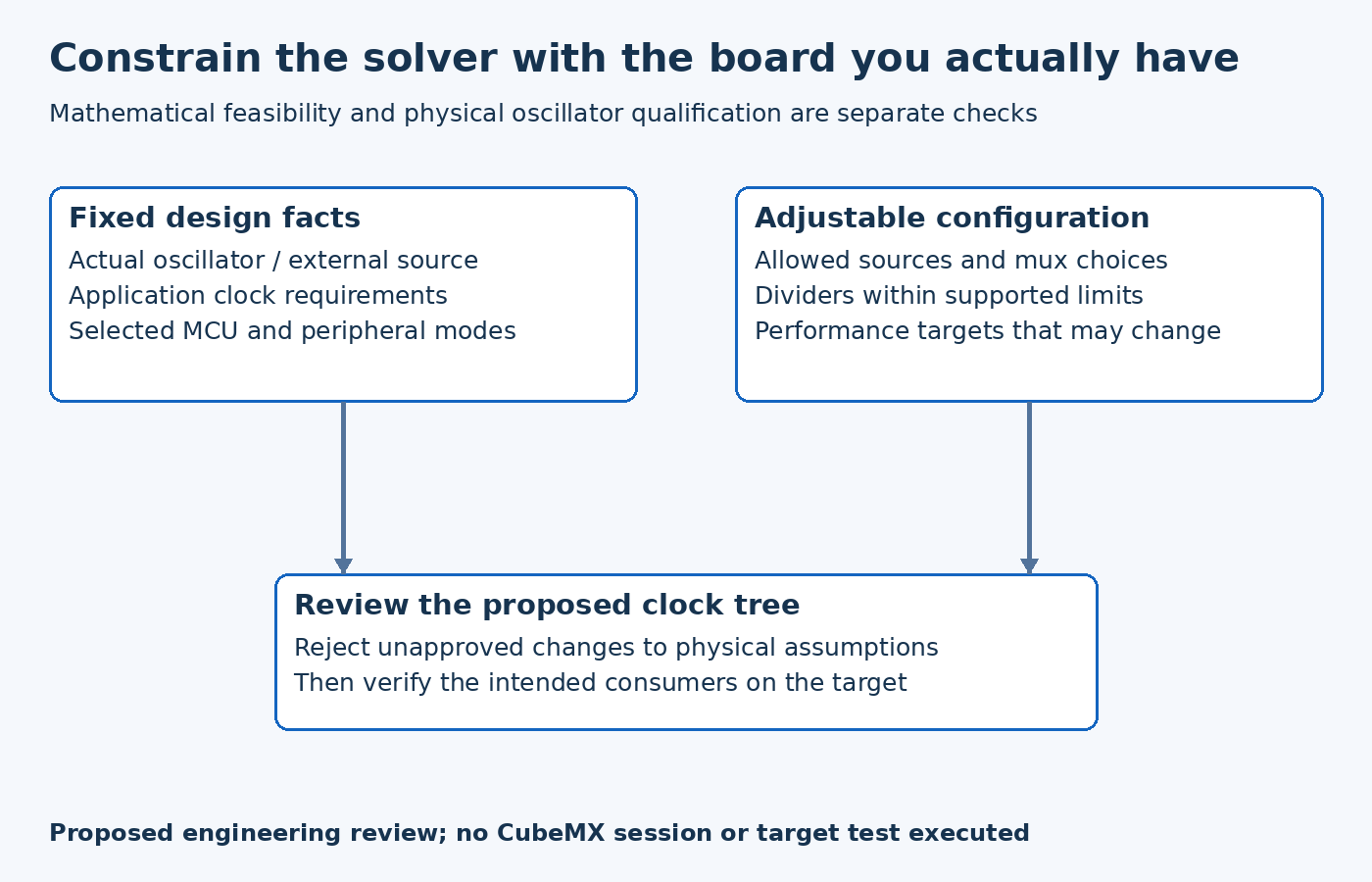
Separate physical facts from adjustable choices
Write down the board's available sources before solving the tree. Distinguish a fitted crystal from an externally supplied clock and from an internal oscillator option. Record the intended frequency from the actual design, rather than selecting a convenient number simply because it makes a divider chain work.
Then identify the application clocks that are contractual requirements and those that may change. A maximum CPU speed can be negotiable; a peripheral clock needed for a particular interface may not be. This distinction gives the solver a meaningful problem rather than asking it to maximize one number while leaving the rest implicit.
The CubeMX clock-tree section describes frequency locks, source selection and automatic constraint resolution. Its resolution sequence can optionally adjust source frequencies, other frequencies and multiplexer choices before iterating divider settings. Inspect the resulting tree, not only whether its error highlighting disappeared.
Investigate an unavailable path before forcing a frequency
Some clock choices depend on enabling the corresponding source or peripheral in the configuration views. The same manual explains that external sources become available through RCC configuration and peripheral clock paths depend on peripheral setup. A grayed path can therefore represent a configuration prerequisite rather than proof that the silicon lacks the feature.
Check the selected MCU and intended peripheral mode, then revisit the clock view. Avoid solving against a temporary peripheral selection and later assuming that changing its mode leaves every clock choice valid. The tool's linked configuration views deserve a coordinated review.
For a hypothetical board, suppose the first candidate reaches the requested CPU frequency but changes a fixed external input. Reject that candidate for the existing hardware, or explicitly treat it as a proposal for a different oscillator design. Do not silently carry the new input value into generated firmware while leaving the physical source unchanged.
Keep oscillator qualification separate
ST's AN2867 oscillator-design guide, Rev 24, February 2026, addresses crystal selection, external components and PCB implementation. Those physical design questions are not answered by arithmetic in a clock-tree editor.
Use the device's applicable electrical limits and the oscillator design's qualified operating conditions when accepting a source. A configured nominal frequency alone does not demonstrate startup reliability or performance across the product's operating range. If the source fails to start on a board, separate that investigation from whether a PLL ratio is mathematically legal.
Verify the clocks the application consumes
After reviewing the generated configuration, plan target checks for the consumers that motivated the constraints. Observe a suitable supported clock output or peripheral behavior using the measurement method appropriate to the board. Check the relevant timer or communication timing rather than inferring every downstream clock from a single CPU-frequency report.
State the tested operating mode. A startup measurement does not automatically qualify later clock changes or low-power wake-up behavior. Those transitions need their own design and tests when the product uses them; they are not demonstrated by this configuration review.
Accept the clock solution when the source assumptions match the board, fixed application requirements remain satisfied and the intended target checks pass. The configuration tool is most effective when its adjustable parameters remain visibly separate from the hardware facts it cannot change.