Linux Serial Read Timeouts: VTIME Does Not Always Bound the First Byte
Setting VTIME does not always impose a deadline on a Linux serial read’s first byte. When both VMIN and VTIME are nonzero in noncanonical mode, the timer starts after initial input becomes available. A silent instrument can therefore leave that read waiting much longer than the timeout number suggests.
This guide uses the Linux man-pages 6.18 termios(3) page dated 2026-02-08. Its embedded-gateway examples assume a blocking descriptor, noncanonical input and no bytes already queued. Timelines are illustrative API behavior, not UART measurements or exact scheduling predictions.
Classify the selected case first
The noncanonical-mode reference defines four combinations. VTIME is measured in tenths of a second, not milliseconds. Read back the effective terminal configuration and separately inspect descriptor flags before applying this matrix.
| Settings | Completion behavior relevant to this review |
|---|---|
VMIN=0, VTIME=0 |
Return available bytes immediately; zero if none are available. |
VMIN>0, VTIME=0 |
Wait for the minimum-byte condition, subject to the requested read size and errors. |
VMIN=0, VTIME>0 |
Start the timer at the read call; return when input is available or the timer expires. |
VMIN>0, VTIME>0 |
Wait for initial input, then use a restarting interbyte timer. |
For the last case, Linux also completes when the requested byte count has been received, even if that count is below VMIN; the manual identifies this as a portability difference. Do not write a cross-platform test that assumes every implementation handles that smaller request identically.
Trace the missing first-byte deadline
Take VMIN=4, VTIME=2 and a read request large enough for four bytes. The timer interval is 2 * 0.1 = 0.2 seconds. If the peer sends nothing, that interval does not begin merely because the application called read().
In an idealized trace, let the first byte arrive one second after the call and the second arrive 100 milliseconds later. With no further input, the interbyte timer expires roughly 200 milliseconds after that second byte. The read can return those two bytes, fewer than the requested minimum, after about 1.3 seconds in this illustrative schedule.
The important result is not the exact return timestamp. It is that the initial one-second wait was outside the interbyte timer, and the second byte restarted that timer. Scheduler delays and driver buffering can alter observed timing on a real product.
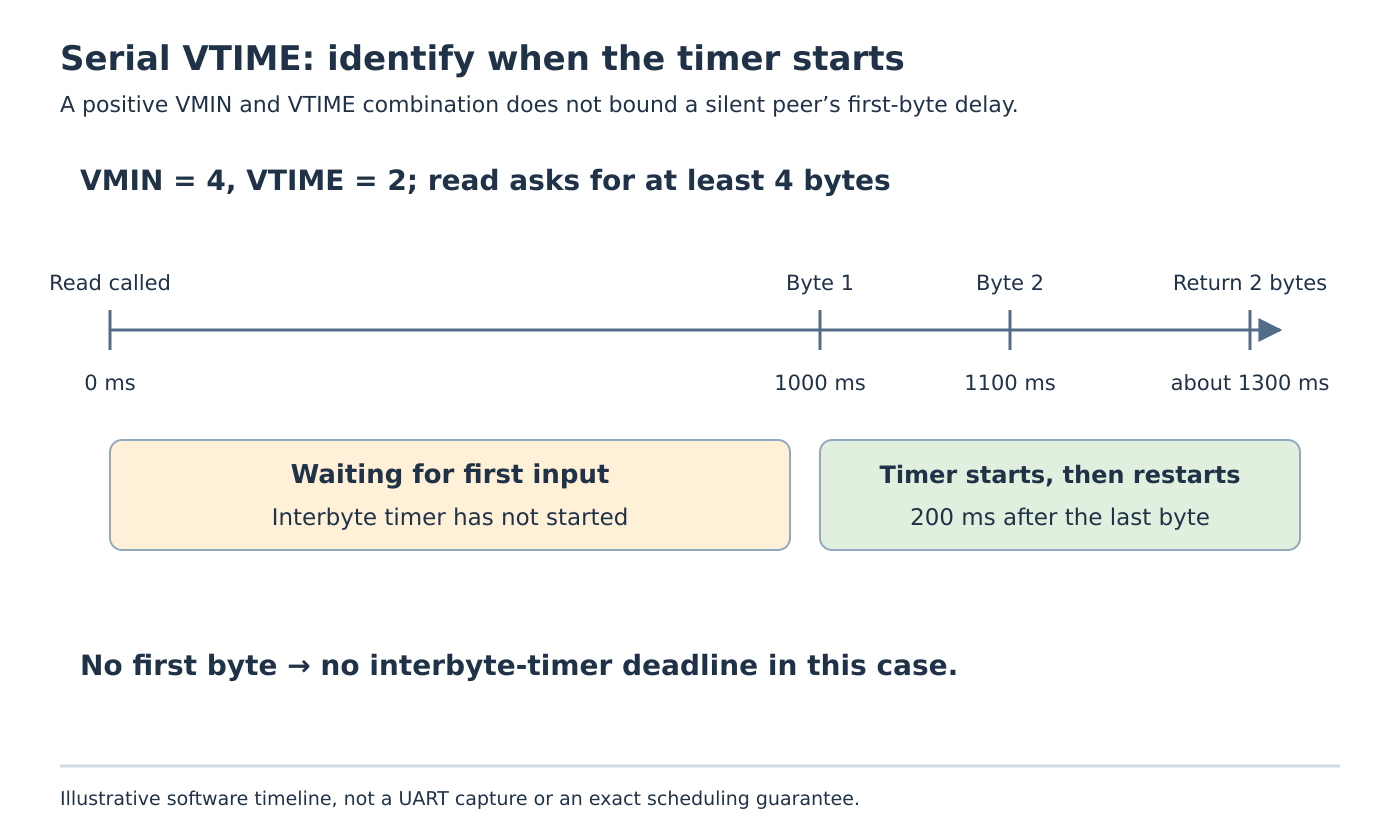
Original hypothetical blocking-read timeline. The timeout governs the gap after input begins, not total request duration.
Contrast a timer that begins with the call
For a separate fixture using VMIN=0 and VTIME=2, a read with no available input starts its timer immediately and can return zero on expiry. If input arrives before expiry, it can return without waiting to accumulate four bytes.
That zero result is a defined no-input timeout in this configuration; it should not automatically be classified as permanent end-of-file. Conversely, positive partial data are real bytes that need explicit parser ownership. Discarding every short result can lose a response that ordinary delivery split across calls.
An application transaction deadline is another policy. If the gateway must abandon a request after a fixed total interval, design a monotonic deadline and an I/O strategy that can enforce it. Checking the clock only after a read that can wait indefinitely for its first byte does not enforce the intended deadline.
Keep nonblocking mode explicit
O_NONBLOCK changes the assumptions. POSIX does not define whether it takes precedence over the minimum and timer settings; a noncanonical read may return immediately, and no-data behavior may be zero or an EAGAIN error. Do not mix observations from a nonblocking event loop with expectations from this blocking fixture.
Also keep serial character processing separate from timing. Baud rate, parity, flow control and input transformations need their own verified configuration. Fixing VMIN does not establish that binary data reach the parser unchanged.
Qualify software timing and wire framing separately
A proposed pseudo-terminal test can exercise silence, delayed first input, two-byte partial input and four-byte completion under the chosen settings. Record effective flags, read size, delivered byte count and monotonic timestamps. Such a test addresses the software read contract; it does not reproduce UART parity errors or prove Modbus RTU wire-gap compliance.
On the embedded target, repeat with the actual adapter and driver, retaining incomplete parser state under a bounded policy. Accept the design when first-byte waiting, interbyte completion and total transaction expiry are separately understood. A timeout field containing the desired-looking number is not sufficient evidence.