Embedded Linux and Qt HMI Development | Obeita
Delivered project. The completed hardware and software met the customer’s agreed requirements in testing. Specifications for a new project must be agreed separately.
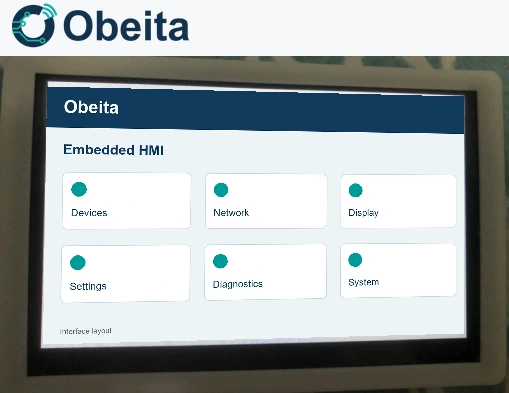
Obeita completed an embedded Linux and Qt HMI project based on an Allwinner V3S core board and a separate peripheral carrier. Customer requirements, contract confirmation, hardware and software design, physical testing and delivery formed one project scope for the operator terminal.
A compact HMI with a defined software budget
The project’s technical focus was combining a touch interface and local peripherals within the V3S platform’s integrated 64 MB DDR2 budget. Obeita developed the agreed HMI hardware and software together. The documented architecture uses a 5-inch 800 × 480 capacitive-touch display, with Linux and Qt providing the application path for equipment status, settings and service interaction.
Core-board and carrier responsibilities
The four-layer core board groups V3S, clock/reset circuitry and the EA3036 power stage; the two-layer carrier holds the product peripherals. EA3036 provides 1.2 V, 1.8 V and 3.3 V rails in the documented design. Their Mini PCIe-shaped connection carries board-to-board signals with a project-specific pin assignment. Its mechanical shape must not be read as standard PCIe compatibility. Before attaching anything to this reused connector, check every pin’s function and voltage against the actual core and carrier revisions.
Display integration links the RGB666 interface’s 18 colour data lines and additional timing/control signals with panel timing and voltage, the PT4103 backlight driver, touch input and one-button power circuit. This division of functions gives the hardware and software work a clear boundary: the connector wiring, panel configuration and driver behavior must describe the same terminal.
Linux, Qt and the peripheral map
The documented software stack spans U-Boot, Linux configuration, device-tree/drivers, the root filesystem and Qt 5. The peripheral map includes RTL8723BS with SDIO for Wi-Fi and UART for Bluetooth, a DS3231 RTC, SHT30 and MPU6050 sensors, and microphone/headphone/speaker audio. Application design needs to account for the available memory and the chosen graphics and input paths.
An optional W25N01GV NAND position remains a storage alternative in the public material. Population, boot support and recovery require agreement for a specific build; the footprint alone does not confirm flash boot. Similarly, screen artwork illustrates an interface direction and is separate from runtime evidence.
Documented architecture and configuration
This table records the project’s documented architecture and selection boundaries. Options, variants and design inputs remain qualified as shown; their inclusion here is not an independent guarantee that every option formed part of the delivered configuration.
| Item | Configuration |
|---|---|
| Processor / RAM | Allwinner V3S; integrated 64 MB DDR2 |
| Display | 5-inch 800 × 480; capacitive touch; RGB666 |
| Software | U-Boot + Linux + rootfs + Qt 5 |
| Board sizes | Core 30 × 50 mm; carrier 76 × 100 mm |
| Peripherals | RTL8723BS, DS3231, SHT30, MPU6050 |
| Audio / power | Microphone, headphone, 8002B amplifier; one-button power |
Delivery and physical-test outcome
The agreed Linux/Qt HMI hardware and software implementation was delivered to the customer. Obeita completed physical testing, and the tested functions met the customer’s requirements. This case does not publish a boot-time or touch-latency result, claim every peripheral was exercised concurrently, or establish support for every optional storage path.
For a similar HMI, review application memory, panel timing, touch behavior, audio switching and recovery requirements alongside the enclosure. FPC routing, radio-antenna clearance and access to connectors influence how the terminal can be assembled and maintained. Before enclosure assembly in a new project, check panel timing, backlight current and touch interrupts together, and keep PCB copper clear of the radio antenna region.
Plan a similar Linux/Qt HMI
Share your operator screens, display details, required peripherals and startup expectations with Obeita. These inputs define the core/carrier adaptation, Linux software and physical-test scope for a new terminal.