A Production Fixture Changes: Decide Which Earlier Unit Passes Need Retesting
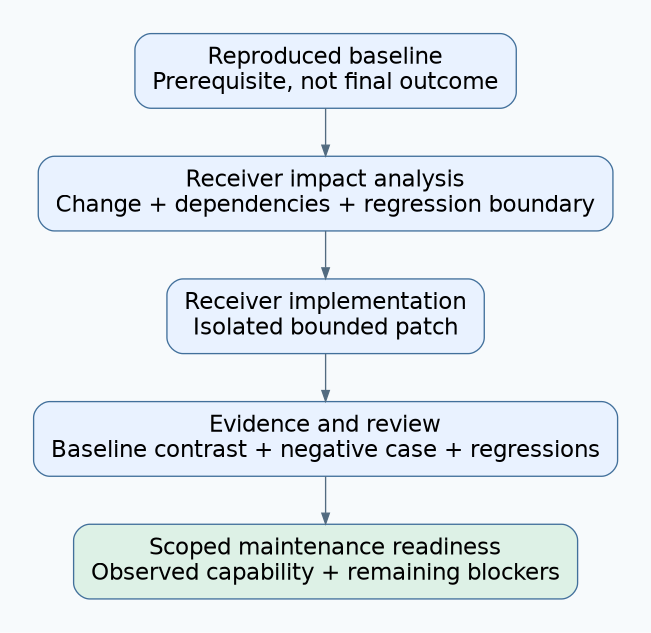
A fixture change does not automatically invalidate every earlier pass, but neither does a new successful station check validate all old results. Select earlier unit results by the measurement path, fixture/calibration revision and exposure interval that the change could affect. Hold records with insufficient scope evidence instead of treating missing metadata as proof that they are unaffected.
This article develops an original retrospective impact procedure using NASA SP-2016-6105 Rev2 and NIST measurement-process guidance. A Python 3.12.14 model exercised synthetic result selection and history preservation. No factory record was changed, physical unit retested or production release decision executed.
Describe the change as an evidence problem
Start with the observed defect or approved modification: a replaced probe block, changed gain coefficient, repaired relay path or corrected test algorithm. Identify which reported measurements depend on it. A fixture revision label is useful only when its changed functions are known.
Separate two situations. A planned improvement can require prospective qualification without proving an earlier defect. Discovery of an incorrect measurement path can make earlier acceptance evidence suspect. Write the reason for retrospective review rather than assuming that every change has the same consequence.
The NASA handbook’s configuration-management and verification guidance supports retaining configuration history, change dispositions and the equipment/software context of verification. The per-unit selection logic below is an engineering adaptation, not a NASA-prescribed manufacturing release rule.
Establish the affected path and exposure window
Build a dependency map from each test result to the fixture route, instrument range, calibration record and interpretation algorithm it used. A shared instrument does not necessarily mean every channel or range was affected; conversely, a shared coefficient can affect results from more than one fixture.
Find the last trustworthy evidence that the old path met its requirements and the first trustworthy evidence after repair or correction. Use installation logs, qualified check-unit history, controlled configuration records and preserved raw data. Do not substitute the time the problem was noticed for the time it could have begun.
If onset is uncertain, broaden the candidate interval or preserve an explicit unknown interval for review. A convenient shift boundary is not a technical justification. Likewise, “after the repair” should mean after the corrected path was qualified, not merely after a part was installed.
NIST’s gauge-study discussion warns that a study’s uncertainty estimate may cease to represent a process whose characteristics change over time. That supports rechecking applicability; it does not supply a universal retest population or a fixed lookback duration.
Join the scope to individual historical results
| Required association | Question for the impact review |
|---|---|
| Unit and immutable result identity | Which specific earlier acceptance observation is under review? |
| Measurement path and requirement | Could the changed component influence this test’s decision? |
| Station, fixture and calibration revisions | Did the result use an affected configuration? |
| Trustworthy sequence/time context | Was it produced inside the possible exposure interval? |
| Raw observation and decision-rule revision | Can the result be reassessed, or is a new physical observation needed? |
Use the configuration actually active during the run, not the station’s current settings. Reconstruct a missing association only from trustworthy retained evidence and label the reconstruction. An operator’s recollection or an editable filename is not equivalent to a bound run record.
Return three separate outcomes: candidate for retest/reassessment, demonstrably unaffected by this change, or scope unknown and held. “Unaffected by this change” does not mean that every other release requirement has passed.
Read the executed synthetic selection example
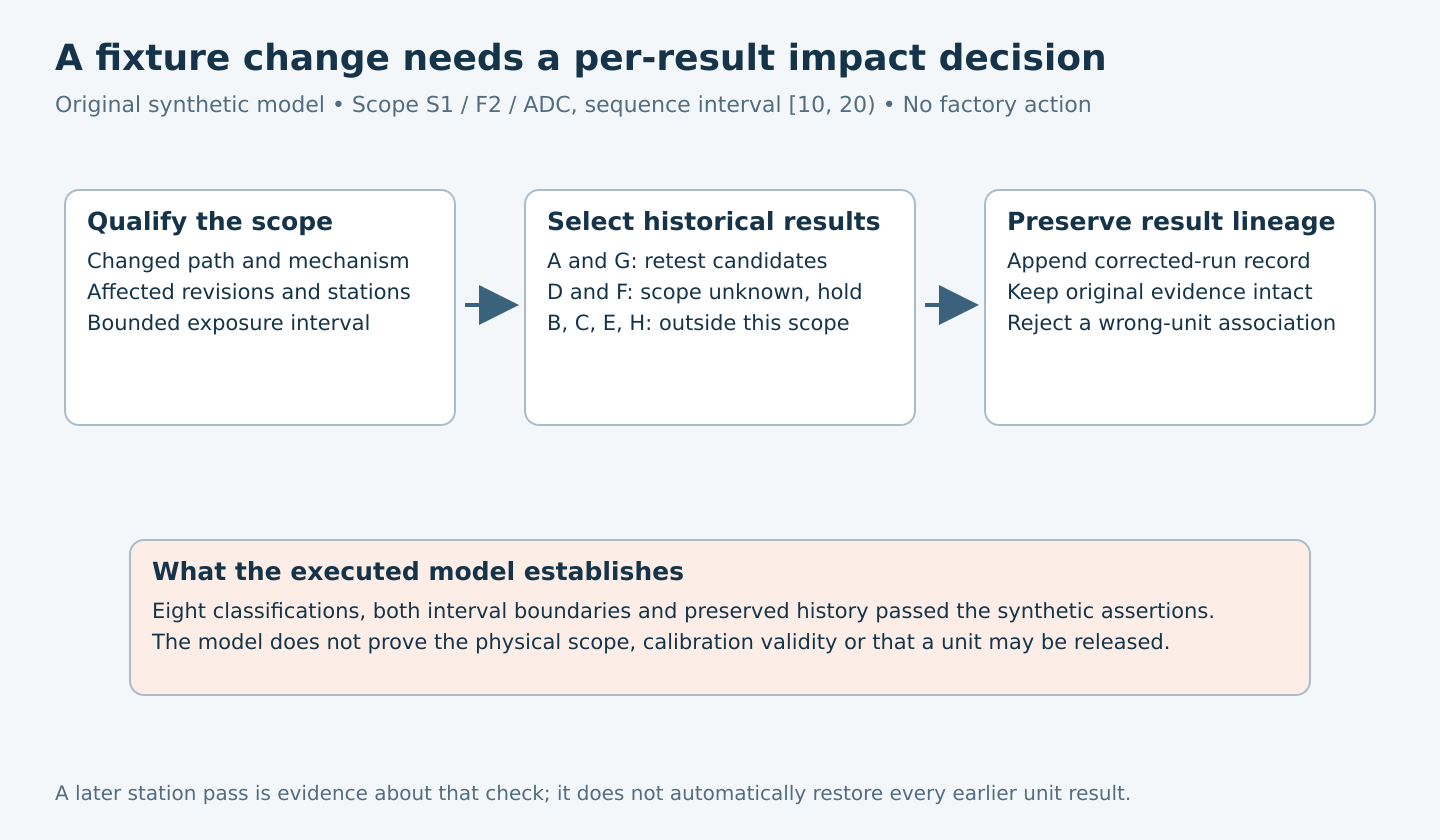
The model received an already-approved hypothetical scope: station S1, fixture F2, ADC path and sequence interval [10, 20). These sequence labels are synthetic ordering data, not timestamps from a real production line. The model did not establish whether that scope was physically correct.
| Synthetic unit | Relevant history | Model decision |
|---|---|---|
| A | S1/F2, ADC, sequence 12 | Retest candidate. |
| B | Same station/revision/time, GPIO path | Unaffected by this scoped ADC change. |
| C | Station S2, ADC, sequence 12 | Unaffected by the station-specific scope. |
| D and F | Missing fixture revision or sequence | Hold: exposure cannot be excluded. |
| E | S1/F2, ADC, sequence 9 | Outside the supplied interval. |
| G and H | Sequences 10 and 20 | G included; H excluded by the explicit half-open interval. |
All eight expected classifications passed. The boundary controls matter: an inclusive-versus-exclusive mismatch can omit the first affected result or include a result already produced under the qualified state. Real clock and installation-order uncertainty must be handled before assigning comparable boundaries.
Choose reassessment or physical retest deliberately
If a parser correction changes only interpretation and complete raw observations remain valid, an approved offline reassessment may be possible. First qualify the old/new parser’s semantic differences against an independent expected result. Agreement between two parsers is not itself that qualification.
If the fixture applied the wrong stimulus, missed a contact or measured through an invalid path, recalculating stored numbers may not recover the missing physical evidence. The responsible engineer must specify the required new test and whether the unit’s present state still represents the earlier condition.
Keep that decision separate from prioritization. A unit being difficult to retrieve does not make its evidence valid. The product owner must disposition inaccessible units and any residual risk through the applicable process.
Append the new result without erasing the old one
Assign a new result identity to a reassessment or retest. Link it to the original result, change record, unit identity and corrected station configuration. Preserve the original raw observation and original pass decision as historical facts, alongside the later validity disposition.
The host model appended a synthetic A retest record under F3, retained all original records byte-for-byte under its canonical serialization and rejected an attempted link to unit B. This tests record association only; the synthetic new pass is not a physical retest result.
Close the change with a reconciled population
Report counts and identities for affected, unaffected and unresolved records, with the justification for each exclusion. Reconcile selected units against completed retests, reassessments and approved dispositions so no unknown case disappears from the report.
The deliverable is a reviewable impact map and preserved result lineage. Its strength depends on the scope evidence supplied to it. A correct database query cannot rescue an unjustified exposure window or an unqualified replacement fixture.