Power-Cycle Test Campaigns: Verify the Power Actually Reached the Required Off State
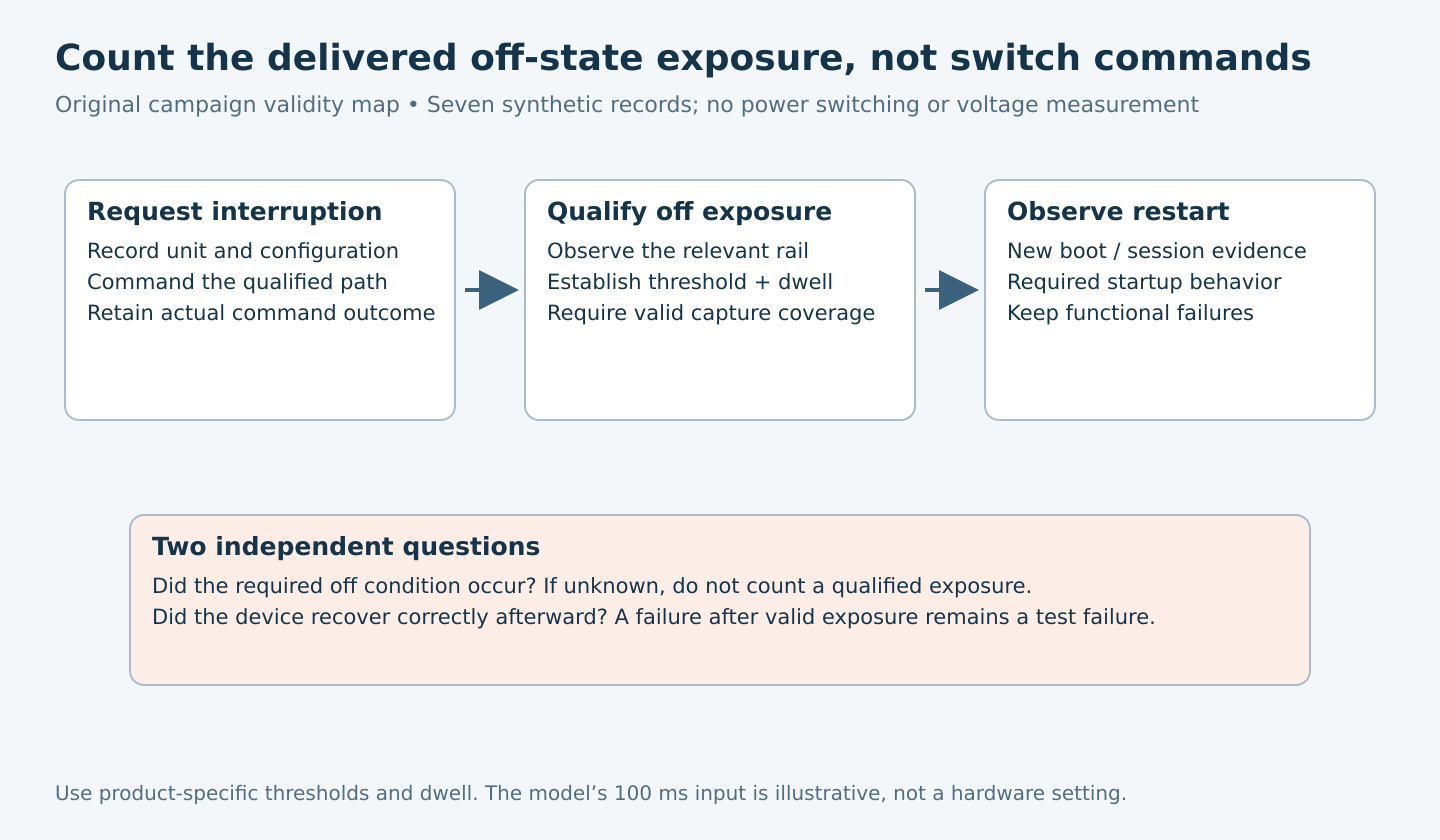
Count a power-cycle exposure only after evidence shows that the relevant device rails reached the required off state for the required interval. A relay command, a dark LED or a new console banner is insufficient by itself. Keep invalid exposures separate from functional failures after a valid cycle.
This is an original campaign-validity procedure informed by NASA SP-2016-6105 Rev2. Seven synthetic record controls ran on CPython 3.12.14. No supply was switched, rail measured or device reset. Actual voltage, duration, sequencing and safety limits must come from the specific product and component requirements.
Define what off means for this experiment
Identify the behavior being qualified: cold initialization, restart after complete supply removal, recovery from a short interruption or another defined power transition. These are different exposures and should not share an undefined “power cycle” label.
Draw the relevant power domains and all connected sources, including batteries, debug interfaces, communication cables and externally driven signals. The measurement boundary must cover the domain whose state the requirement depends on. Removing the main input does not establish that every internal domain lost power.
Use the actual component and board specifications to define the off-state criterion, minimum dwell, transition conditions and restart sequence. Do not copy a delay from another board or assume that a reset threshold is identical to a complete state-retention boundary.
Measure the rail that establishes the exposure
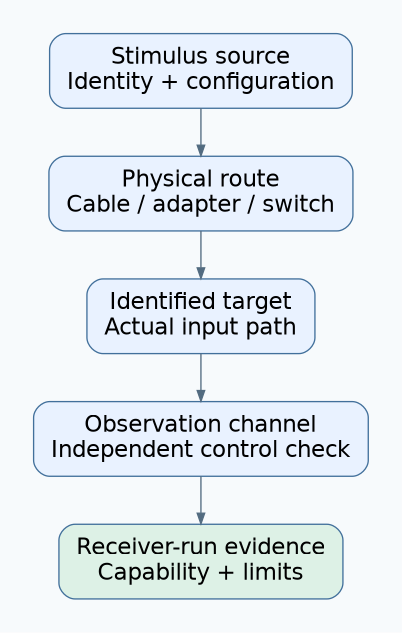
Select an observation point electrically representative of the required domain. Record the instrument range, input characteristics, sampling or triggering method, bandwidth and relevant uncertainty. The setup must be able to resolve the threshold and interval used in the decision.
A front-panel supply reading can describe the supply output while a downstream capacitor or another path keeps the device energized. Conversely, a probe at an irrelevant rail can fall to zero while the domain under test remains active.
Qualify the observation method with safe, approved bench procedures. A disconnected measurement lead can resemble a low voltage, so include a valid powered-state observation and an appropriate channel/path check. Do not create shorts or bypass protective circuitry to accelerate discharge.
Start dwell at the qualified state transition
The off dwell begins when the observed domain satisfies its off criterion, not when the runner sends the supply command. Retain the command time as context and the actual threshold-crossing evidence as the exposure boundary.
Account for uncertainty and observation gaps. A few low samples do not prove that the rail stayed below the limit between samples unless the qualified acquisition method supports that inference. If the interval cannot be established, mark the cycle’s exposure invalid or unknown.
Use a predeclared maximum wait for the domain to reach the required state. If it never does, stop and investigate rather than extending a campaign that is not delivering its intended stress. A workaround that changes the discharge path changes the test configuration and needs review.
Record one complete cycle as a state sequence
| Phase | Required evidence | Example invalid condition |
|---|---|---|
| Before interruption | Unit identity, configuration and known starting state. | Unknown prior recovery or wrong device. |
| Power removal requested | Command outcome and controlled path. | Switch command failed or target path uncertain. |
| Off state qualified | Relevant rail criterion and observation validity. | Residual power or missing measurement. |
| Off dwell complete | Required continuous interval established by the method. | Insufficient dwell or unbounded capture gap. |
| Restart observed | New boot/session evidence and intended startup path. | Old buffered banner or unchanged session. |
| Function checked | Requirement-specific behavior after the valid exposure. | Functional failure, retained as a real test result. |
The NASA verification guidance calls for configuration, conditions, criteria and results. The cycle ledger makes the delivered condition explicit rather than treating the runner’s loop count as that evidence.
Separate valid exposure from successful recovery
A device can experience a valid off interval and then fail its startup requirement. That is a qualified exposure with a functional failure, not an invalid test to remove from the denominator.
Conversely, a device can resume normal behavior after an interruption that never reached the specified off state. That observation may be useful for another requirement, but it cannot satisfy this campaign’s cold-start exposure.
Maintain counts for requested cycles, qualified exposures, invalid observations, incomplete off intervals and post-exposure functional outcomes. Preserve the order and first failure. Do not report a target cycle count as achieved merely because the command loop iterated that many times.
Executed synthetic admission controls
The host model used a hypothetical required off dwell of 100 milliseconds, solely to exercise a boundary. It received supplied flags for off-state qualification and observation coverage; it did not calculate them from voltage samples.
A record with qualified off state, complete coverage, exactly 100 milliseconds, a new boot identity and successful function was admitted. Ninety-nine milliseconds, missing duration, missing coverage and an unqualified off state did not qualify the exposure. An unchanged boot identity retained the independently qualified off exposure but reported restart not established; it still counts in the qualified-exposure denominator.
A seventh case retained the qualified exposure while reporting functional failure. All expected classifications passed. The 100-millisecond input is not a recommended hardware setting, and model acceptance does not establish that a physical rail met any voltage requirement.
Stop when the campaign loses its meaning
Stop or quarantine the setup after unexplained residual power, lost observation, unexpected heating, abnormal current or a switching-path fault. Follow the equipment’s approved safety and restoration procedures. High-energy systems require qualified personnel and protections beyond this article.
After changing a cable, fixture, supply configuration or discharge arrangement, requalify the relevant observation and exposure path. Preserve earlier records under their original configuration rather than silently treating all cycles as equivalent.
The final result should state the exact exposure definition, valid cycle count, functional outcomes and unresolved gaps. That makes a power-cycle campaign evidence of delivered physical conditions instead of a count of successful automation commands.