Handover of a Hardware Test Bench: Prove the Receiver Can Recreate the Stimulus, Not Only Run the Script
Transfer a test bench by having the receiver recreate and independently check the stimulus and observation paths before running the product test. A script that exits successfully can still operate the wrong relay, read the wrong serial port or observe a simulated source instead of the intended hardware input.
This article proposes a bench-transfer exercise for authorized engineering equipment. It supplies no electrical connection values, pinout or live-device commands. Use actual schematics, instrument manuals, rated interfaces and approved safety procedures. All examples are hypothetical; no bench was connected or exercised.
1. Define the capability being transferred
Name the product requirement the bench supports and the physical quantity or event it must generate. Identify where that stimulus enters the target and where the result is measured. Include the permissible operating conditions and relevant uncertainty or timing limitations.
NASA’s verification-preparation guidance, section 5.3.1.2.1, includes the measurement environment and equipment. A receiver-run capability check turns that preparation into an observable handover outcome.
Keep the bench’s own qualification distinct from the product verdict. If the stimulus path is unverified, a product failure may be inconclusive and a product pass may be misleading.
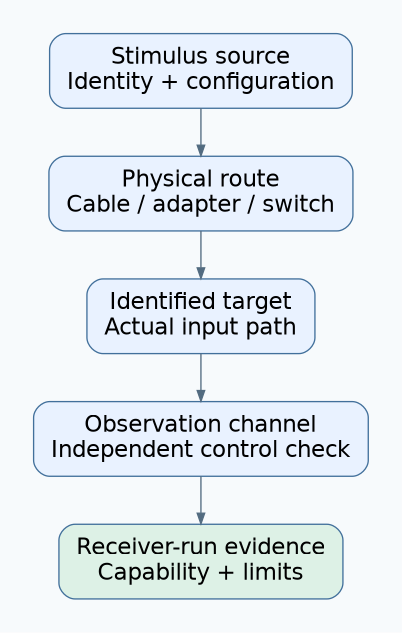
2. Deliver a physical and logical routing map
| Bench element | Required handover detail | Receiver check |
|---|---|---|
| Stimulus source | Instrument identity, mode and saved configuration | Observe the intended output with the approved method |
| Routing | Cable, adapter and switch path references | Confirm actual endpoint and selected channel |
| Target | Unit, board, firmware and configuration identities | Read applicable identities from the designated unit |
| Observation channel | Probe/interface, scale, acquisition and trigger settings | Confirm it responds to the intended event |
| Automation mapping | Logical resource names and binding configuration | Trace each name to the physical equipment |
Use controlled drawings and photographs where permitted, but do not rely on a photo alone to prove internal routing or instrument state. Record undocumented adapters as a gap, not as harmless accessories.
3. Distinguish access from physical correctness
In labgrid 25.0.1’s architecture, resources describe access information and drivers implement actions. Managed resources can appear, disappear or change properties. That abstraction supports automation but cannot by itself prove that a cable reaches the correct target pin.
Apply the same caution to any automation framework. A logical name such as “input_source” may remain constant while an instrument or cable changes. Confirm the mapping after transport, replacement or reconfiguration.
Preserve the automation revision and resolved configuration used in the transfer exercise. A current repository branch is not enough to identify which bindings the receiver actually used.
4. Check instrument state explicitly
Restore or review relevant output mode, range, termination, coupling, bandwidth, trigger, sample rate and channel selection as applicable to the real equipment. Do not prescribe universal settings; the product requirement and instrument documentation determine them.
Identify calibration or verification records required by the measurement plan. A factory reset may remove important settings and is not an automatic readiness step. Similarly, a saved setup file can restore unsuitable values if it belongs to another fixture revision.
Confirm that the stimulus and observer share the intended timing references where the result depends on elapsed time. Host timestamps from separate systems should not be assumed synchronized merely because both display wall-clock time.
5. Use independent positive and negative controls
Choose a harmless positive control that demonstrates the intended stimulus reaches the intended observation path. Where safe and approved, add a negative control that proves the bench can detect a missing or deliberately different stimulus.
The negative control should fail for the expected reason. A test that still passes when its essential stimulus is absent may be reading cached data, the wrong channel or an overly permissive assertion.
Do not disconnect energized or hazardous circuits to create a failure. Use an approved simulation point, isolated test load or other safe method appropriate to the equipment. The transfer record should state which path the control actually covers.
6. Run a fictional channel-transfer exercise
A fictional bench has two low-risk logical input channels, A and B. The receiver follows the handover package to route a permitted test stimulus to A and observes the designated target indication. The exercise then uses an approved control to show that selecting B does not masquerade as the A result.
This is a conceptual routing test, not a pinout or a claim that arbitrary channels may be interconnected. Actual levels, isolation and loading must be established from the real design.
If the script passes for both selections, retain the evidence and investigate the mapping or assertion. Do not change the expected result to match the bench until the physical and logical discrepancy is understood.
7. Let the receiver operate without hidden assistance
Have the receiver assemble the documented setup, restore the approved state, run controls and explain the observations. The original team may intervene for safety, but every undocumented intervention should become a recorded handover gap.
Record the receiver’s actual setup and the evidence from each control. Classify blockers as documentation, access, equipment, calibration, mapping or procedure issues so the responsible owner can resolve them.
Close the transfer only for the capabilities demonstrated. A successful single-channel exercise does not establish every fixture mode or measurement range. The useful outcome is a reproducible physical test capability with clear limits, rather than a script bundle that only its author knows how to connect.