Archiving an Embedded Product: Keep the Evidence Needed to Interpret Its Final Release
Archive the dependencies needed to understand the final release, then prove that an authorized reader can retrieve and interpret a representative record without relying on the retiring project’s live services. A directory full of intact files may still be unusable if units, schemas, tool versions or links to the governing requirement have disappeared.
This article proposes a technical archive-readiness exercise. It does not prescribe legal retention periods, authorize deletion or replace active update/recovery-artifact policy. All archive examples are synthetic. No service was retired, file deleted or archive restored.
1. Define the future questions the archive must answer
Start with a small list of engineering questions: what configuration was delivered, which requirements were assessed, what limitations remained, how a reported result was obtained and which evidence supports a historical decision.
These questions determine the archive’s dependency map. Preserving every temporary file without a usable index can make retrieval harder while retaining unnecessary sensitive information. Conversely, preserving only the final PDF can remove the data needed to understand a borderline result.
NASA’s technical-data-management discussion, section 6.6, includes lifecycle retirement and access to information written in legacy software. The procedure below focuses on that interpretability problem rather than rebuilding a current product.
2. Map artifacts to the things that make them readable
| Artifact | Interpretation dependencies | Typical hidden failure |
|---|---|---|
| Raw measurements | Units, channel mapping, timestamps, schema and procedure | Numbers survive but their meaning does not |
| Binary trace | Decoder revision, symbols, framing and build identity | Current viewer decodes an older format incorrectly |
| Test verdict | Requirement revision, decision rule and source observations | PASS survives without its scope |
| Design decision | Alternatives, assumptions, rationale and approved disposition | Issue-tracker link points to a retired service |
| Native engineering document | Reader, format version and external references | File opens with missing linked content |
Record dependencies explicitly, including those owned by another team. A URL is an access route, not a retained copy or an assurance of future availability. Respect distribution rights when deciding what can be included.
3. Preserve semantics alongside bytes
Give each record a stable identity and associate it with the relevant product, requirement and procedure versions. For numeric data, retain column meanings, units, scaling, missing-value conventions and time-base descriptions.
If an export changes representation, preserve the original where permitted and document the transformation. A rendered plot can aid review but should not silently replace data required for later analysis. A text export may omit metadata or precision; verify what it preserves before assigning it an archival role.
Record known gaps plainly. “Raw channel calibration unavailable” is more useful than an unexplained archive completeness percentage. Future readers need to know which conclusions remain supported and which cannot be reconstructed.
4. Treat readers and tools as dependencies
Identify the software required to open or interpret each important format, including its version and any necessary plugins. Distinguish a documented format with multiple readers from one depending on an unavailable service or license.
Where policy permits retaining a legacy environment, document its access and execution constraints. Do not connect obsolete software to production networks merely to open an old trace. Use an approved isolated review environment and keep original evidence unchanged.
Retaining a tool does not establish permission to redistribute or execute it. The archive owner must resolve those rights and access questions through the appropriate process; this article does not provide a legal conclusion.
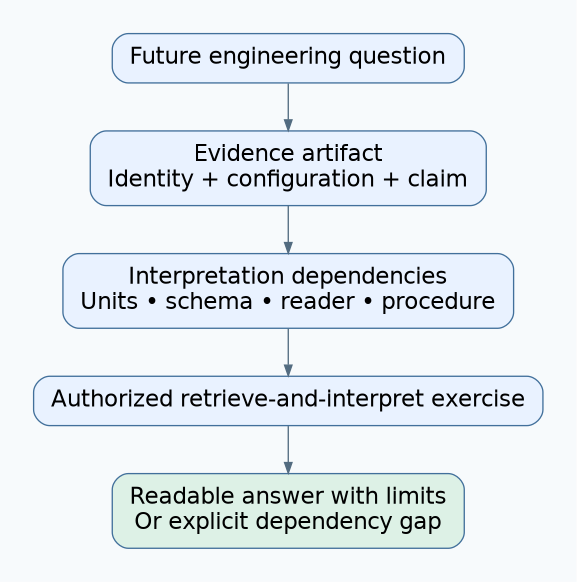
5. Run a restore-and-interpret exercise
- Select a representative engineering question and its expected evidence scope before retrieval.
- Have an authorized reviewer locate the record using the archive index rather than the original author’s memory.
- Retrieve a working copy and check its identity against the controlled manifest.
- Open or decode it using the recorded reader and environment.
- Explain the result’s configuration, units, conditions, decision rule and limitations.
- Record missing dependencies, ambiguities and any unsupported conclusion.
A checksum match supports file identity. The interpretation steps establish whether the retained package still answers the chosen engineering question. Passing one exercise does not prove every file in a large archive is usable; choose coverage according to the archive’s actual risks and formats.
6. Consider a synthetic latency report
A fictional final-release archive contains a plot labeled “response time” and a binary trace. The project dashboard that explained the axes is scheduled for retirement. A receiver can open the plot but cannot tell whether timing started at request submission or physical transmission.
The archive exercise identifies missing semantics before the service disappears. The owner adds the controlled procedure, channel definitions, decoder version and requirement revision, subject to the approved records process. The original plot remains unchanged.
If those definitions cannot be recovered reliably, the archive must retain that limitation. Guessing an axis meaning to make the package appear complete would create false historical evidence.
7. Assign ongoing retrieval ownership
Name who controls the archive index, authorizes access, maintains readable copies and responds when a reader or storage system changes. Define review triggers such as format migration, repository relocation or loss of a required tool.
Keep migration receipts linked to the old representation and verify the important interpretation properties after conversion. A successful bulk copy only establishes that the copy operation finished; it does not validate every document’s links, fonts, numeric precision or decoder behavior.
Conclude with an archive-readiness statement naming the exercised questions, tested retrieval routes, supported formats and unresolved dependencies. This preserves usable engineering history without promising indefinite support, prescribing a retention duration or authorizing disposal of the original records.