Digital Sensor Startup Delays: Wait for Ready Evidence Before the First Measurement
A responding sensor is not necessarily ready to provide a new measurement. Separate supply and reset completion, internal initialization, configuration acceptance, and conversion completion. Publish the first result only when its prerequisites belong to the current startup attempt; otherwise a successful bus read can turn a reset default or retained value into plausible telemetry.
Applicability: the concrete device is Bosch BME280 in forced mode. The official datasheet retrieved on 14 October 2026 has a revision 1.24, February 2024 cover, BST-BME280-DS001-24, but retains revision 1.23/January 2022 interior footers. The register and timing clauses below were checked in that mixed-label PDF. The separate Bosch SensorAPI source identifies itself as v3.5.1 and was inspected on the same date.
1. Define readiness as several gates
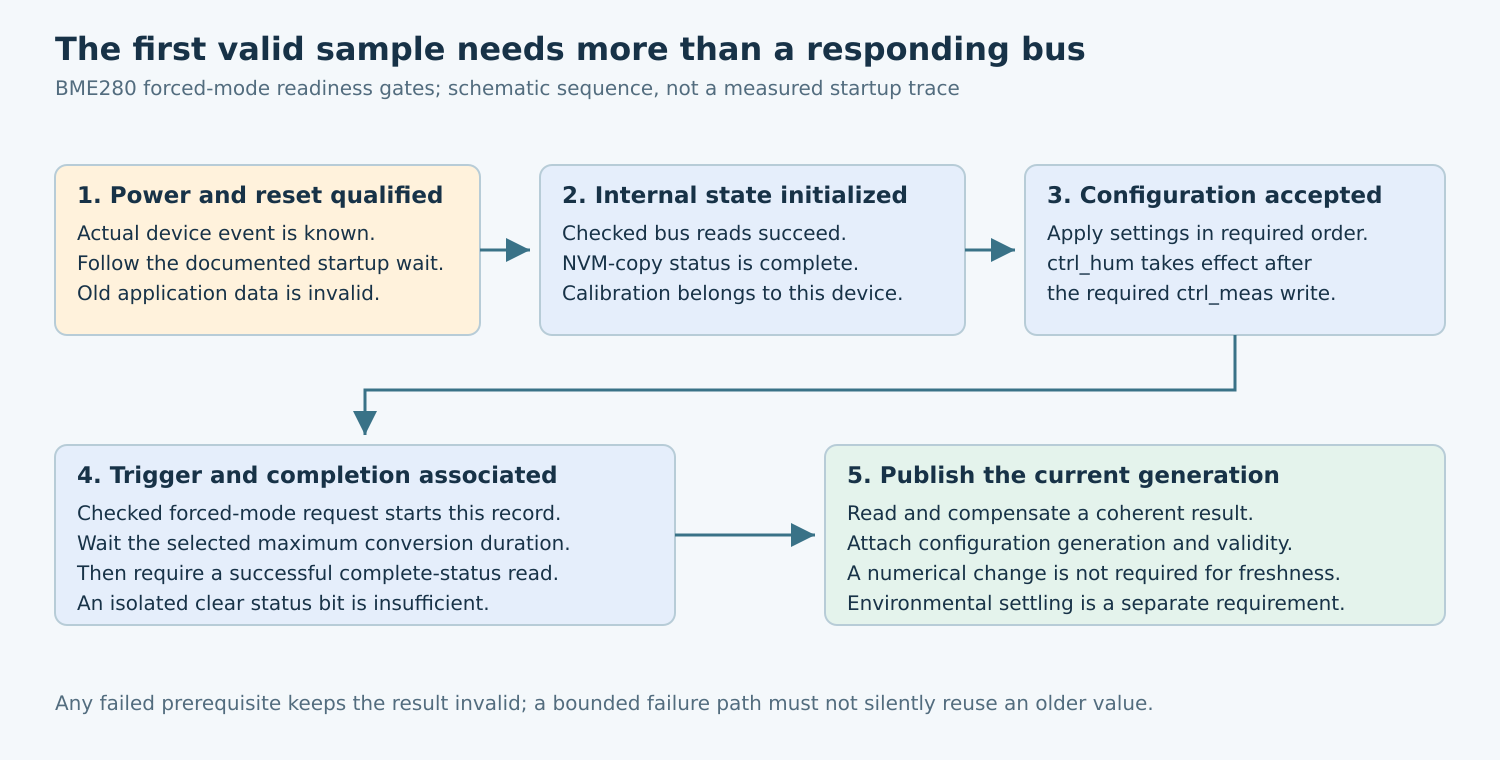
Start a new initialization generation when the sensor loses power, receives a reset, or enters a state that invalidates the previous configuration. Mark application data unavailable immediately. A previously valid temperature does not become the first measurement of the new generation merely because its memory buffer survived.
Use distinct states such as power-qualified, interface-accessible, initialized, configured, converting, and valid. For each transition record its evidence, timeout policy, and failure destination. This makes “sensor startup failed” actionable: an engineer can see whether the problem was a transport error, unfinished internal work, or a conversion that never became eligible for publication.
Anchor the startup interval to the actual device power/reset event, not to application process launch. The hardware may have powered up earlier, or a shared regulator may still be ramping. Verify the selected part’s supply and interface conditions with board evidence before relying on software timing.
2. Finish internal initialization before using calibration
The BME280 register description defines status.im_update as NVM copying in progress. A zero means that copying is finished. Its reset command restarts the power-on-reset procedure. A readable identity register alone does not certify that a measurement has occurred.
Follow the documented startup wait, then read status with checked transport results and a bounded deadline. Never convert a failed register read into a zero status byte. That error handling would make a disconnected device appear immediately ready.
The inspected Bosch SensorAPI implementation checks identity, performs a soft reset, waits and checks NVM-copy status, and reads calibration only after successful initialization. This is useful implementation evidence, not a universal retry count or substitute for the deployed source revision.
Store the calibration data with the current device instance and validate parsing before enabling output. If initialization fails, preserve the first failing stage and raw error. Do not repeatedly reset in a tight loop: that can prevent a healthy device from ever completing its own startup.
3. Apply the intended configuration in an explicit order
The BME280 starts in sleep mode. Changes to ctrl_hum become effective after a write to ctrl_meas. Forced mode performs one measurement and returns to sleep. These ordering rules are specified in the datasheet’s mode and register sections.
Maintain a desired configuration object, including enabled channels, oversampling, and filter settings. Apply it while the sensor is in the appropriate state, preserving unrelated register fields. Check every write result and read back the fields whose documented behavior permits meaningful comparison.
A configuration readback is an acceptance check, not a conversion-completion check. Keep the configuration generation beside the result so a sample cannot be scaled or labeled with settings that were applied afterward. Serialize reconfiguration against acquisition rather than allowing two tasks to race through the startup sequence.
4. Associate completion with the accepted trigger
The datasheet says status.measuring is one during conversion and returns to zero after results reach the data registers. An immediate zero read is ambiguous: it could precede visible activity or follow a conversion too short for the host to observe. Requiring every poller to observe a one would also reject legitimate fast completion.
One conservative procedure is to issue a successfully checked forced-mode request, wait at least the configured maximum measurement duration, then require a successful status read showing completion before fetching results. Use a monotonic timer and include host communication and scheduling allowances in the overall operation deadline. A failed request never starts a valid conversion record.
For an illustrative configuration with temperature, pressure, and humidity oversampling all set to ×1, the maximum-time formula in datasheet section 9.1 gives 1.25 + 2.3 + 2.875 + 2.875 = 9.3 ms. This is a calculated device timing bound under the datasheet conditions, not measured board latency or a universal startup delay. Different settings require recalculation.
Do not confuse the time needed for a conversion with environmental response, thermal stabilization, or an enabled filter’s settling behavior. A newly completed result can still be unsuitable for an application that needs an equilibrated measurement. Define that additional qualification separately.
5. Test the gates with deliberate failure cases
| Proposed case | Required application behavior |
|---|---|
| Identity read succeeds; NVM status never clears | Initialization times out without publishing a result. |
| A configuration write fails | No conversion is labeled with the unconfirmed configuration. |
| First status poll is already clear | The accepted-trigger and elapsed-time rules still determine eligibility. |
| Power interruption occurs during conversion | Invalidate the generation and restart the required gates. |
| Completed result is unchanged numerically | Do not reject freshness solely because the physical value is stable. |
Exercise cold startup, an application restart while the device remains powered, explicit device reset, and the supported resume path. These have different retained-state assumptions. A passing warm restart does not establish cold startup behavior.
Inject software transport failures in a safe fixture before attempting board fault tests. Require every timeout and read failure to leave the public result invalid. Keep fault injection separate from any claim about real power sequencing or electrical limits.
6. Publish a qualified result and its provenance
Fetch the completed result through the device’s documented coherent-read procedure, compensate using the matching calibration, and publish one result object with configuration generation and validity. Keep the last historical value available only if its age and invalid-current-state are explicit to consumers.
No sensor startup or driver execution was performed for this article. The deliverable is a gate-by-gate initialization record: source revision, power/reset evidence, checked configuration, trigger time, completion evidence, deadline outcomes, and first valid publication. That record explains why the result is eligible without pretending that a bus acknowledgement or arbitrary sleep proves readiness.