Kernel Allocation Failures: Decode GFP Context and Allocation Order Before Adding RAM
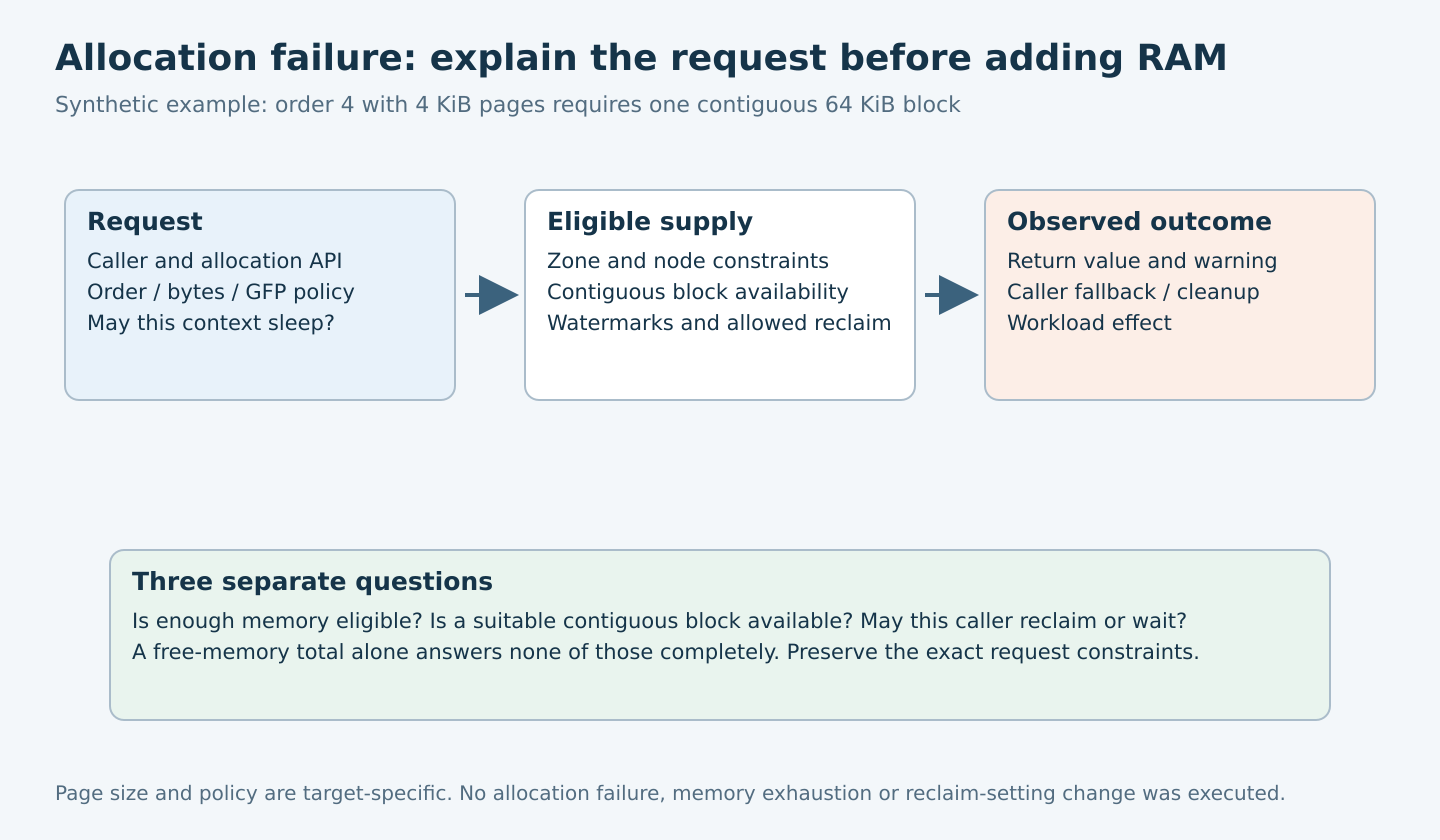
An allocation failure means that a particular request could not be satisfied under its constraints, not simply that the machine had no free RAM. Decode the request’s context, order, eligible memory and reclaim permissions before proposing a capacity increase. Those constraints explain why a small atomic allocation and a large sleepable allocation can fail for different reasons.
This procedure uses upstream Linux v6.12. It diagnoses observed allocation failures rather than injecting failslab errors or classifying an RTOS heap. No kernel allocation was forced to fail, no memory-pressure workload was run and no production memory setting was changed. Example quantities are hypothetical.
Keep the complete request evidence
Preserve the first warning and its surrounding context: allocating task, call trace, requested order, GFP mode, node mask, allowed-memory information and allocator state when available. Identify the caller’s API and requested byte size in matching source. A stack trace often points into an allocator wrapper rather than the design decision that selected the request.
The v6.12 warning path formats the GFP mode and node information, then includes a stack and memory state. It also rate-limits reports and honors __GFP_NOWARN. Absence of a warning is therefore not evidence that every allocation succeeded; check the caller’s return-value handling and relevant failure counters.
Decode symbolic flags against the deployed build’s GFP definitions. Do not paste a hexadecimal mask into an unrelated kernel version’s table and assume identical meaning. Preserve the original numeric value as evidence even when adding a symbolic interpretation.
Translate order into the actual physical request
For a page-allocator request, order n asks for a physically contiguous block of 2 to the power n pages. Multiply by the target’s actual page size to obtain bytes. With hypothetical four-kilobyte pages, order four needs sixteen contiguous pages, or 64 KiB. A target with a different page size has a different byte requirement.
Total free memory can be much larger than that request while no suitable block is immediately available in the eligible region. Fragmentation, migration restrictions, watermarks and concurrency can all matter. A later snapshot of plentiful free memory cannot reconstruct the exact state at the failed allocation.
For slab or kmalloc callers, distinguish the requested object size from a backing-page allocation visible in the warning. Trace the allocator path and cache configuration instead of assuming the printed page order is the application’s object length.
Ask what the calling context permits
| v6.12 allocation policy | Interpretation to verify |
|---|---|
| GFP_KERNEL | Allows direct reclaim; the caller must be allowed to sleep |
| GFP_NOWAIT | No direct reclaim; can wake background reclaim and includes warning suppression in this tag |
| GFP_ATOMIC | No direct reclaim; reserve access is available under its policy, without a success guarantee |
| Additional retry or zone flags | Modify effort or eligibility and must be decoded individually |
The allocation guide explains these policy choices. A non-sleeping caller cannot safely gain reclaim capability merely by replacing its flags with GFP_KERNEL. Move allocation to a suitable earlier context or provide a justified reserve/fallback design when that fits the subsystem.
Conversely, GFP_ATOMIC is not a universal allocation API for every strict execution context. The pinned flag documentation explicitly excludes NMI and certain other strict non-preemptive contexts from current support. Verify the actual API and architecture constraints before treating “atomic” as blanket permission.
Retry modifiers are not interchangeable guarantees. Adding __GFP_NOFAIL can introduce an unbounded wait, and v6.12 documents that buddy allocations with that flag and order greater than one are unsupported. Do not use it as a generic way to silence a failure report.
Identify the eligible memory, not just the total
Record the relevant zone selection, node preferences, nodemask, cpuset constraints and any accounting or subsystem-specific restrictions. Then inspect the actual allocation path’s fallback rules. A preferred node does not necessarily mean a strict single-node requirement, and different flags can change permitted fallback.
The proc filesystem reference describes buddyinfo as counts of free chunks by node, zone and order. A read-only snapshot can support a fragmentation hypothesis, especially when compared with the warning’s state. It is not a reservation or promise that the next request will succeed.
Inspect the relevant order and larger available orders, since a larger free block may be split. Even then, counts alone do not settle watermarks, eligibility or races. pagetypeinfo can add migration-type context when necessary, but avoid collecting an impressive inventory without tying it to the failed request.
Choose a bounded next test
- Reproduce the normal workload on a recoverable test target, preserving the request and configuration.
- Determine whether failure follows request size/order, concurrency, placement constraints or a non-sleeping allocation path.
- Change one justified condition, such as bounded concurrency or earlier preallocation, without weakening unrelated safety constraints.
- Measure both successful operation and the caller’s failure/recovery behavior.
- Keep snapshots time-aligned and state whether the same request constraints were preserved.
If smaller requests succeed while a higher-order request fails, investigate the contiguity requirement and eligible free-block distribution. If failures cluster in a non-sleeping burst, inspect peak demand and reserve ownership. If the underlying error is an invalid size calculation, fix that first; more memory does not repair an overflowing request expression.
Review alternatives against the consumer contract
For storage that requires virtual rather than physical contiguity, vmalloc or an appropriate kvmalloc-family API may avoid a large physically contiguous request. That change is valid only when the caller permits the allocation context, mapping behavior and matching release API. It is not a drop-in replacement for a hardware DMA buffer.
Preallocation can move demand to a safe phase, but it needs a bounded capacity, ownership rules and an exhaustion path. Reducing allocation order may require changing the consumer to handle multiple pieces. Evaluate those changes as designs, not as flag substitutions.
Finally, require allocation failure to produce a defined outcome: reject or defer work, release partial state and avoid exposing uninitialized objects. More RAM may be justified after the constraints and workload are understood, but the evidence should identify why it helps. Deliver the request worksheet and tested recovery behavior, rather than equating one warning with global memory exhaustion.