Page Table Check: Decide Whether Mapping Corruption Needs a Different Debug Kernel
Choose Page Table Check when the hypothesis concerns an illegal userspace page mapping or a checked page-table flag combination, and when the target can run the required diagnostic kernel. It is most useful when a mapping mistake should be caught near the mapping update, before later application activity makes the failure difficult to attribute.
The baseline is upstream Linux v6.12. This is a narrow mapping-consistency checker, not an all-purpose detector for heap overruns, every bad PTE or every hardware memory fault. Most detected mapping corruption can crash the kernel. Use a disposable virtual machine or recoverable bench target; no checker-enabled kernel or invalid-mapping test was executed for this article.
Pass the eligibility gates first
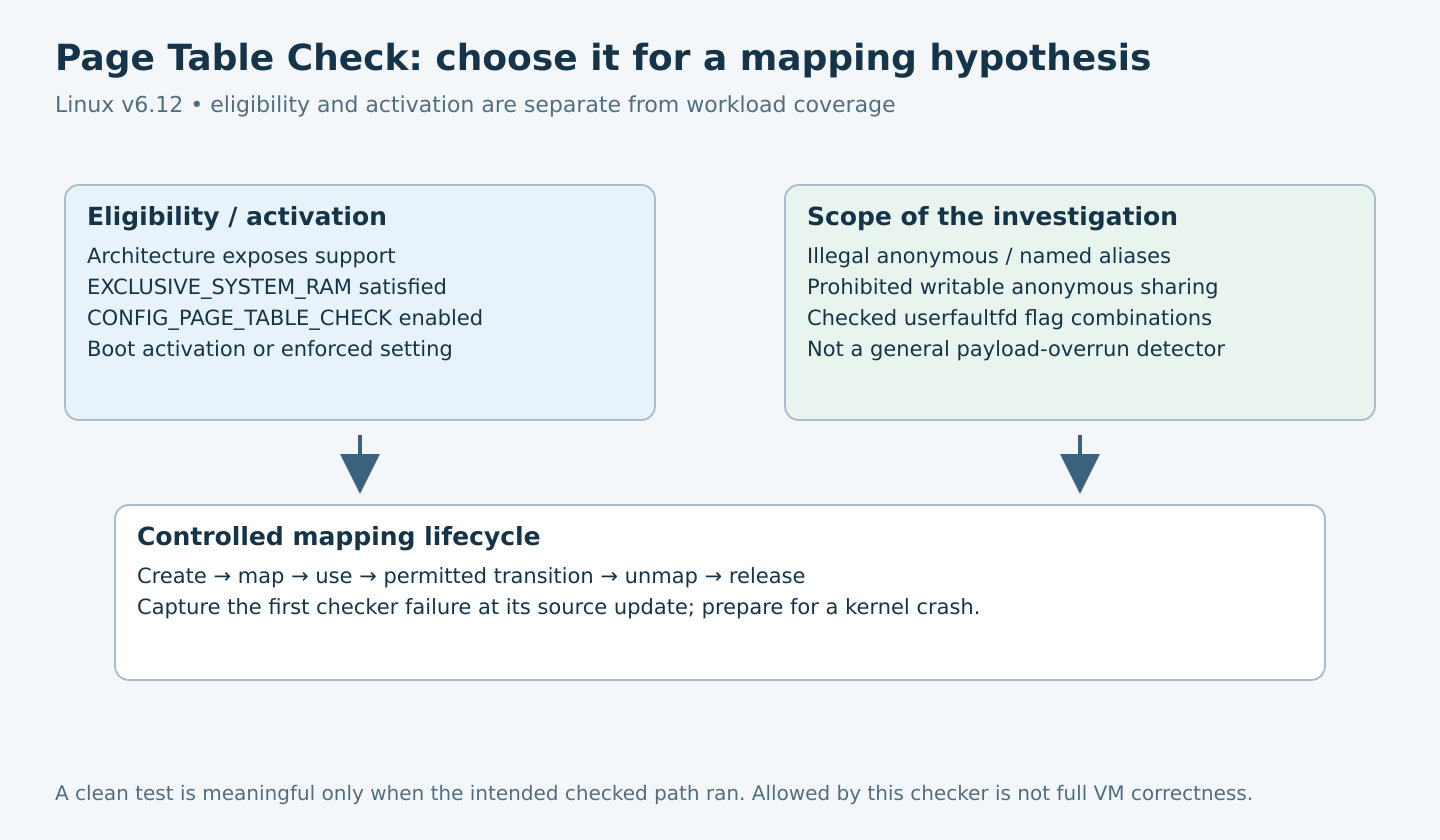
The v6.12 configuration requires ARCH_SUPPORTS_PAGE_TABLE_CHECK and EXCLUSIVE_SYSTEM_RAM for CONFIG_PAGE_TABLE_CHECK. The latter dependency matters because unrestricted mappings of system RAM can conflict with the checker’s assumptions about page identity and use.
For concrete architecture evidence, the v6.12 arm64 configuration selects the support symbol, while the x86 configuration selects it for x86_64. These are upstream source observations, not a promise that every vendor board or 32-bit architecture offers the feature. Let the exact target configuration resolve its dependencies.
The checker documentation requires activation with page_table_check=on unless CONFIG_PAGE_TABLE_CHECK_ENFORCED enables it by default. Save both the final build configuration and boot parameters. A requested option that disappears during configuration is an unmet gate, not a successful test setup.
| Gate | Evidence needed | If it fails |
|---|---|---|
| Architecture and dependencies | Resolved support symbol, exclusive-system-RAM requirement and final checker option | Use a suitable diagnostic build or select another investigation method |
| Runtime activation | Matching build plus activation parameter or enforced configuration | Do not interpret a quiet workload as checker evidence |
| Fault capture and recovery | Known recovery path and preserved first failure record | Do not run a deliberate negative test |
| Relevant mapping path | Evidence that the workload reaches the checked mapping operation | Refine the reproducer before extending its duration |
Know which mapping rules are actually checked
The documented double-mapping model distinguishes anonymous pages from named pages. Read-only anonymous sharing is allowed by its table, while adding a writable anonymous mapping into the prohibited double-mapping situation is rejected. Mixing anonymous and named mappings of the same page is prohibited; named-to-named sharing is allowed by this particular rule set.
“Allowed” here means this checker rule permits that relationship. It does not certify the caller’s permissions, file lifetime, reference counts or broader virtual-memory behavior. Nor should the table be read as “all anonymous sharing is invalid.” Copy-on-write and legitimate read-only sharing require that distinction.
The v6.12 implementation tracks anonymous and file mapping counts, checks consistency as entries are added or removed, and validates relevant counters during page allocation/free transitions. Its design is deliberately separate from the VMA state machine, using limited page information instead of assuming the rest of memory management is already correct.
Separate mapping failures from flag warnings
Preserve the exact failure type and stack rather than combining every message under “page table error.” The implementation also checks certain userfaultfd write-protection flags against writable entry states. Those checks use warning paths, while several invalid mapping/count conditions use fatal assertions. The diagnostic consequences are therefore not uniform.
Map the reported operation back to the page-table update in the exact source. Record the process and mapping lifecycle, page category, permissions and relevant entry level. Do not infer those properties from a later userspace segmentation fault alone. A later fault can be a consequence, an unrelated input issue or a different memory bug entirely.
Likewise, an application page fault is not automatically a Page Table Check report. Confirm that the first kernel record names the checker or resolves into its checked path. Keep ordinary fault handling, sanitizer findings and hardware error records as separate evidence until a relationship is demonstrated.
Construct a mapping-lifecycle reproducer
- Identify one externally valid operation sequence involving the suspect mapping: creation, use, permission transition where relevant, unmap and final object release.
- Run the baseline sequence on the diagnostic image without intentional corruption. Confirm the expected mapping operations and normal application result.
- Vary the transition tied to the hypothesis, such as concurrent teardown or a repeated mapping request, using supported inputs rather than arbitrary physical-memory writes.
- Preserve the first checker failure, including preceding mapping events and matching symbols. Stop dependent testing after a fatal inconsistency.
- After correcting the owning source path, rerun both the minimized reproducer and ordinary mapping lifecycles.
If a deliberately invalid mapping fixture is needed to verify the observation channel, it requires separate source review, isolation and recovery preparation. Do not expose arbitrary kernel mappings through a production debug interface merely to make a negative test convenient. This article provides no corruption module or command that modifies live page tables.
Apply the method to a hypothetical mapping defect
Imagine a driver exposing a buffer to an application, with an intermittent failure during close and reopen. The current evidence only says that the second application instance later faults. First determine whether the driver’s mapping construction, page category and lifetime match the upstream API contract. Page Table Check is worth evaluating only if a checked mapping inconsistency is a plausible intermediate event.
A useful diagnostic outcome would identify the exact update that introduces a prohibited mapping relationship. That narrows the source review to the buffer’s allocation, classification, mapping and release history. It still does not justify changing a page’s apparent category just to make the checker accept it. The backing-memory and mapping API contract must remain valid.
If the checker remains quiet while a copied buffer is overwritten, that may be an expected coverage gap: an ordinary payload overwrite need not violate one of these mapping rules. Choose the next detector from the observed mechanism rather than repeatedly rebuilding the same checker and calling longer runtime greater proof.
Decide whether the diagnostic build earned its place
Record whether the checker moved the first useful failure closer to the suspected mapping operation, whether the workload remained representative, and what memory or timing changes the diagnostic image introduced. No universal overhead percentage follows from the feature name. Compare actual builds when resource limits affect the product.
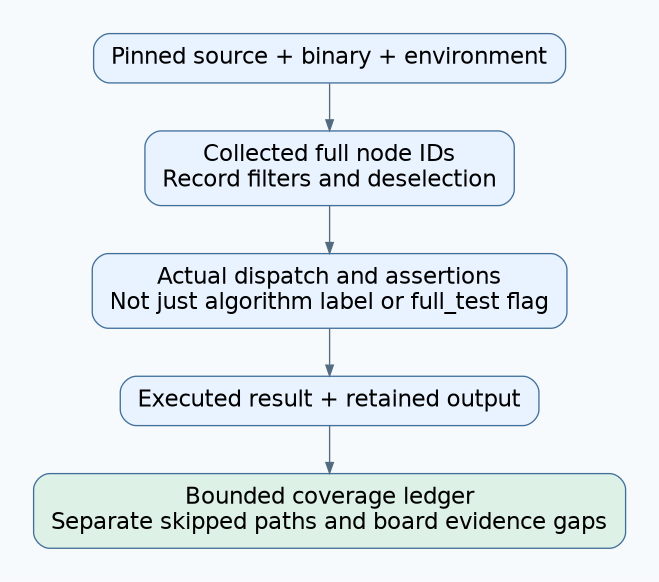
The final packet should contain eligibility evidence, activation settings, a mapping-lifecycle worksheet, raw first failure and the source-backed correction. Accept only the mapping claim exercised by those tests. Keep unsupported architectures, unvisited entry paths and unrelated corruption classes explicit so the checker adds precision rather than a broad but misleading “memory safe” label.