systemd Automount for Service Media: Separate Boot Success from First-Access Readiness
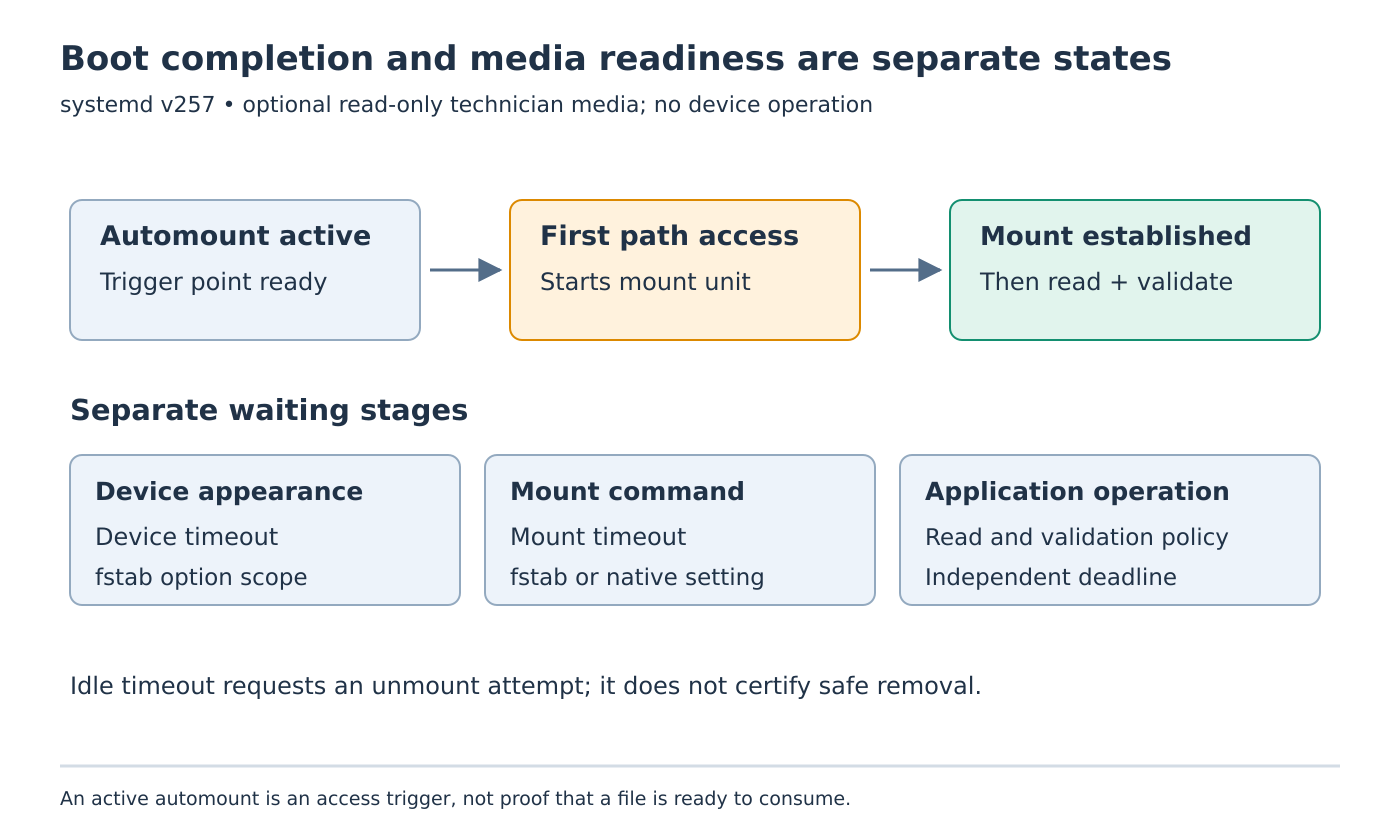
An embedded device can finish booting while an optional technician-media path is not yet mounted. With systemd automounting, an active automount unit establishes a trigger point; the matching mount is activated when something accesses that path. Boot completion therefore does not establish that the first media read will succeed promptly.
This review pins systemd v257 and uses read-only removable service media. It excludes essential root or configuration volumes. No mount, unmount, device access or configuration edit was performed.
Track two units and one application operation
The v257 automount manual describes separate matching .automount and .mount units. Access to the automount path activates its mount unit. Observing the former as active is not evidence that the latter already mounted the intended filesystem.
For a hypothetical path /mnt/service-media, record three states separately: automount trigger available, media mount established, and the requested file successfully read and validated. A status indicator that turns green at the first state misrepresents the last two.
An ordinary pathname access can be the event that starts mounting. Consequently, an eager directory scan in a startup health check can move the wait back into startup even if the user interface has not requested media. Identify every consumer that touches the path, including discovery and monitoring code.
Understand what nofail buys
The v257 mount manual explains that nofail weakens the mount’s relationship with the relevant filesystem target and allows boot to continue without waiting for a successful mount. That is a boot dependency policy, not an application-readiness certificate.
For optional service media, booting without it can be intentional. The product still needs a visible “media unavailable” outcome when a technician requests a file. It should not silently substitute an empty directory, an older cached file or a default calibration file for a failed media read.
Keep the example read-only. In a design that writes to removable media, an inactive or absent mount can expose the underlying directory on the root filesystem. A generic fallback that creates files there can consume internal storage while falsely reporting a media export. Such a writer needs its own verified destination-identity and lifecycle contract.
Give each waiting stage its own boundary
Device appearance and mounting are different operations. In an /etc/fstab entry, x-systemd.device-timeout= limits the device-arrival wait, while x-systemd.mount-timeout= limits waiting for the mount command. One value cannot be read as a universal deadline for every stage of a media operation.
Both names are fstab-generator options. Copying them into a native mount unit’s Options= field does not apply those timeout controls; the v257 manual explicitly says they are ignored there. A native unit must use the appropriate supported unit settings and dependency design instead.
Application work continues after mounting: opening the selected file, reading it, checking its type and size, parsing it, and validating its contents. A mount timeout does not bound all that work. Define an application deadline and cancellation design that accounts for blocking I/O rather than assuming a user-interface timer automatically cancels a kernel operation.
The useful diagnostic record identifies which stage waited and which timeout, if any, expired. “USB timed out” is too vague to distinguish an absent device, a stalled mount helper and a slow or invalid file.
Put dependencies on the right object
The automount manual cautions against placing mount dependencies directly on the automount unit, where they can create ordering cycles. Review the dependency graph for the actual mount and the application consumer instead of copying a generic ordering stanza to both units.
For the fictional reader, a request can remain pending until the selected medium becomes usable, or fail with an explicit bounded outcome. Choose the desired behavior before adding dependencies. A request requiring a specific medium should not become satisfied merely because some filesystem appeared at a familiar pathname.
Do not turn an idle timeout into an unplug signal
TimeoutIdleSec= asks systemd to attempt unmounting after the configured idle interval. It is not proof that a busy filesystem has already been unmounted, and it does not certify that physical removal is safe. A process retaining an active use of the mount can change the result.
A proposed lab matrix should include media absent at boot, first access with media absent, successful mounting followed by a valid read, and an idle interval while the mount remains busy. Inspect the two unit states and the application’s result separately. No such cases were executed here.
The acceptance goal is a clear service-media state machine: boot may proceed, first access may wait or fail, and validated content becomes available only after its own checks. That contract prevents a successful boot from concealing an unresolved first-use dependency.