V4L2 Media Pipelines: Diagnose STREAMON EPIPE Before Reallocating Capture Buffers
Capture buffers can be allocated correctly while an MC-centric camera pipeline still fails to stream. If VIDIOC_STREAMON reports EPIPE under the documented pad-format contract, inspect the negotiated pipeline before repeatedly reallocating the same buffers.
This article uses the Linux v6.12 V4L2 documentation and a hypothetical sensor, bridge and scaler. It is a configuration-review method, not a camera bring-up result. No links, formats, controls or streaming state were changed on hardware.
Establish which control model the device exposes
The v6.12 device-opening documentation identifies MC-centric devices through V4L2_CAP_IO_MC in device_caps. Those devices require Media Controller pipeline configuration and sub-device control. Do not impose that workflow on every USB camera or video-node-centric device merely because a media node exists.
For the hypothetical graph, identify the source and sink pads at each enabled link. Record the intended path from sensor to capture node. A list of device filenames alone does not describe which connection carries the stream.
Keep two format namespaces separate. A media-bus code describes data at a sub-device pad; a video-buffer pixel FourCC describes a video-node memory format. Similar-looking color names do not make those identifiers interchangeable, and correct buffer plane allocation cannot repair an incompatible pad connection.
Negotiate a coherent path using returned values
The sub-device format contract gives TRY state a useful role: negotiation is stored on the sub-device file handle without changing hardware state. Preserve each handle during its negotiation session. Reopening the node and reading TRY state does not retrieve the old handle’s work.
Drivers may adjust a requested format. Record the format returned by the set operation and inspect related pads that may have changed inside that sub-device. Then explicitly configure the compatible endpoint across the next link; propagation does not automatically cross from one sub-device to another.
Consider a synthetic bridge requested to pass a width of 1920 pixels. Suppose the driver returns a source width of 1918 after its internal constraints. Leaving the scaler’s sink at 1920 preserves a mismatch even though both earlier calls returned successfully. The numbers are an illustrative counterexample, not capabilities attributed to a real bridge.
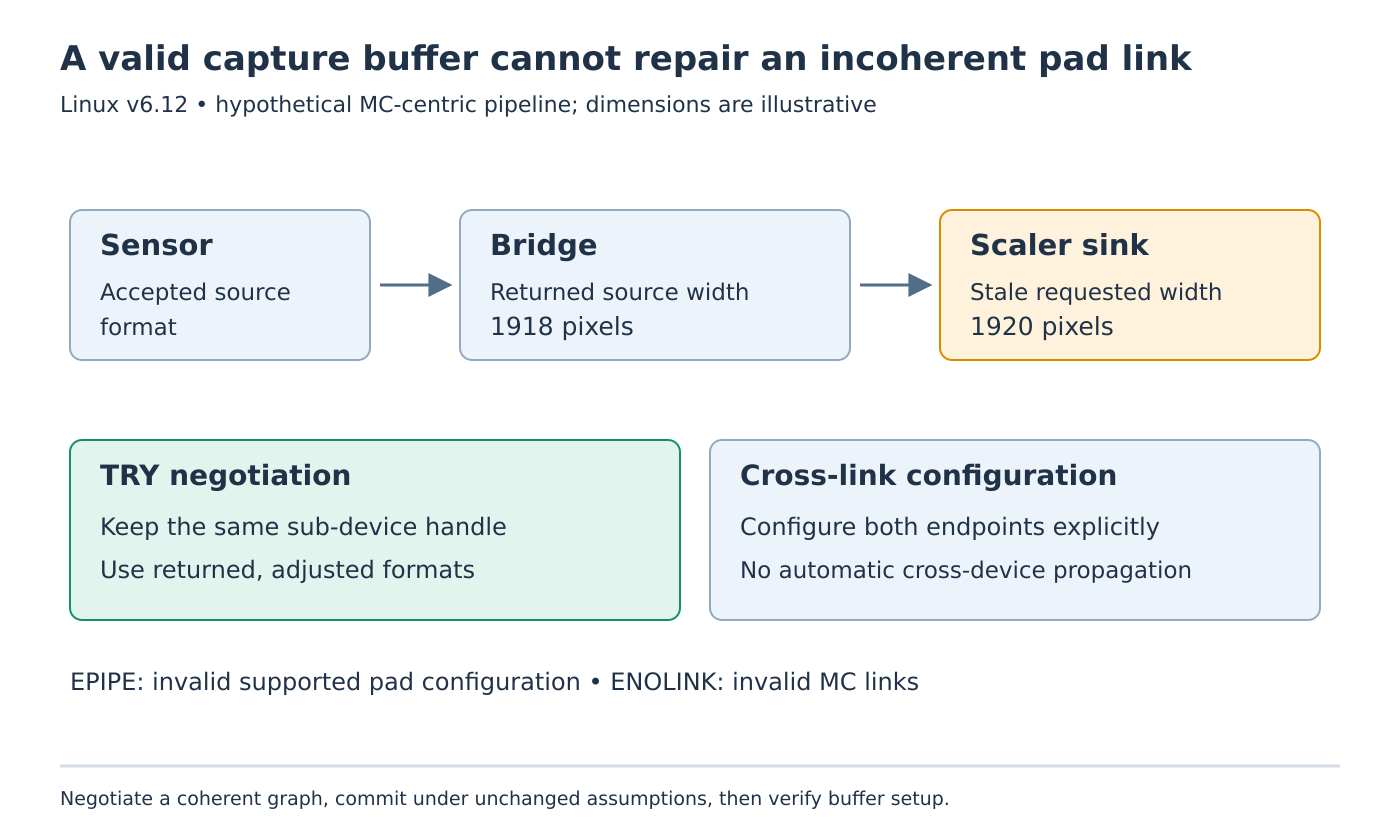
The repair is to negotiate from the accepted graph state, not to insist that every component use the application’s first request. Whether unequal formats can be compatible is driver-specific. Matching connected formats is the straightforward documented compatibility case, while a device accepting a transformation requires its actual contract.
Commit without changing the assumptions
A returned negotiated format is supported under the external parameters used for negotiation. Relevant links, controls and neighboring formats can affect that result. Do not treat an old TRY success as a permanent capability certificate after those inputs change.
Once the hypothetical graph is coherent, apply the intended ACTIVE configuration under the same relevant conditions and read back the resulting state. Serialize configuration ownership so another application cannot silently change the assumptions between negotiation and streaming.
This does not replace capture-buffer setup. After the accepted pipeline and video-node format are known, the application still needs the correct buffer type, memory-plane descriptions and queue state. Keep those checks in their own part of the diagnostic record.
Interpret the streaming error at the right layer
The v6.12 streaming reference distinguishes an invalid pad-level pipeline configuration reported as EPIPE from an invalid Media Controller link configuration reported as ENOLINK, for drivers implementing those checks. These meanings are specific to this ioctl and supported interfaces; they are not universal translations for those error numbers throughout Linux.
Record the failing ioctl, buffer type, error, enabled graph and accepted pad formats together. A generic “camera failed” message loses the distinction between a disconnected graph and an incoherent format path.
Also preserve queue ownership on failure. The streaming reference says already queued buffers remain queued when STREAMON fails. Do not assume a failed start has silently reset the queue to an empty initial state, and do not begin arbitrary teardown without following the selected buffer lifecycle.
Build the acceptance record around the graph
A proposed test matrix begins with one coherent synthetic configuration, then changes one link endpoint’s accepted dimensions, then disables a required link. Expected diagnostics must identify which configuration boundary failed, rather than merely count failed start calls.
For a real target, retain capability results, entity and pad identities, returned TRY values, committed ACTIVE values, relevant controls and queue state. No successful streaming or image-quality claim follows from this document review. Its deliverable is a reproducible explanation of the pipeline the application actually asked the driver to stream.