U-Boot Environment Callbacks: Verify the Bound Function, Not Just the Association String
A callback name written into U-Boot’s .callbacks
variable does not prove that a matching function exists in the
executable. In v2025.01, association updates search a linker-registered
callback table. An unknown name does not automatically become a new
handler or produce a useful association error.
This article examines rebinding variables that already exist in
U-Boot proper. New-variable initialization and small-loader builds have
different paths. The question is which function will receive a later
variable change, not which variables an environment import selects.
Separate registration
from association
The environment
implementation guide describes two responsibilities. Code registers
a named callback with U_BOOT_ENV_CALLBACK; configuration
associates an environment-variable name with that registered
callback.
Static associations come from the built configuration, while
.callbacks supplies runtime associations. A list entry
without a callback name removes the association. When enabled,
regular-expression matching adds another configuration dimension, so a
literal-name fixture is the simplest way to isolate function
resolution.
An association string cannot link code that the build omitted.
Inspect the actual callback registry or executable alongside the
configuration, especially when a board option conditionally includes the
implementation.
Existing
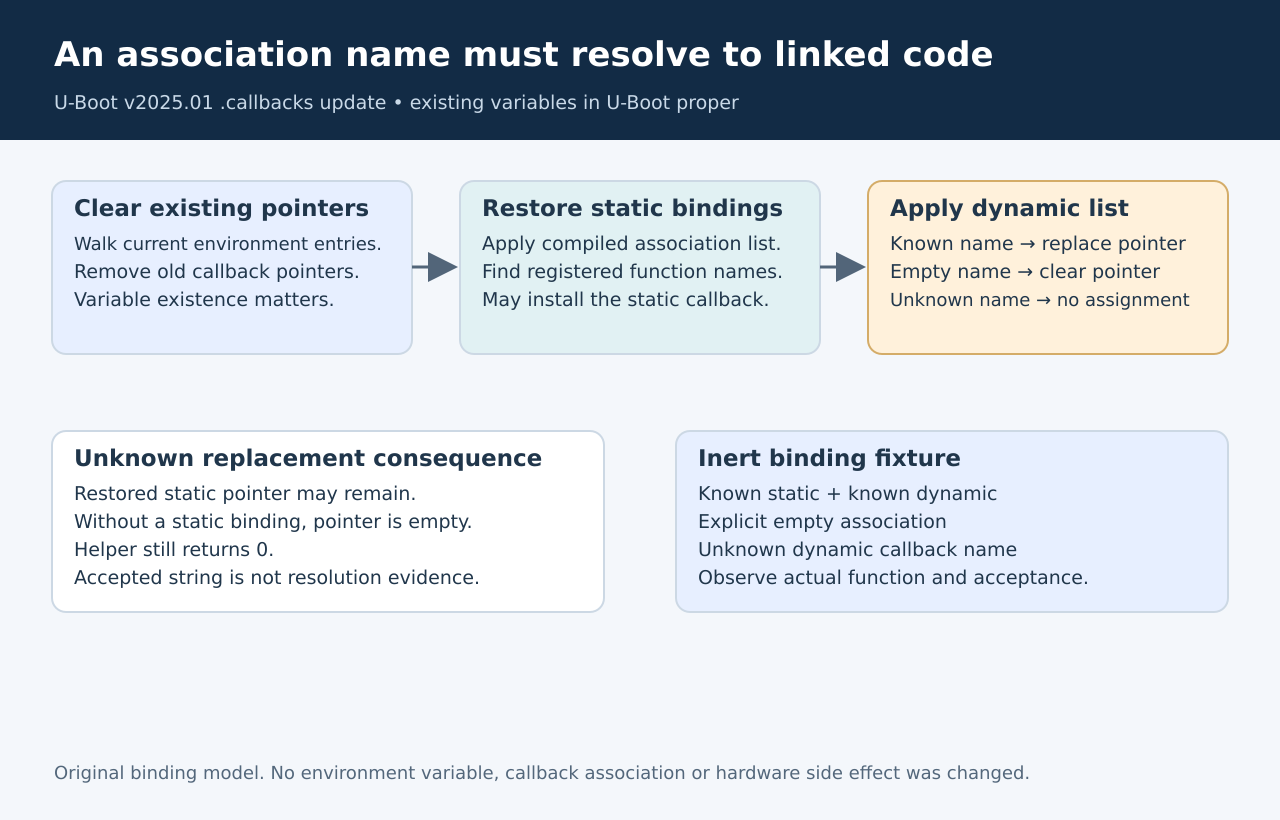
variables are rebound in three passes
The callback
implementation handles a change to .callbacks by first
clearing callback pointers across existing environment entries. It then
applies static associations, followed by the new dynamic list.
For each named existing variable, a dynamic entry with no callback
name explicitly clears its pointer. A known callback name replaces the
pointer with the registered function. An unknown callback name finds no
matching registry entry, so that assignment is not performed.
The last case has an important consequence. If the static pass just
restored a callback, an unknown dynamic replacement can leave that
static callback installed. If no static association supplied one, the
pointer remains empty. These outcomes differ from both successful
replacement and explicit removal.
The list-processing helper returns zero even when the requested
callback function is not found. An accepted .callbacks
update therefore cannot be treated as a complete report that every
requested association resolved as intended.
Test the binding
rather than the spelling
Use a harmless development variable and callbacks that only record
invocation identity. Establish a known static association, then compare
a known dynamic replacement, an explicit empty association and an
unknown callback name. The expected result for the unknown name depends
on the restored static binding, not merely on the text of the dynamic
request.
Record the variable’s existence before rebinding. The new-variable
initialization function has its own lookup/fallback behavior; do not
extrapolate this existing-entry three-pass result to every creation
path.
If regular expressions are part of the product configuration, qualify
their matches separately after the literal-name case works. Otherwise a
name-resolution problem and an association-match problem can produce the
same apparent lack of callback activity.
A callback’s
acceptance is a separate boundary
The environment
hash-table implementation invokes an existing entry’s callback
before replacing its stored value in the ordinary overwrite path. A
nonzero callback return rejects that change. This is why resolving the
correct function matters: a different binding can apply different
validation or side effects.
The callback receives the proposed new value as an argument. Code
should not assume that reading the environment by name during this
pre-replacement call necessarily returns that proposed value. Also avoid
treating callback execution and arbitrary hardware side effects as a
transaction automatically rolled back by the environment layer.
No callback association or variable was changed for this analysis. A
release check should establish both the function present in the build
and the pointer bound to the intended existing variable, then verify the
acceptance behavior with an inert fixture. The association string alone
supplies only the requested relationship.