Signed Firmware and Mutable Boot Arguments: Identify Policy Outside the Signature
Audit the final boot-policy inputs, not only the signature on the executable image. A correctly verified kernel can receive command-line arguments assembled from a separate mutable source. If those arguments choose storage, initial userspace or security-relevant behavior, their authority belongs in the boot trust review.
This guide uses U-Boot v2024.10’s common Linux device-tree setup and Linux 6.12 parameter documentation. It does not assume every board uses that path or permits environment changes. No production configuration was modified, and the proposed tests were not executed.
1. Trace the final command line backward
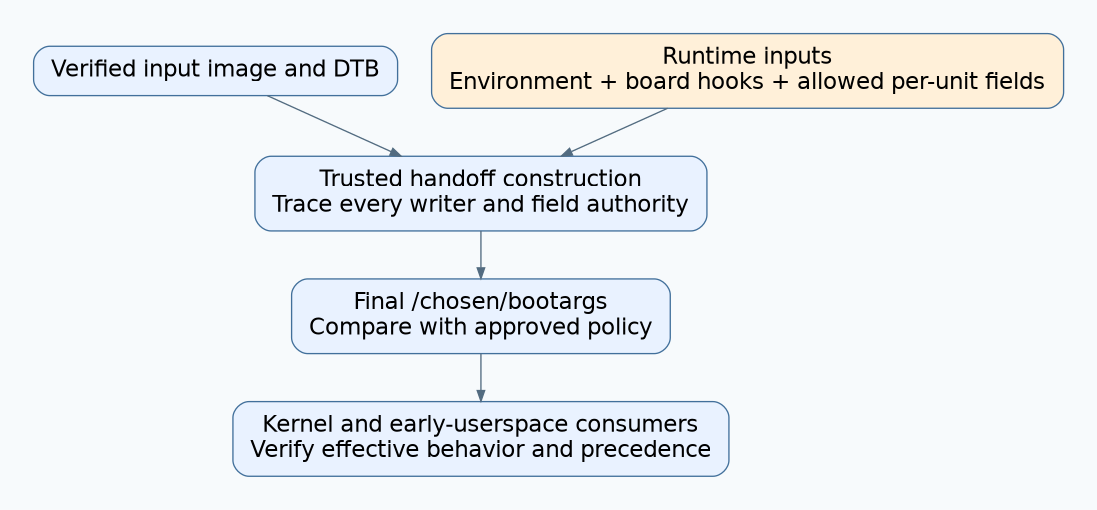
Start with the effective command line and observed boot behavior on the exact release build. Work backward through the final operating-system device tree, loader fixups, board hooks, scripts, environment and authenticated release inputs.
The U-Boot environment reference identifies bootargs as command-line arguments passed during boot and distinguishes the in-memory environment from saved state. Therefore a source-tree default is not sufficient evidence of the value consumed on a deployed unit.
Also inspect the kernel’s architecture-specific command-line configuration and early-userspace handling. The string supplied by the bootloader is an input to that path; it is not automatically the complete description of every parameter the product ultimately acts on.
2. Inspect the post-verification writer
In v2024.10’s common FDT support, the weak board_fdt_chosen_bootargs() hook returns the environment’s bootargs value by default. When that result is non-NULL, fdt_chosen() writes it into /chosen/bootargs. A board can override the hook.
The Linux FDT setup path calls chosen-node setup and includes further architecture and board fixups, with additional environment-driven processing when configured. Inspect the enabled code paths in the actual build rather than assuming the input DTB remains byte-identical at handoff.
This behavior does not mean the FIT signature is broken. The signature can authenticate the input artifact, while trusted loader code subsequently constructs runtime data. The review question is whether every security-relevant runtime input has an appropriate authority and constraint.
3. Classify fields by consequence and permitted owner
| Input class | Security question | Evidence to require |
|---|---|---|
| Root filesystem selection | Can it redirect execution to storage outside the approved integrity policy? | Allowed targets and their own verification boundary |
| Initial userspace selection | Can it change which startup program receives control? | Approved program selection and enforced constraints |
| Security subsystem policy | Can a supported parameter weaken required enforcement? | Exact kernel feature, accepted values and protected authority |
| Diagnostics and consoles | Can a permitted diagnostic change expose sensitive output or access? | Bounded service policy and recipient/access review |
| Per-unit operational data | Who may change it, and can parsing cross into policy fields? | Typed schema, length limits and field separation |
Linux 6.12’s parameter guide documents that root selects the root filesystem, while init and rdinit influence initial userspace selection. These names identify review surfaces, not suggested values or bypass commands. Their actual effects depend on the kernel and early-userspace build.
Do not classify all diagnostics as harmless or all mutable fields as unacceptable. A product may legitimately need service-selected logging or board-discovered memory. Define the allowed variation and preserve the fields that must remain under release authority.
4. Make provenance and precedence explicit
For each significant field, record its initial source, whether that source is authenticated, every later writer, the actor allowed to change it, and the final consumer. Include fallback behavior when a source is absent, corrupt or rejected.
Compare at least three artifacts: the signed input tree, the tree immediately before operating-system handoff, and the effective command line. Explain every difference that affects policy. A digest difference between the first two is expected when approved fixups occur; it is a prompt for a field-level explanation, not automatic proof of compromise.
Specify how duplicate parameters, conflicting sources and quoted values are handled by the actual consumer. Avoid implementing a string blacklist that assumes every subsystem uses the same first-or-last-value rule. Prefer a small, explicit construction contract whose accepted fields and encodings can be tested.
5. Use harmless negative policy fixtures
Begin with an offline parser or handoff-generation fixture where possible. Use synthetic policy fields and inert test endpoints to establish provenance and rejection behavior before attempting a board boot. Preserve the original environment and media on recoverable development devices.
- Change a permitted diagnostic field and confirm only its approved output changes.
- Supply an unapproved policy-field candidate and require rejection or replacement by the authoritative value.
- Provide conflicting values from two candidate sources and verify documented precedence.
- Remove the mutable source and identify which default is used.
- Use an older retained environment and verify it cannot silently restore obsolete policy.
- Exercise malformed, duplicate and oversized inputs without accepting partial policy.
Do not run live tests that disable security enforcement, redirect production storage or start an unrestricted maintenance environment. The fixture should show that unauthorized candidates cannot influence the final approved policy, not demonstrate a usable bypass on a deployed product.
6. Interpret the result at the right boundary
A successful FIT verification followed by an unexpected final argument is a policy-provenance finding. Investigate the writer and its authority before changing signing keys. A correct final argument with an unexpected kernel result instead requires checking consumer semantics, compiled options and early-userspace processing.
Unknown arguments also deserve attention: the Linux guide describes forwarding some unrecognized arguments to init. Rejecting only known kernel switches can leave a separate application input channel unreviewed.
Hypothetical retained service environment
A new signed release contains the approved board tree, but a controller retains an older service environment. The common hook supplies that environment’s bootargs during handoff. The image signature still verifies, while the final root-selection policy differs from the release expectation.
The corrective design assigns the critical field to an authenticated or otherwise protected authority and qualifies any allowed service variation. Close the issue with the provenance table, final-field assertions and negative fixtures. Re-signing unchanged firmware alone would not address the independent writer that produced the unexpected argument.