BitBake Task Signatures: Diagnose Why an Apparently Small Change Rebuilds Many Packages
A small metadata edit is followed by a long BitBake build. The changed line looks unrelated to most of the tasks that ran, so the shared cache is blamed first. Before deleting anything, preserve the signatures and identify the earliest changed input. The useful explanation is a dependency chain, not a list of packages that happened to rebuild.
This procedure targets Yocto Project 5.0.12 with the BitBake 2.8 signature documentation. It concerns task-level invalidation and reuse decisions. Compiler-object caching is a different mechanism. The example task names and changes are illustrative, and no build-time reduction or executed diagnostic result is claimed.
Preserve both sides of the comparison
Record the metadata revisions and build configuration before and after the change. Keep the relevant signature files from each state, along with the exact target and task names. If the earlier data has already disappeared, say so; comparing against an unrelated cached task can produce a technically valid diff that answers the wrong question.
Avoid beginning with a broad clean command. It can remove the evidence needed to explain the rebuild and force additional work without correcting the dependency model. First determine whether the task actually executed, was restored through shared state, or merely appeared in a dependency graph. A task being relevant to the build is not the same as its work being rerun.
The signature-debugging guide documents bitbake-diffsigs for comparing signature records. It also describes -S none and -S printdiff. Use a controlled before-and-after pair when available; automatic selection of a recent match still needs to be checked against the intended baseline.
Ask which input first diverged
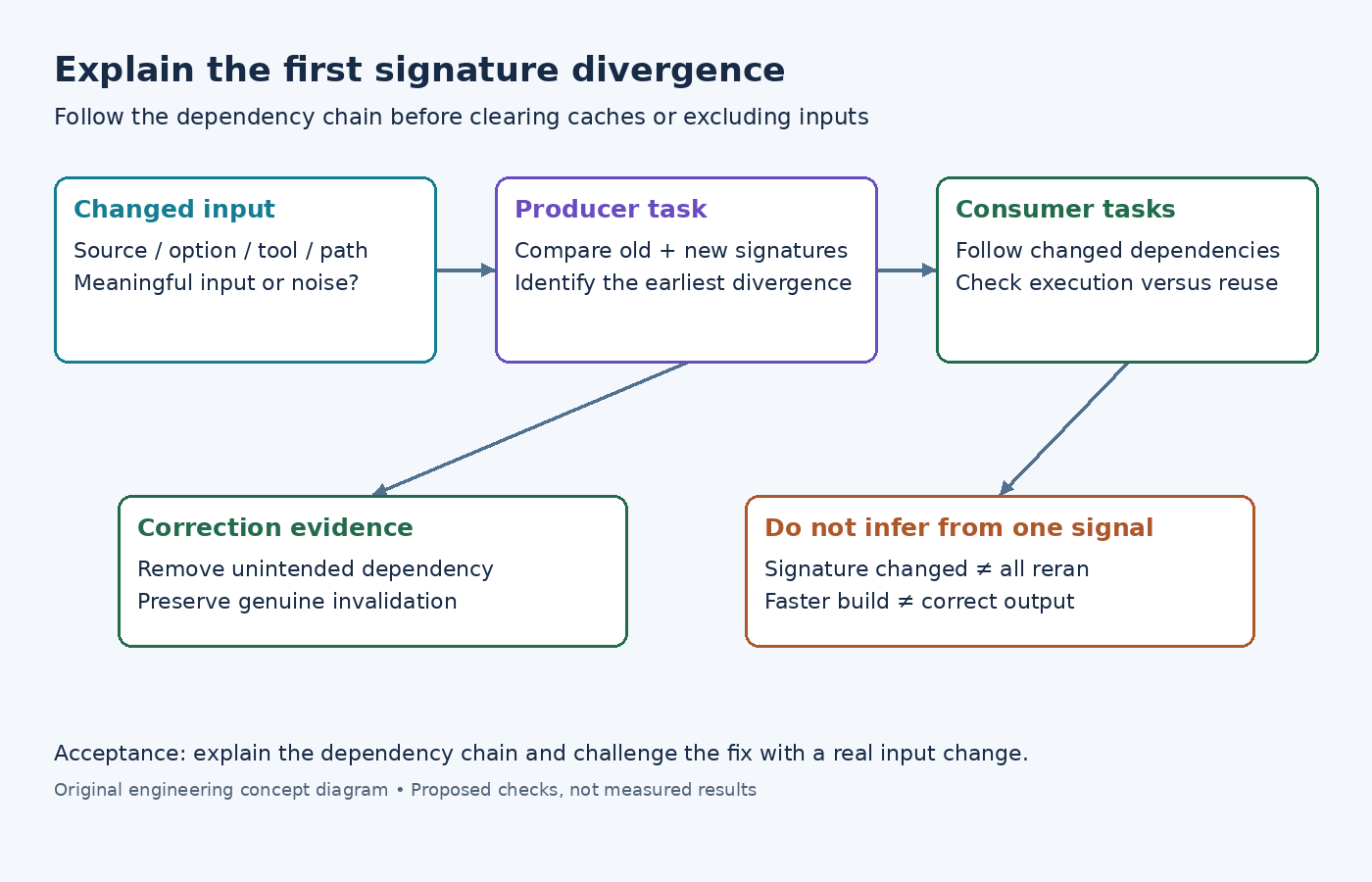
Start with one unexpectedly affected task. Compare its old and new signature information, then follow a changed dependency toward the producer that introduced the difference. Repeating this process should narrow the explanation from a large downstream rebuild to a smaller set of changed inputs.
The BitBake checksum discussion explains how task signatures account for metadata and dependencies. The practical consequence is that a consumer may change because a producer changed, even when the consumer's recipe text did not. Do not infer irrelevance from an unchanged recipe file.
For an illustrative report, record that a generated-header task changed because a configuration value changed, and that the application's configure task depends on that producer. That is a testable chain. A statement such as everything rebuilt after editing local.conf does not identify whether the change was necessary or accidental.
Separate a correct dependency from accidental noise
Once the first divergence is identified, determine whether it can affect the task output. A compiler option, generated input, source revision, or tool version may legitimately require new work. A value containing a developer-specific path might be harmless in one task and materially affect generated files in another. Inspect the task and its commands before classifying it.
Do not suppress a variable from signature dependencies merely because the resulting build is faster. That can make cached output appear reusable when a real input changed. If exclusion is proposed, require an explanation of why the value cannot affect the task's output and a test designed to challenge that explanation.
A better fix may be to remove an unnecessary input from the task, stop embedding a volatile value in an artifact, or narrow a configuration change to its intended scope. Those changes improve the dependency contract itself. A global ignore setting can conceal the symptom while leaving the contract wrong.
Read reuse behavior with the configured hash model
The shared-state concepts chapter describes hash equivalence as a way to recognize unchanged output despite changed task inputs and limit downstream rebuilding. Therefore, a changed input signature alone does not predict every later task execution. Inspect the hash-equivalence configuration and the actual run behavior when explaining the final result.
Keep three observations separate in the investigation record: an input changed, a task executed, and a downstream result was reused. They can all be true in the same build. This avoids describing successful reuse as a missed rebuild or treating every signature change as evidence of wasted work.
If a result looks stale, preserve the suspect artifact and its provenance before experimenting. Check whether the metadata declares every input used by the task. An untracked external file can undermine the reasoning even when the signature tools behave exactly as designed.
Verify the correction with a deliberate perturbation
Use the smallest affected target that still exercises the dependency chain. Reproduce the original change in a controlled build, retain its signature comparison, and then apply the proposed correction. Compare both the task decisions and the relevant output; a shorter task list is not enough evidence.
- Restore the recorded baseline inputs and capture the affected task signatures.
- Apply the original change and explain the first divergence using the signature diff.
- Apply the correction and confirm that the intended artifact still reflects the meaningful change.
- Change a genuinely relevant input and verify that required work is not incorrectly reused.
- Repeat from a separate work directory with the intended cache configuration to check that the fix is not dependent on leftovers.
These checks are proposals for the product build, not reported test results. Record any cache misses separately from signature changes, because availability and validity are different questions.
A complete diagnosis ends with a short causal statement: this input changed this task, which affected these consumers, and this correction removed only the unintended dependency. That explanation remains useful after the immediate build finishes and gives future maintainers a reason to trust the cache rather than routinely clearing it.