Zephyr OS HTTP Responses: Separate Body Fragments, Final Notification and Success
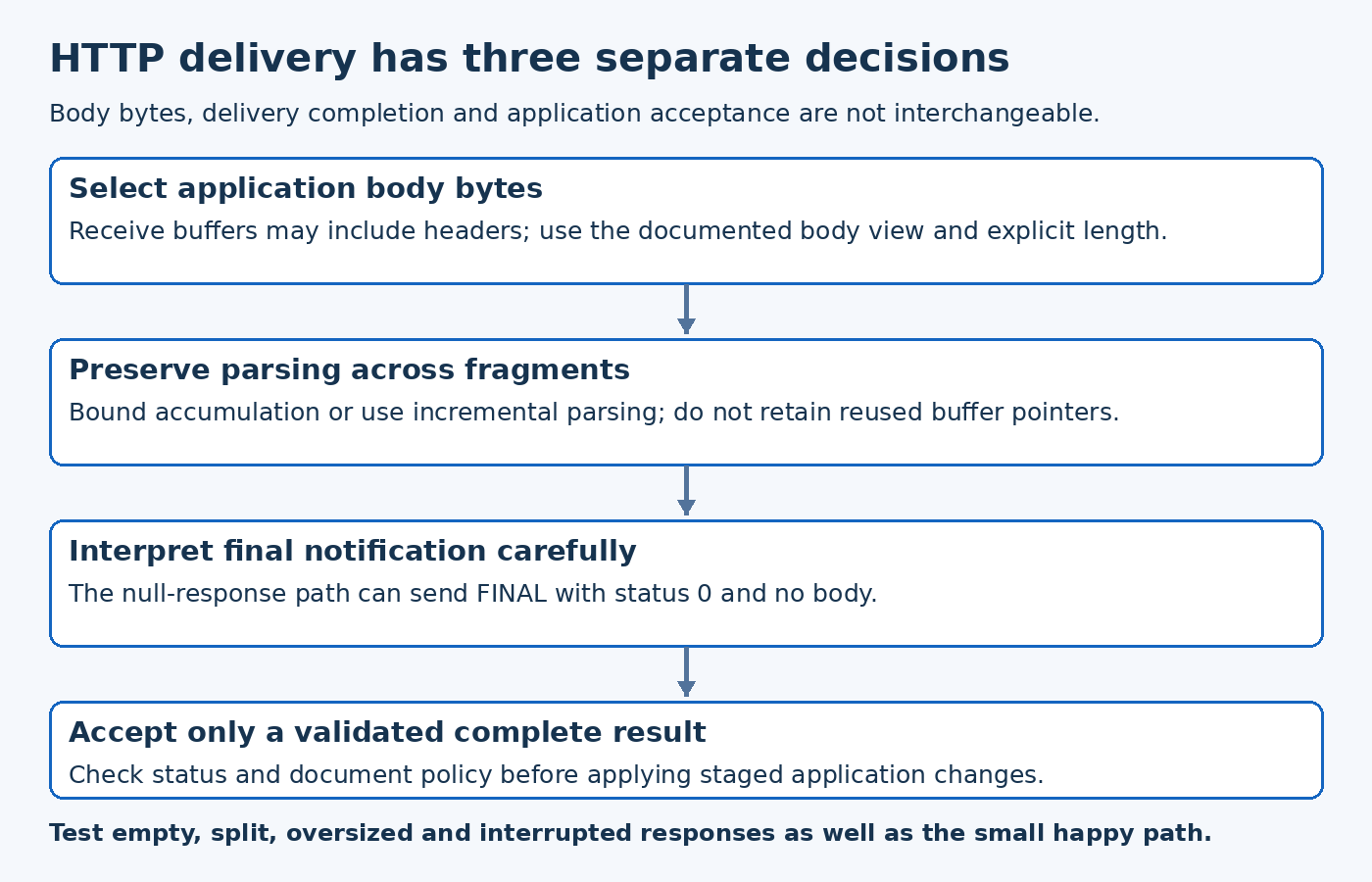
Receiving an HTTP callback does not mean its entire buffer is application payload, and a final notification does not automatically mean the server returned the expected document. A robust Zephyr client keeps three decisions separate: which bytes belong to the body, whether response delivery has ended, and whether the completed response is acceptable to the application.
This article uses Zephyr 4.4.0's HTTP client interface and implementation. It proposes a response-consumption design, not a tested download or server compatibility claim. Complex transfer-encoding cases still need explicit tests against the exact parser path used.
Consume the body view rather than the raw receive buffer
The tagged HTTP client header distinguishes recv_buf and data_len from body_frag_start and body_frag_len. It illustrates that a receive buffer may contain headers followed by body bytes. With a response callback, data can be delivered over multiple calls rather than fitting into one buffer.
Use the documented body view for a simple body consumer and check its pointer and length before access. Do not append every byte in recv_buf to a file or feed it directly into a JSON parser merely because the callback ran. Headers and body serve different purposes.
Also avoid treating a fragment as a complete text string. Its length is explicit; a trailing NUL is not an application-level guarantee. A bounded text accumulator must reserve its own terminator space, while a binary consumer should preserve the exact byte count without string operations.
Preserve parser state across delivery boundaries
A hypothetical JSON response can split a field name or value across callbacks. Parsing each fragment as an independent document will fail for a reason unrelated to whether the server sent valid JSON. Choose either an incremental parser or a bounded complete-body accumulator, and define its maximum accepted size.
If accumulation exceeds that limit, reject the response through a deliberate path rather than truncating it and attempting to interpret a partial document. If using streaming consumption, retain only the parser state and owned data needed between callbacks. Do not keep a pointer into a receive buffer that the client can reuse.
Keep byte accounting tied to the selected consumption path. If low-level parser callbacks are also enabled, avoid processing the same body through both the parser callback and the higher-level response callback. Test the specific transfer encodings you support instead of assuming all framing maps into one contiguous application fragment.
Final means delivery ended, not that the result is useful
The tagged client implementation has a null-response path that invokes HTTP_DATA_FINAL while setting status code and response metrics to zero and the body pointer to NULL. Its normal completion path also sends a final notification. Therefore, the final marker alone cannot establish a valid successful HTTP response.
At completion, check the request result, response status, parser completion where relevant, and the application document requirements. A transport operation can finish while the server response is outside the accepted status range. A syntactically complete body can still omit a required field.
For a hypothetical configuration fetch, stage the candidate configuration separately and apply it only after the full validation policy passes. Do not modify live settings as each fragment arrives unless the protocol and application explicitly support that transactional behavior.
Test boundaries that a small response hides
Use development responses smaller than the receive buffer, larger than it, and split near a meaningful token boundary. Include an empty response, an unexpected status, a connection closed before any response bytes, and an interrupted body. Observe accepted application state as well as callback count.
These tests should establish one clear result: only complete, policy-accepted content reaches the consumer, regardless of how transport delivery was partitioned. Increasing a buffer until one demonstration fits does not establish that boundary. Separating byte selection, completion and acceptance does.