Zephyr OS Modem Chat: Keep Unsolicited Lines from Completing a Command Step
A modem can emit a state notification while a command is waiting for its response. If the parser treats any received line as completion, the script may advance before the requested operation has actually finished. In Zephyr Modem Chat, response, abort and unsolicited matches have different effects; configure those roles deliberately.
This article uses Zephyr 4.4.0's Modem Chat API and parser implementation. The example line sequences are hypothetical. Actual command syntax, response ordering and unsolicited indications must come from the selected modem's documentation and verified traces.
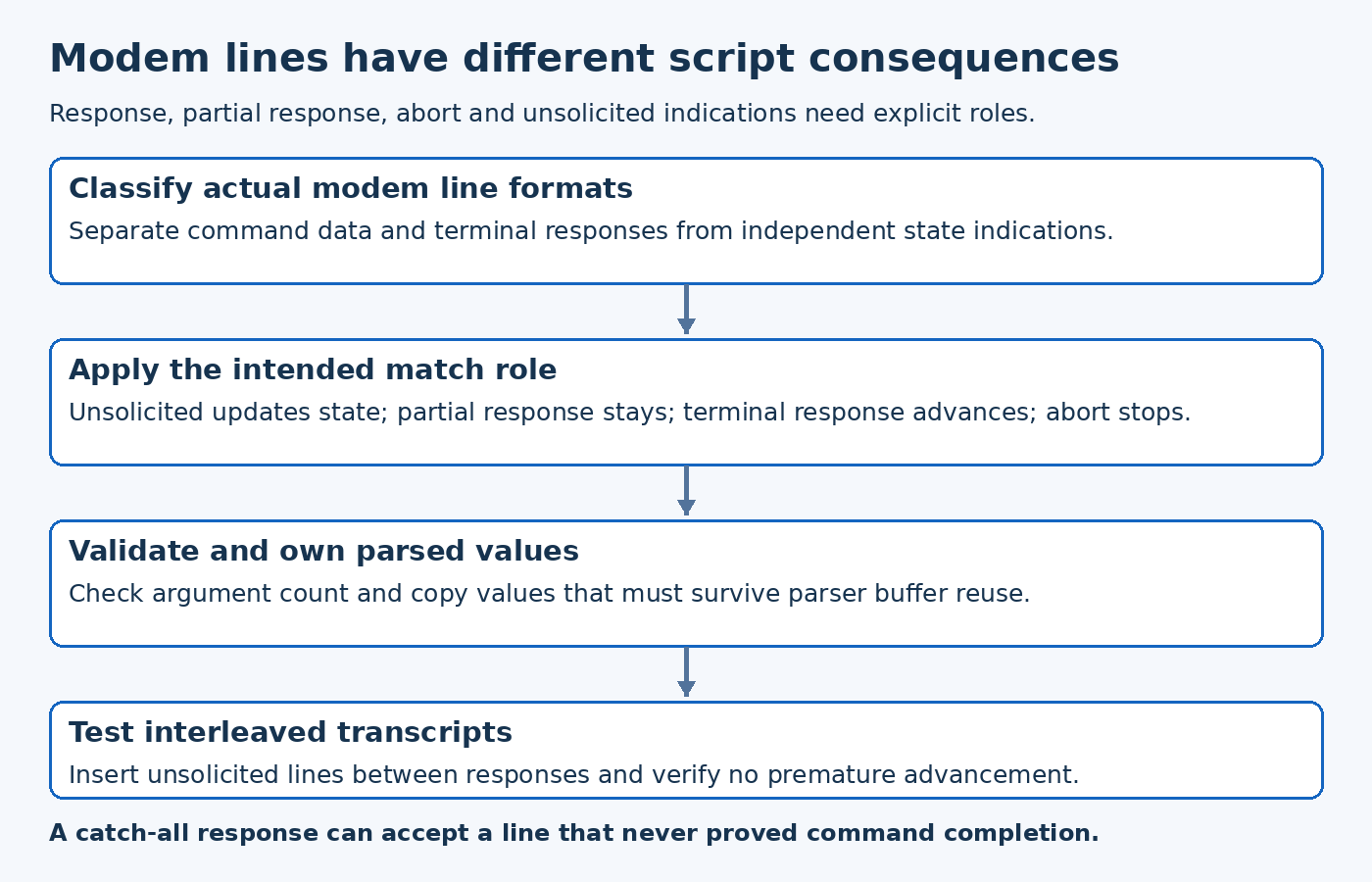
Classify lines by their effect on the script
The tagged Modem Chat header separates per-step response matches, script abort matches and instance-level unsolicited matches. It also provides a partial flag whose documented purpose is to avoid advancing the script on that match.
Build a response definition from the modem's actual command contract. Distinguish intermediate data lines from the terminal success response, and distinguish both from state changes that can occur independently. Do not classify a line as a response merely because it often appears immediately after a command during a quiet test.
For a hypothetical status query, several data lines may precede a final acknowledgement. An intermediate match can update staged information without ending the step; the terminal match can permit advancement. An unsolicited registration change should update modem state through its own path instead of masquerading as that acknowledgement.
Understand the consequences of each matched line
The tagged parser implementation invokes an unsolicited match callback without advancing the script. An abort match stops the script with an abort result. A response match invokes its callback and advances unless partial is set. Match search returns the first applicable match it finds, so overlapping definitions deserve review.
These mechanics make permissive catch-all response matches risky when unsolicited traffic can interleave. A line that the application does not understand may still satisfy an overly broad rule and move the script forward. Prefer explicit terminal-response definitions and a separate diagnostic path for unknown lines.
Do not rely on match ordering as a substitute for unambiguous intent. Where a modem genuinely reuses the same prefix for solicited and unsolicited forms, identify the additional context needed to distinguish them. Test that ambiguity with the relevant firmware version instead of claiming a generic parser configuration can always resolve it.
Check arguments before changing application state
A match callback receives parsed arguments and an argument count. Validate the count and each value required by the selected line format before interpreting it. A matching prefix does not prove that every expected field was present or within range.
Copy data that must survive callback processing into owned storage. The parser uses its receive buffer for parsed arguments and resets parsing after a completed line. Retaining an argument pointer as a permanent modem property creates a separate lifetime problem.
Stage multi-line command results until the terminal response establishes the intended completion condition. If the script aborts or times out, define whether partial values are discarded or retained as explicitly incomplete observations. Do not publish them as a successful fresh status merely because some lines arrived.
Test interleaving, not only the normal transcript
A useful development sequence inserts an unsolicited line before the first response, between intermediate responses, and immediately before the terminal response. Also test an abort indication, an unknown line, and a malformed argument list. Observe script advancement and application state separately.
Review buffer and argument capacity against the modem's longest supported line formats. The inspected implementation resets parsing on receive-buffer or argument-array overrun; a larger buffer may be necessary, but it does not repair ambiguous match definitions.
The script is ready when unsolicited state changes remain observable without completing an unrelated command, intermediate data remains provisional, and only the intended terminal response advances the step. That is a stronger integration contract than matching one successful serial transcript.