Zephyr OS TLS Credentials: Keep Registered Bytes Alive and Separate Removal from Erasure
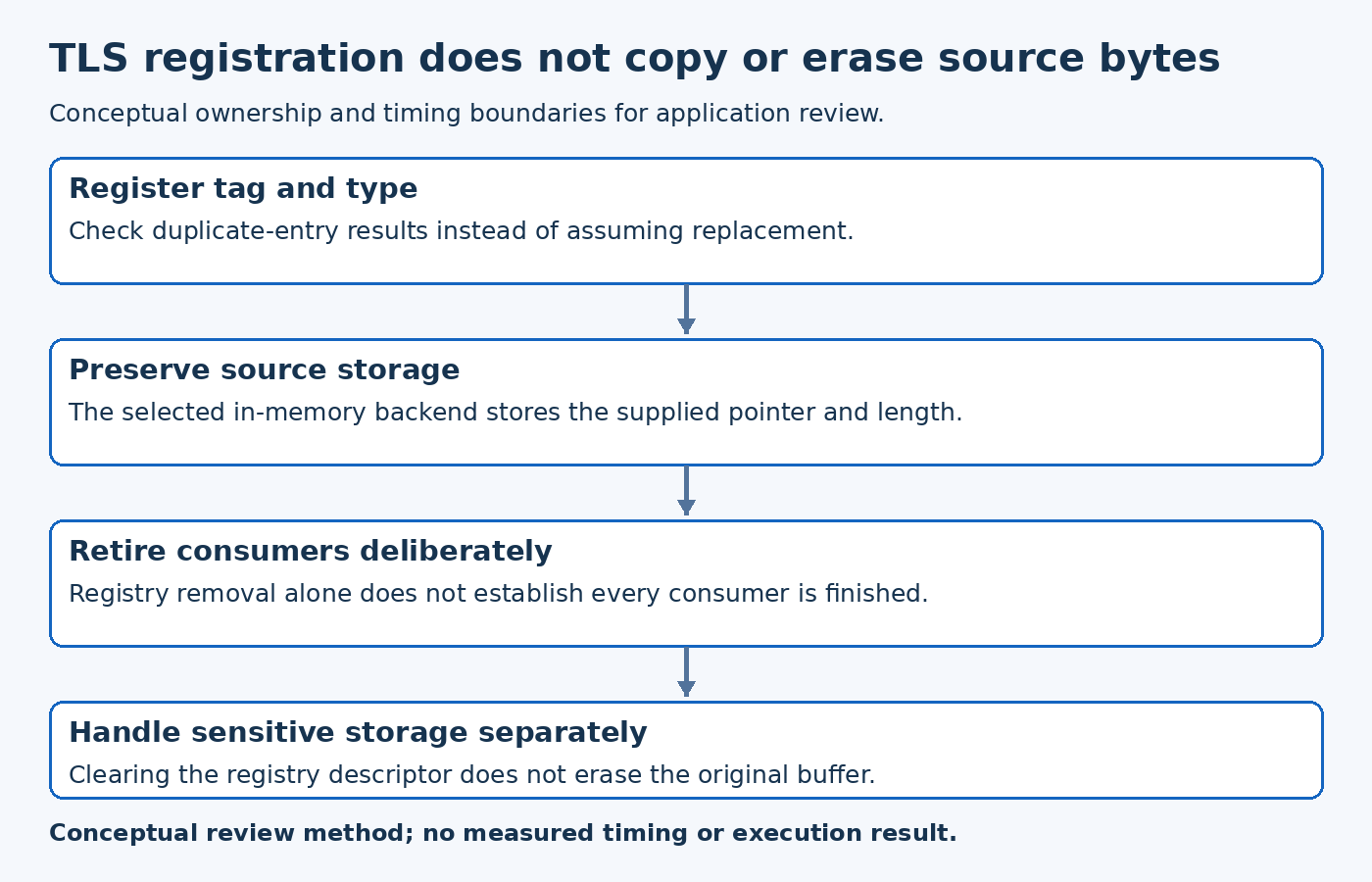
Adding a TLS credential does not necessarily copy its bytes into private storage. The Zephyr OS v4.4.0 in-memory credential backend stores the supplied pointer and length. Removing its registration clears the backend's descriptor, not the original buffer containing the credential.
These details matter when firmware loads credentials from temporary storage or rotates an application-owned buffer. The discussion is limited to this backend and version; secure-element integrations or alternate credential backends require their own contract review. No real credentials or account changes are involved here.
Identify a credential by both tag and type
The versioned credential API accepts a security tag and credential type. An existing entry with the same tag and type produces an already-exists error. Certificate/key or PSK/identity pairs can share a tag where the consuming subsystem supports multiple types per tag.
That pairing model does not mean that a tag identifies one interchangeable byte array. During setup, name the intended type of each member and check every registration result. Do not treat an already-exists result as proof that the existing entry contains the newly supplied value.
For a hypothetical development configuration, adding a replacement certificate under an occupied tag/type can fail while the application mistakenly reports “updated.” The next connection may then use the prior registration. A setup log needs the operation result, not the credential contents.
Understand the storage relationship
The tagged in-memory implementation assigns the supplied address to the credential descriptor. The getter copies bytes from that registered address into a caller-provided destination. The delete operation clears the descriptor structure and marks its type unused.
The registered source must therefore remain valid while this backend and its consumers require it. A temporary local buffer that goes out of scope after registration is unsuitable. Reusing the same buffer for another purpose can also change what a later retrieval sees, despite no second add operation.
Keep ownership explicit: which component allocated the bytes, who may modify them and when all consumers have stopped needing them. The registry's lock protects its own descriptor operations; it does not automatically coordinate arbitrary writes made elsewhere through the original pointer.
Do not confuse deletion with complete retirement
Deleting a registration removes one lookup entry. It is not evidence that the caller's source allocation has been erased. It also does not establish that every TLS context has discarded every representation it previously obtained. Review active-consumer behavior before reclaiming or changing storage.
For a production rotation design, treat registration, consumer transition and sensitive-storage cleanup as distinct steps with explicit failure handling. This article does not prescribe an atomic replacement sequence or claim that an in-place modification is safe. The relevant TLS implementation and product requirements determine that procedure.
Where sensitive bytes must be cleared, use the project's approved storage and zeroization mechanism after its lifetime requirements are satisfied. Ordinary removal of metadata is not an equivalent security operation. Avoid printing keys or full credential buffers in diagnostics merely to prove which version was used.
Verify ownership with non-secret test data
A controlled unit or integration test can use synthetic, non-secret byte patterns to examine registration behavior. Check duplicate tag/type handling, retrieval into a sufficient destination and the result after removing the entry. Keep those backend checks separate from TLS parsing or handshake success.
The getter exposes another useful boundary: the length parameter represents destination capacity on input and reports credential length on output. If the buffer is too small, use the reported required length according to the API rather than treating a partial destination as a complete credential.
Finally, review the product's actual credential backend selection. The important outcome is a documented lifetime and retirement path for the deployed configuration. A successful add call alone cannot establish independent storage, completed rotation or secure erasure.