Zephyr OS DAC Conversion: Validate the Reference and Full-Scale Code Before Writing
A successful millivolt-to-code conversion is not proof that the resulting integer is valid for a particular DAC channel. In Zephyr OS v4.4.0, the helper's full-reference boundary deserves explicit checking, and a missing reference value must be rejected before division.
This is a software-boundary review for a device that turns requested voltages into DAC codes. It does not establish analog accuracy, safe output limits or the correct transfer function for every converter. Those decisions still require the selected component's documentation and circuit constraints.
Read the conversion that the build actually uses
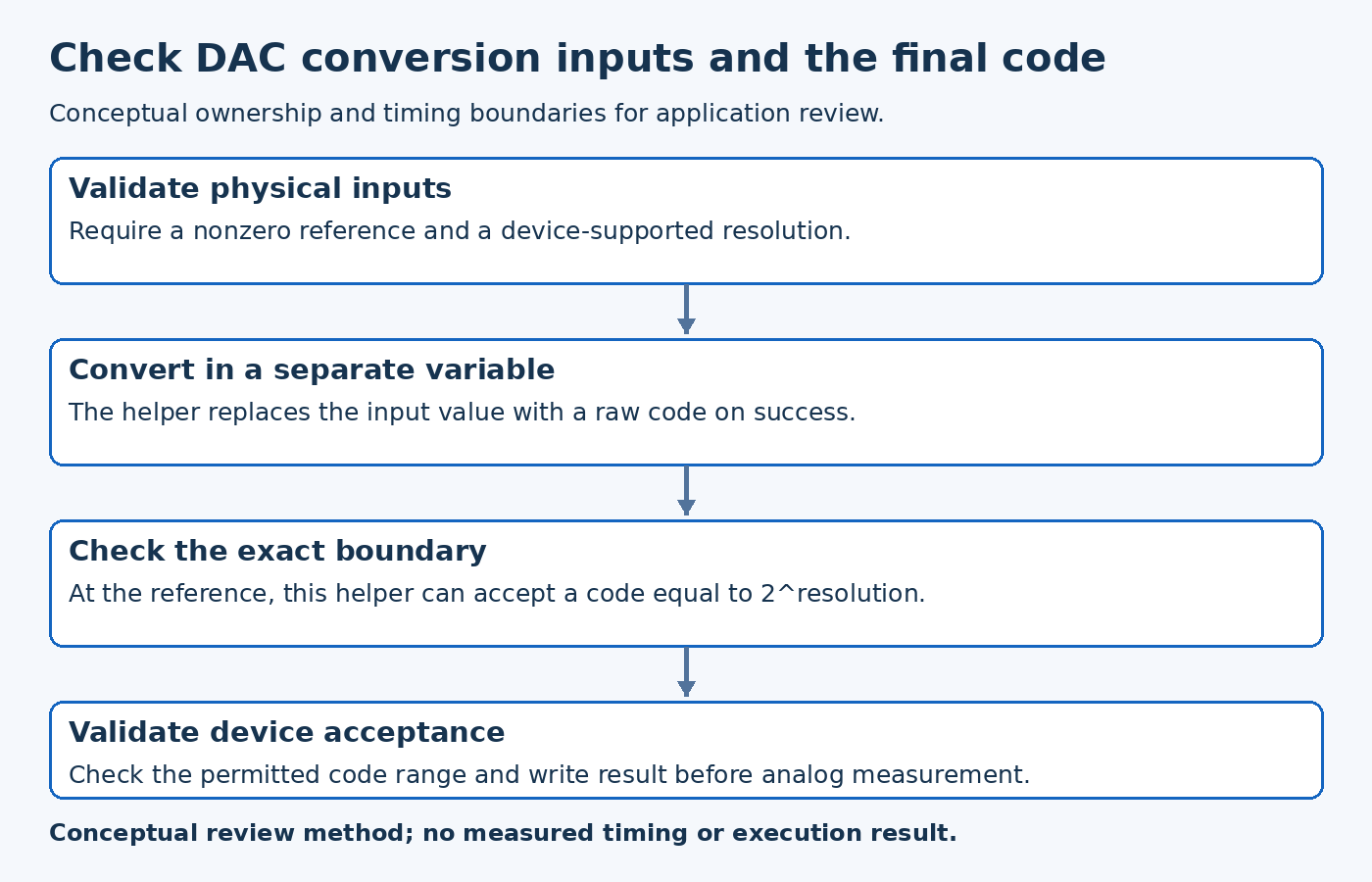
The tagged DAC header computes the millivolt conversion by shifting the requested value by the resolution and dividing by the reference. Its range check rejects a result greater than 2 raised to the resolution, rather than greater than the largest conventional unsigned code of that width.
Consequently, an input exactly equal to a valid nonzero reference can produce 2 raised to the resolution and pass that helper's comparison. The device-specific write operation remains separate. Do not assume conversion success has already established the device's permissible code range.
For hypothetical arithmetic with a 12-bit resolution and a 3300 mV reference, requesting 3300 mV produces 4096 under that expression. A conventional unsigned 12-bit code occupies 0 through 4095. This arithmetic example is not a claim that any particular circuit reaches exactly its reference voltage or that blindly clamping is the correct policy.
Validate reference information before calling the helper
The common DAC channel binding provides a channel reference-voltage property for calculations. It describes the selected reference; it does not measure the board's actual rail. The channel's name and configuration must also match the binding requirements for the generated API data to be available.
The header's devicetree specification can contain zero when no reference was provided. Its conversion wrapper checks that the channel configuration node exists, then forwards the stored reference and resolution. That existence check is not a nonzero-reference check.
Reject missing or invalid conversion inputs before calling the arithmetic helper. A zero reference is not a useful signal to discover by attempting division. Validate resolution against both the device and the arithmetic's supported range rather than allowing an arbitrary user setting to become a shift count.
Keep voltage policy separate from code conversion
Decide what the application should do with a request at or beyond its allowed output boundary. Possible policies include rejecting it, limiting it to a documented device-specific maximum, or using a calibrated conversion model. The choice must come from the actual product requirement, not from the helper's integer comparison.
Preserve the requested physical value separately from the converted code. The conversion operates through an input/output pointer, so reusing that variable later as though it still contained millivolts can introduce a second error even when the original arithmetic was valid.
Then check the result of the channel write itself. Passing a computed code to the API and receiving a successful software result still does not establish the voltage at the connector. Output buffering, reference selection, load and analog tolerances remain outside this helper.
Test the boundary without overclaiming the hardware
Start with software cases below, exactly at and above the chosen maximum, plus missing reference information. Verify that invalid inputs are rejected before conversion, and that accepted outputs lie inside the selected DAC's documented code range.
Only after those checks should a controlled hardware test compare requested and measured outputs under defined conditions. Keep the arithmetic evidence and analog measurement separate. That separation makes an off-by-one software boundary diagnosable without disguising it as calibration error or promising accuracy the code cannot provide.