Zephyr OS Userspace I2S Writes: Budget Slab Allocation Separately from the Queue Timeout
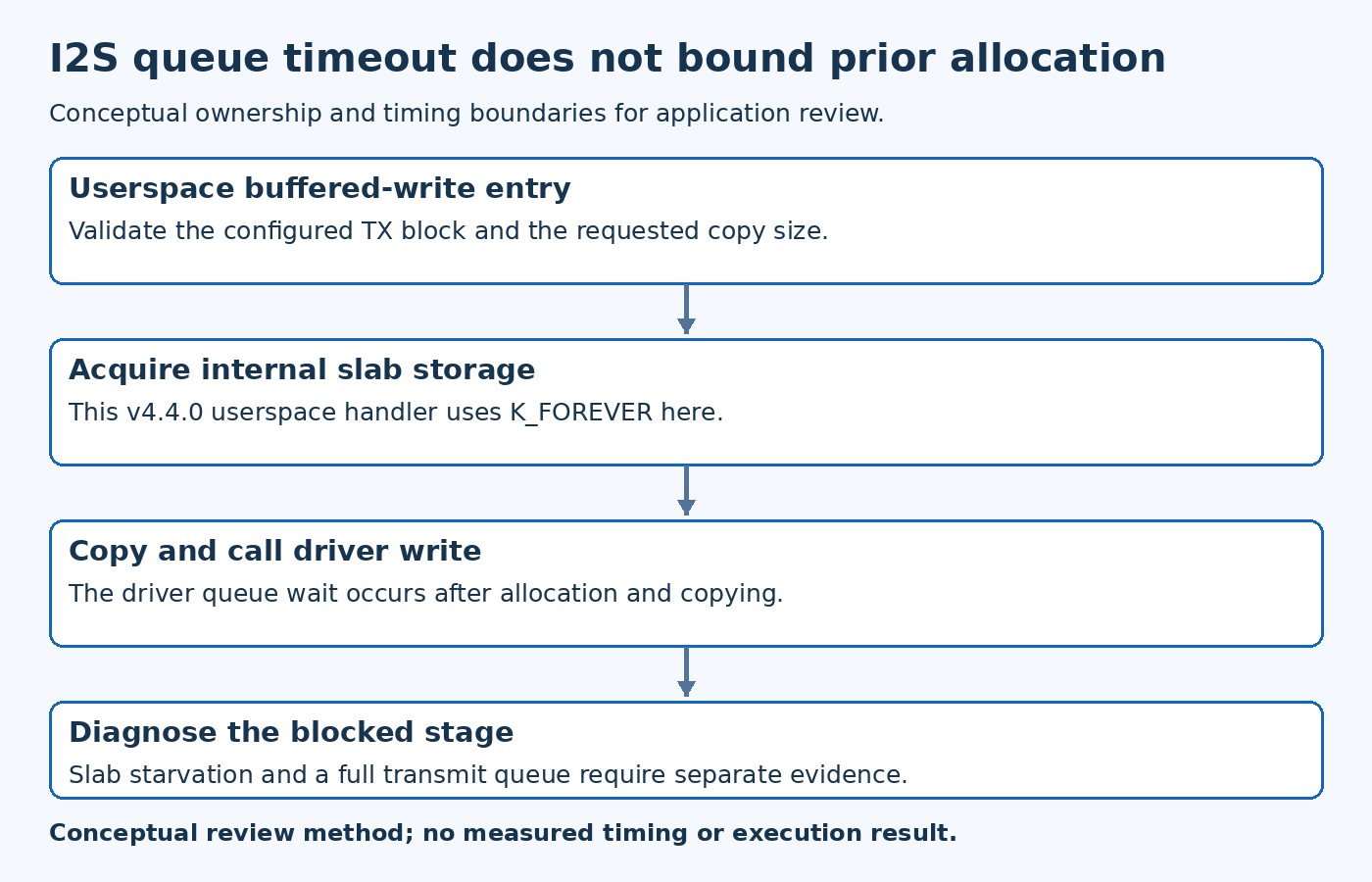
A configured I2S transmit timeout is not automatically an upper bound on every operation performed by a convenience wrapper. In Zephyr OS v4.4.0, the userspace i2s_buf_write() path allocates a slab block before it calls the driver-facing write operation. That allocation uses K_FOREVER.
If an audio-producing thread appears stuck despite a short configured timeout, identify which stage it reached. This article examines that specific userspace path; it does not claim that every driver, privilege mode or later Zephyr version uses the same allocation policy.
Separate allocation from admission to the TX queue
The tagged I2S interface distinguishes direct block writes from buffered writes that acquire a block and copy the caller's bytes. The configuration's timeout describes waiting when the transmit queue is full or the receive queue is empty.
Those are distinct resources: free storage in the configured memory slab and a place in the driver's transmit queue. A short wait for the latter does not prove that the application will reach that wait promptly. The source buffer's size also must fit the configured transmit block.
For a hypothetical producer that needs to respond to a stop request within a bounded time, listing only the queue timeout in the timing budget leaves an earlier blocking point unaccounted for. The producer's caller needs to know the entire path it has chosen.
Follow the userspace wrapper in order
The versioned syscall handler retrieves the transmit configuration, rejects an oversized input, then calls k_mem_slab_alloc() with K_FOREVER. Only after obtaining storage and copying the user's data does it invoke i2s_write(). If that write fails, the wrapper frees its allocated block.
This sequence explains why a driver write timeout might never be observed during slab starvation: execution has not reached the driver call. It also explains why the application should not independently free an internal block that the buffered API never returned to it.
The handler's allocation policy is implementation evidence for this version. Do not turn it into a universal claim that the public I2S interface promises an infinite allocation wait. Pin the actual build and verify its path when making a latency requirement.
Diagnose the resource that is not progressing
In a controlled test, distinguish three observations: entry into the buffered-write call, successful acquisition of an internal block and entry into the driver write. Instrumentation should avoid changing audio timing so much that it hides the original condition.
If the first stage is present and allocation does not finish, inspect which owners retain blocks from the same slab. Check whether transmission is actually running and whether any consumer is expected to release storage. Increasing the queue timeout cannot repair a resource that never reaches the queue operation.
If allocation finishes and the driver write waits, investigate queue admission and transport progress instead. Keep the two diagnoses separate even if both ultimately appear to the user as missing sound. A single “audio timeout” counter loses the distinction needed to choose a repair.
Make bounded behavior a design decision
A product requiring bounded response should choose an ownership and scheduling design that accounts for allocation, copying, queue admission and transmission. A dedicated audio worker can isolate that activity from a control thread, but merely adding a worker does not guarantee that the worker itself will finish on time.
If considering a direct-block path, review its permitted calling context and ownership transfer rather than treating it as a drop-in userspace workaround. Also account for cleanup when admission fails. Use only the API and permissions supported by the selected configuration.
The acceptance check should exercise slab exhaustion separately from a full transmit queue. Record which stage blocks and whether the product's control behavior remains within its requirement. That gives the configured timeout a precise scope instead of asking one number to bound operations it does not govern.