Keeping Buildroot Package Fixes Reliable: Minimal Configs, Clean Builds and CI Checks
A dependency repair is easy to lose when the next package upgrade changes detection logic or introduces a build-time tool. Package-level CI should preserve the smallest evidence that the repaired relationship still holds, then add coverage for the toolchains and features the product actually supports. The baseline here is Buildroot 2025.02.18. Its helper scripts are utils/check-package and utils/test-pkg; paths and options must be checked against that release.
Define what the package CI job is intended to prove
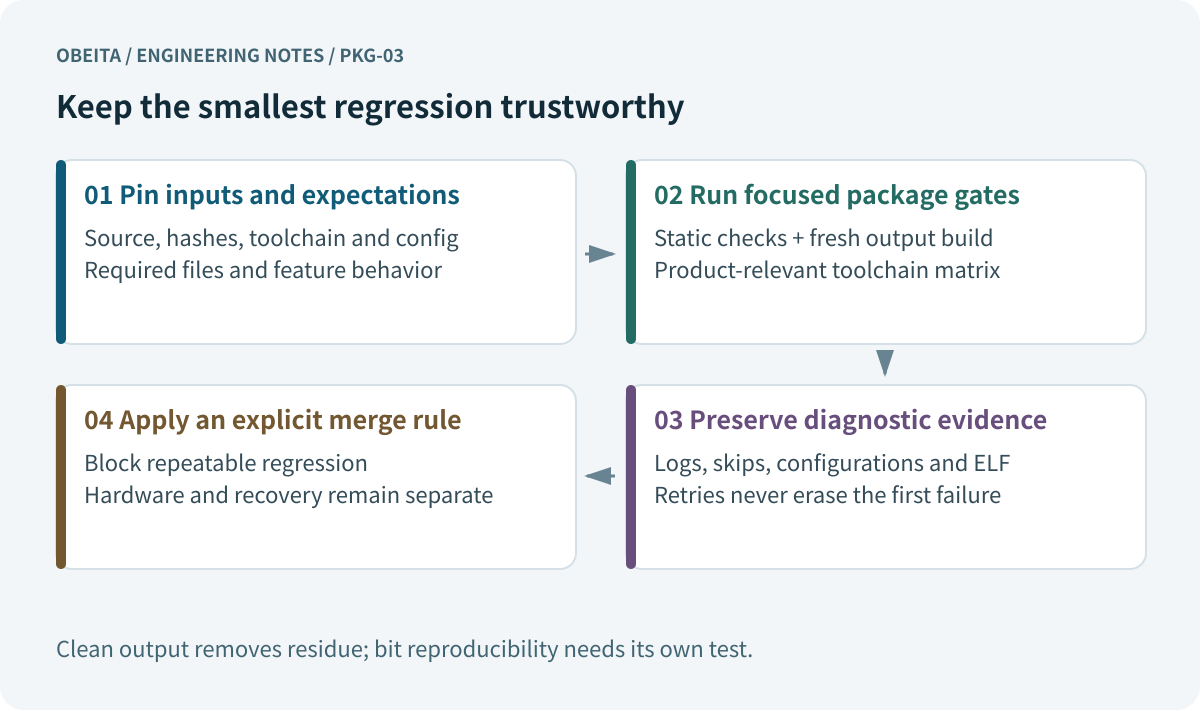
Write a short contract for the job: the package builds from declared inputs, optional features follow configuration, artifacts match the selected target, and required files are installed in the correct destination. Turn each statement into an observable check. For example, “feature disabled” should appear in configuration evidence and agree with the expected dependency and installation set, rather than being inferred from a successful exit status.
State the exclusions in the job description. A package build cannot establish board-specific peripheral behavior, a complete security maintenance decision or byte-identical image reproduction. Those require different inputs and tests. This boundary helps reviewers interpret a green job correctly. It also prevents a small, fast package check from gradually becoming an undocumented promise that every product image and every shipped board has been qualified.
Pin the inputs and preserve a minimal configuration
Pin the Buildroot release or commit, external-tree revision, package source version, source hashes, patches and toolchain configuration. Record the runner image by immutable identity when the CI platform supports it. Save the minimal configuration alongside the regression test, and identify how it differs from the full product configuration. Do not let an unrelated application select the library whose missing dependency you intend to catch.
Keep feature combinations explicit. A useful initial pair is the repaired optional feature enabled and disabled, each with its expected dependencies. Add product-specific combinations only when their risk justifies the cost. The configuration must still include the architecture and toolchain capabilities the package genuinely needs. A configuration rejected because a required toolchain feature is absent is a coverage result to explain, not a successful build to count.
Plan static checks and the toolchain matrix
Use check-package for supported source-style and package checks, and test-pkg for builds against selected toolchain configurations. In the fixed release, test-pkg’s help confirms -c for a configuration snippet, -p for the package, -d for its build directory and -t for a toolchain CSV. Inspect the release script and its help before selecting the matrix. The default subset is not every architecture or libc combination.
# Run from the fixed Buildroot source tree.
./utils/check-package --help
./utils/test-pkg --help
# Invocation shape after real inputs have been prepared:
./utils/test-pkg -c /work/ci/package.config   -p telemetry -d /work/out/test-pkg-run-001
The telemetry command is a template and was not cross-built for this article. It assumes the recipe is registered in the chosen tree; when it lives in an external tree, export the matching BR2_EXTERNAL path for the job. Check-package also has host Python dependencies that the runner must provide. Choose real product toolchains deliberately, distinguish skipped configurations from passing ones, and retain each configuration’s result. A helper script invocation alone does not specify a complete acceptance policy.
| Change or event | Required gate | Result handling |
|---|---|---|
| Recipe or source correction | Minimal clean build and applicable static checks | Block on a repeatable failure |
| Optional feature changed | Feature ON/OFF configurations | Explain skips; verify expected dependencies |
| Toolchain or libc changed | Affected target matrix and artifact checks | Expand runtime checks where risk requires |
| Transient source-download outage | Preserved log and diagnosed bounded retry | Keep original attempt visible |
| Hardware behavior changed | Separate product/board acceptance | Package green status cannot authorize release |
Separate clean output directories from download caches
Give each clean-validation job its own new output directory. Source download caches may be reused when their inputs are properly identified and checked, but previous host, staging and target trees should not become undeclared inputs to the clean job. Separate cache permissions and retention from the build workspace so a convenience optimization does not erase the distinction.
Record whether downloads came from cache or a source location, and preserve hash-mismatch evidence. Classify missing downloads, authentication failures and source changes separately from compiler failures. If a job claims offline readiness, it needs a separate controlled test with the intended inputs already available; an ordinary cache hit does not prove that claim. Similarly, two successful clean builds do not establish bit reproducibility without comparing the relevant outputs under a defined method.
Check installation and minimal runtime behavior
List the expected files by destination. Target runtime executables and libraries belong in the runtime image assembly; headers and development metadata may be needed in staging; native generators belong in host. Check file modes and unwanted development files as well as mere existence. Inspect the final image where packaging or permission transformations matter, rather than assuming target alone is the finished filesystem.
Use ELF checks for architecture, interpreter and dynamic dependencies where applicable. Add an emulator or hardware smoke test only when that environment can exercise the required behavior. A command-line parser may be testable under emulation while a peripheral-dependent transaction is not. State what the smoke test actually observes, such as accepting a fixture and returning the expected output. Leave unsupported hardware behavior explicitly for the product acceptance workflow.
Design failure artifacts and retry rules
Archive the first complete failure before any retry. Keep the full log, a short first-error summary, effective configuration, input identities and relevant discovery or ELF evidence. Capture failures in both the build and log-storage path. This small Bash logging fragment illustrates preserving the command failure while also noticing a failed tee operation; it is not a complete CI pipeline. It assumes errexit is not enabled. If an existing CI script uses set -e, review its failure-capture behavior before inserting this fragment.
# LOG is a unique path; "$@" is the selected command.
set -o pipefail
"$@" 2>&1 | tee "$LOG"
status=("${PIPESTATUS[@]}")
if (( status[0] != 0 )); then
    exit "${status[0]}"
fi
exit "${status[1]}"
A local shell fixture can verify status propagation with harmless test commands. That says nothing about cross-compilation success. Permit bounded retries for diagnosed transient download failures, preserve the original attempt, and require investigation for repeatable build failures. Repeatedly rerunning until a green result appears removes evidence without fixing the cause.
Choose the gates that must block a merge
Require the minimal clean regression and relevant static checks on changes that can affect the package. Expand coverage for version upgrades, changed dependencies, new optional features and toolchain changes. A scheduled broader matrix can supplement per-change gates, but its supported configurations and ownership must remain visible. Select the cadence using actual runtime and risk once measured, rather than claiming a universal cost from an unrun template.
Keep the original missing-dependency example or host-contamination case connected to the regression. Verify the negative test fails for the intended reason before relying on its repaired counterpart. Package evidence can then join the release delivery kit, while system migration acceptance retains responsibility for boards, updates and recovery. The merge rule should explain both what was proved and what remains outside this job.
References and version boundary
Examples are engineering illustrations for the stated version. No board execution, full cross-build, performance benchmark or field-deployment result is claimed.
- Buildroot 2025.02.18 source archive
- Buildroot manual testing and package infrastructure
- Buildroot 2025.02.18 test-pkg source and help
- Buildroot 2025.02.18 check-package source
For a focused BSP maintenance or build review, contact Obeita with the relevant version baseline, a sanitized configuration and the first complete failure log. Include the hardware or toolchain scope and the result you need to establish.