LVGL Display Sleep and Resume: Coordinate Backlight, Panel Power and UI Refresh
Backlight, panel state and UI state are separate
After an inactivity timeout, a device turns off its backlight. On wake, the backlight returns but the screen is blank or shows an old frame. A single Boolean “display asleep” hides several independent states: illumination, panel controller, bus or display engine, LVGL refresh, and application data. This guide uses LVGL 9.2 APIs cross-checked against v9.2.2; panel commands and electrical timing must come from the actual controller and board documentation.
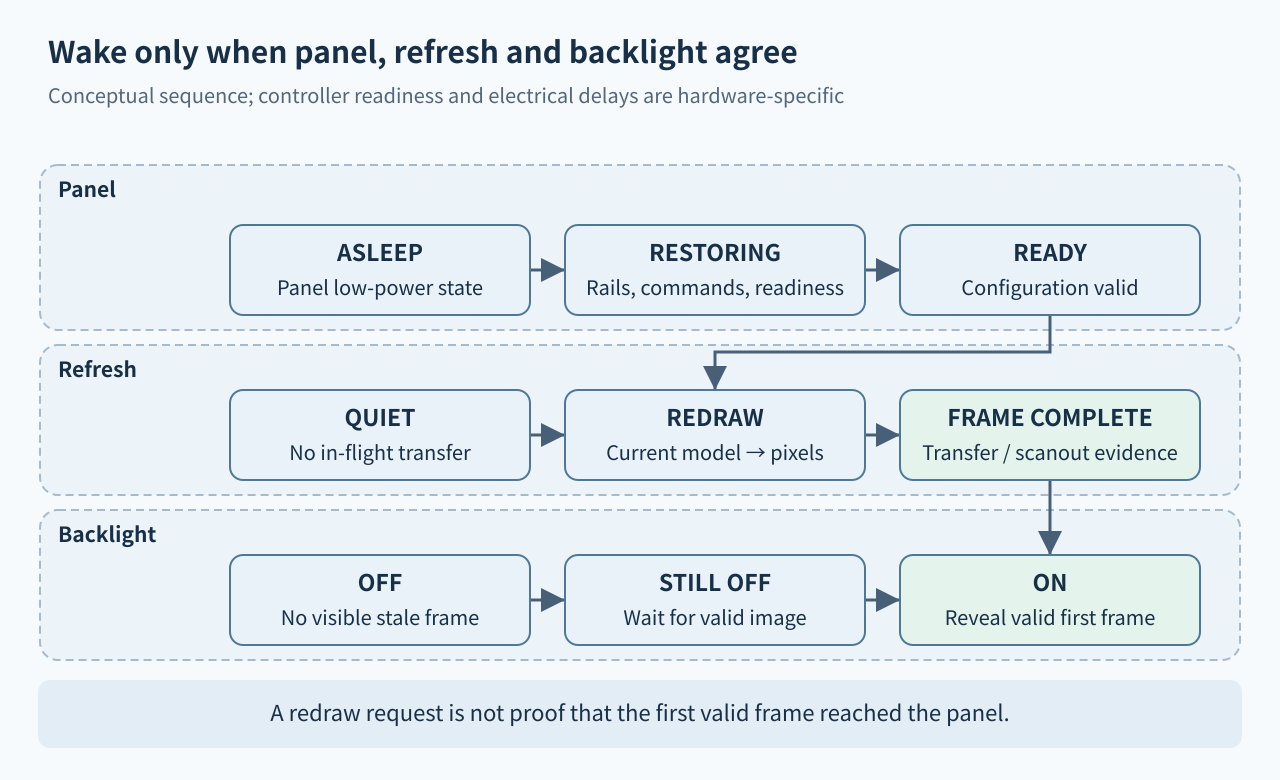
Define a state machine such as ACTIVE, QUIESCING, ASLEEP, RESTORING and FIRST_FRAME_PENDING. For each state, record which subsystem may issue transfers and which event permits progression. A successful GPIO write to the backlight pin is not evidence that the panel has exited sleep or that its pixel memory contains a valid frame. Treat wake completion as a coordinated condition rather than an arbitrary delay.
Decide what remains alive during sleep
A display-only sleep can leave the application model, LVGL timers and input wake detection active. A deeper system sleep may stop clocks or remove panel power. Those are different contracts. If panel memory is retained, resuming refresh may be enough after the documented wake sequence. If controller RAM or configuration is lost, restore initialization and redraw before exposing the image.
Write down whether animations advance during sleep, pause at their visual position, or jump to the current logical state at wake. Also decide whether sensor values continue updating off-screen. A timer count that stops during system sleep needs a deliberate timekeeping policy; otherwise animation and inactivity calculations can disagree with elapsed real time. Keep these choices in the application model rather than relying on whatever happens when the GUI task is delayed.
Quiesce refresh before powering down the transport
The LVGL 9.2 display interface gives the driver responsibility for completing flushes. lv_display_flush_ready() must correspond to actual completion of the transfer ownership expected by the selected driver path. Do not report completion simply to silence a wait while DMA still reads the buffer. Conversely, disabling the interrupt or clock that would complete an outstanding transfer can leave LVGL permanently waiting.
A proposed sleep sequence is: stop accepting new display transfers, blank illumination according to the product policy, wait for or safely cancel outstanding hardware activity, then execute the controller’s sleep and power sequence. The admission barrier and completion synchronization must work together. Pausing future refresh does not retroactively finish a transfer already in flight. Do not block the sole context required to process that completion while waiting for it.
Pause the intended refresh source only
The v9.2.2 display API exposes lv_display_get_refr_timer(). If the port uses that timer, an application can coordinate lv_timer_pause() and lv_timer_resume() with its power state; those timer APIs are defined in the pinned timer header. Check for a valid timer and confirm that the port has not replaced refresh scheduling with its own event-driven mechanism.
In v9.2.2, the default LV_EVENT_REFR_REQUEST handler resumes the display refresh timer. A later UI invalidation can therefore undo a one-time pause. Timer pausing is a scheduling aid, not a durable sleep gate. Keep transfer admission controlled by power state, with an explicit asleep-flush completion and wake-redraw policy. See the pinned display implementation.
Stopping the entire lv_timer_handler() loop is a broader action. It can affect input processing, animation, and application timers as well as the display. Decide whether that is intended, especially when touch is supposed to wake the product. A driver that drops a flush while asleep must have a deliberate completion and redraw policy; silently discarding pixels and claiming success can leave LVGL unaware that the panel needs a full reconstruction later.
Restore hardware before revealing the first valid frame
A conservative wake sequence restores power rails and clocks, performs the controller-specific reset or wake commands, waits for the documented readiness conditions, restores configuration and orientation, and reenables a valid transfer path. Then request the required redraw from the current application state. If the panel lost its contents, invalidate the appropriate full display content rather than assuming the old dirty rectangles still describe what must be sent.
For a conventional opaque screen, lv_obj_invalidate() on the active screen can be part of that redraw request. Port-specific layers and composition may require additional invalidation. The request alone is not proof that the first frame reached the panel. Wait for the relevant transfer or scanout completion condition, then reveal the backlight according to the product’s visual policy. No generic millisecond value is safe to copy across unrelated panel controllers.
Handle the wake touch and failed transitions
Decide whether the first touch only wakes the display or also activates the control underneath it. If it is consumed for wake, suppress the complete gesture consistently, including its release, so the UI does not receive a mismatched press/release sequence. Keep the touch controller’s power and interrupt routing compatible with the chosen sleep depth. LVGL input enablement and hardware wake detection are distinct mechanisms.
A second sleep request during RESTORING should not race a pending first-frame transfer. Serialize power transitions and attach a generation to asynchronous completions if necessary. Define a timeout and recovery path when the panel does not become ready or a flush never finishes. Avoid infinite retries that hide a disconnected cable or failed power rail. Report the current state and the failing boundary so diagnostics distinguish wake hardware from redraw logic.
Verify the three timelines together
Proposed tests include sleep while idle, sleep during a flush, wake after panel power removal, repeated short cycles, a UI update and invalidation while ASLEEP, a wake touch held down, and a new sleep request during restoration. Trace backlight transitions, panel commands, transfer start/completion and the first valid frame. A logic analyzer or driver trace can establish ordering; screenshots alone cannot prove that buffers were released at the correct time.
Assert that no transfer accesses a powered-down transport, every accepted flush has a completion path, and the first visible image represents current model state. Recheck the sequence after changing the display driver or low-power mode. This article provides a coordination design and source checks only; no panel was powered, no timing was measured, and no current-consumption claim is made.
- Power states define ownership of refresh, transport and wake input.
- Outstanding transfers settle before their completion mechanism is disabled.
- Wake restores panel state before the first frame becomes visible.
- Gesture handling and interrupted transitions have explicit policies.