SSID Bytes and Unicode: Preventing Wi-Fi Setup Failures with Non-ASCII Network Names
Treat the SSID as bytes with a display label
A network name can look identical on a phone and an embedded display while the two devices submit different bytes. The repair is a byte-preserving contract from scan result to association, not another password retry. Keep an SSID’s length and raw bytes separate from the human-readable label used in the interface. Linux 6.12 cfg80211 represents an SSID with a byte array and a length, while Zephyr 3.7.0’s Wi-Fi API defines a 32-byte maximum. These interfaces are useful reference boundaries; confirm the selected product API rather than assuming it accepts every possible byte sequence. This guide does not require a router to change its existing naming policy.
Find the first irreversible transformation
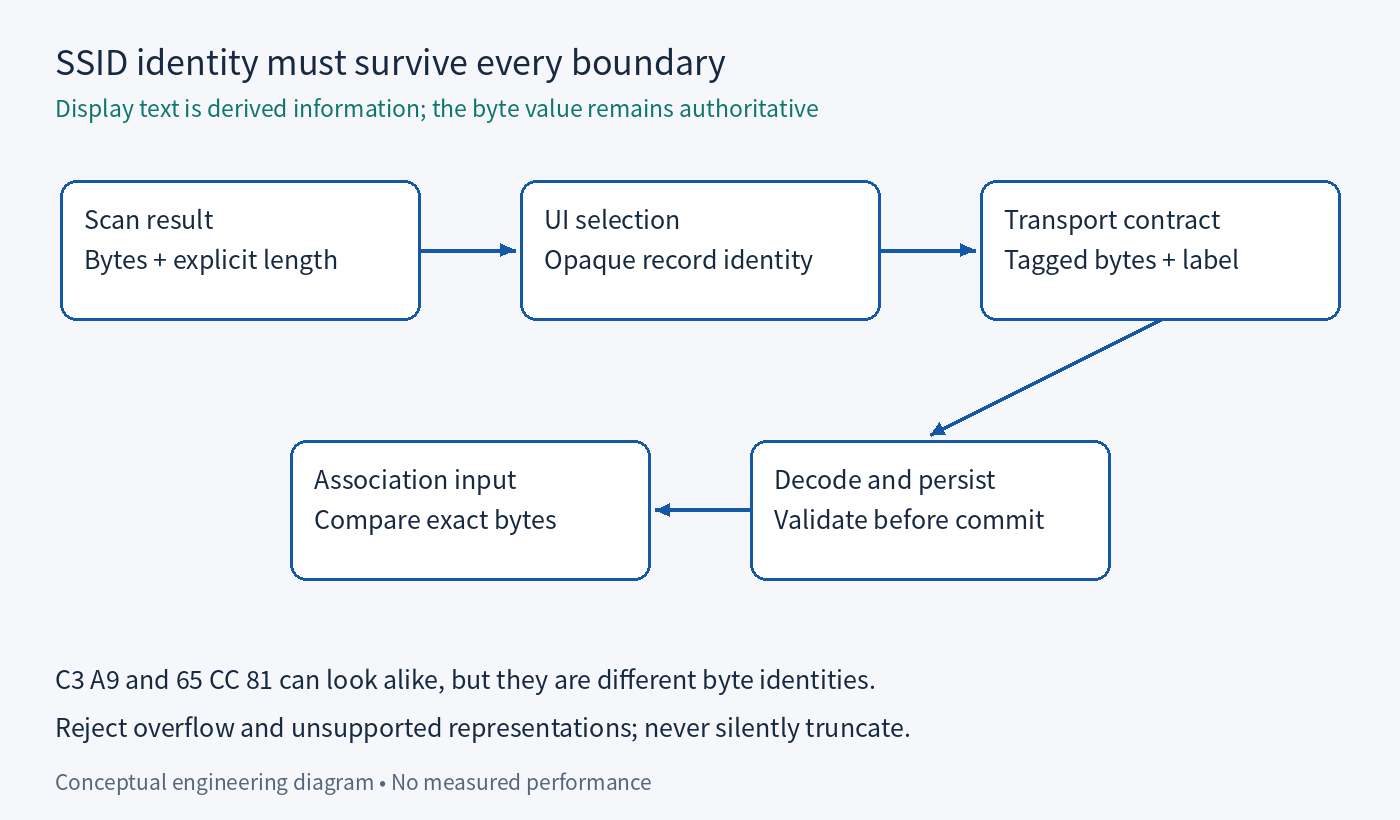
Draw the actual path: radio scan, driver callback, provisioning service, mobile data model, transport encoding, device parser, persistent profile and association call. At every boundary, document whether the value is bytes, a UTF-8 string, a platform string or a printable escape sequence. A scan parser may produce a display string with replacement characters for invalid input. If the application later re-encodes that label, the original SSID has already been lost. Preserve an opaque scan-result identifier that resolves to the retained byte value when the user selects an entry. Treat hand-entered names as a separate path with an explicit encoding policy, because text entry cannot faithfully recreate every arbitrary byte sequence.
Do not normalize an identity to make it look tidy
Unicode normalization deliberately changes representations so equivalent text can share a consistent form. Unicode UAX #15, revision 58 defines those transformations; it does not say a Wi-Fi implementation may normalize a network identifier. A constructed example is an accented e encoded as U+00E9 versus U+0065 followed by U+0301. Their UTF-8 bytes are C3 A9 and 65 CC 81. They may render similarly but are different SSID byte sequences. Do not apply NFC, case folding, trimming or smart punctuation to a scanned value. If a product intentionally normalizes newly created network names, that is a separate naming contract agreed with the AP configuration, not a repair that can be silently applied during joining.
Check lengths where the representation changes
A 32-character limit is insufficient because a Unicode character can require several UTF-8 bytes. Check the encoded byte length before sending the profile, and validate it again at the device boundary. Never truncate a network identifier to fit a buffer; truncation can select a different network. A byte array also needs a length independent of any terminating zero. If an SDK exposes only a C-string interface, test and document what it cannot represent, rather than claiming arbitrary-byte SSID support. The AOSP supplicant configuration supports a hexadecimal SSID form, useful for exact representation in controlled fixtures. That syntax belongs to the configuration parser and must not be copied blindly into an API that expects raw bytes.
Specify one transport contract and test its round trip
For a JSON-based provisioning protocol, one defensible design is an explicitly tagged base64 or hexadecimal byte field plus a separate display label. Require a decoded length, enforce the 32-byte bound, and reject malformed encodings before changing the saved profile. The display label must never override the byte field. For manual text entry, document UTF-8 encoding and reject unsupported input with a specific message. Version the message schema so older firmware cannot mistake a newly introduced byte field for literal text. Use locally generated fixtures to prove that encode, transmit, parse, persist and reload all return exactly the original bytes. These are application design recommendations, not requirements imposed by the Wi-Fi standard.
Use a compact but adversarial fixture set
Include a plain ASCII name, leading and trailing spaces, a quote and backslash, a multibyte Chinese name, the two accented forms, and values exactly at and just beyond the byte limit. For example, ten repetitions of the three-byte UTF-8 character 中 produce 30 bytes; adding two ASCII letters reaches 32, while an additional letter exceeds it. Also exercise a zero byte and invalid UTF-8 if the underlying API claims byte-array support. The expected outcome may be an explicit unsupported-input error rather than successful association. Test scanning and selecting independently from typing. A fixture that passes only a serializer unit test does not prove that the driver or AP accepted the intended value.
Diagnose without turning names into permanent identifiers
During a private lab session, compare byte lengths and controlled fixture hex dumps at each boundary. In production, avoid uploading raw network names or assuming a plain hash anonymizes them: likely SSIDs can be guessed. Prefer an ephemeral local correlation identifier, encoding category, length, and a flag indicating whether the selected scan bytes matched the submitted bytes. If richer evidence is necessary, make collection explicit and time-limited. Do not record credentials alongside the SSID debugging data. An error report should identify the first failing stage, such as transport decode, length validation, unsupported SDK representation or association, rather than collapsing everything into “incorrect Wi-Fi password.”
Require identity preservation before shipping
Acceptance means that selecting a scanned entry preserves bytes through reboot, manual text follows its declared encoding, and unsupported cases fail before the working profile is overwritten. Review UI sorting and deduplication too: visually identical labels must not automatically merge different byte identities. Retain clear, localized messages for byte-length overflow and unrepresentable names. The proposed examples are reproducible software fixtures; no phone, AP or embedded board was exercised for this article. Final compatibility depends on the complete path and the specific SDK versions recorded in the test report.