A Firmware Workaround Has Operating Limits: Qualify Its Preconditions Before Handover
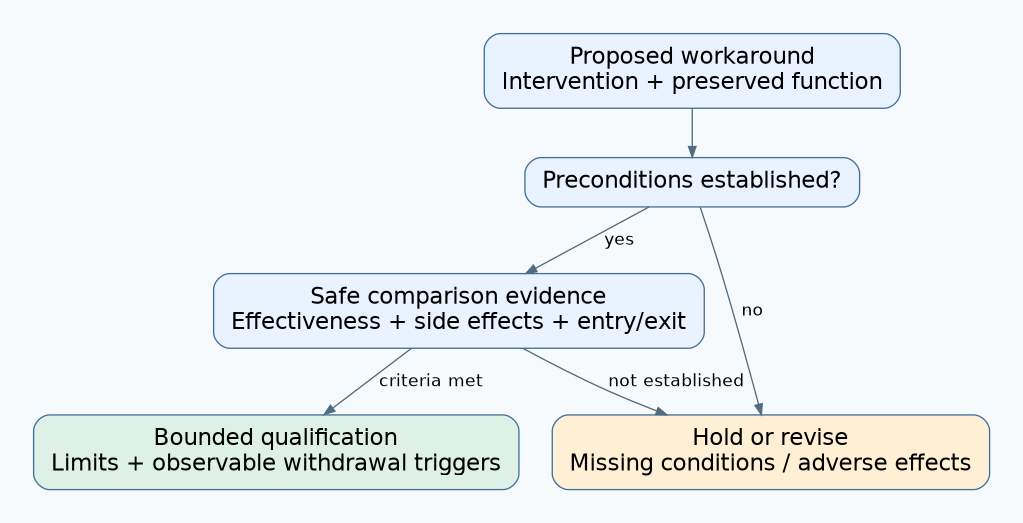
Qualify a workaround as a bounded intervention: establish its preconditions, compare its effect against the original problem, check displaced effects and define when it must be withdrawn. A symptom disappearing once is not enough. The intervention may have hidden the observation, disabled required behavior or moved the problem to another operating condition.
This article proposes an engineering qualification method for firmware workarounds. It does not authorize a temporary deviation, prove root cause or approve product release. Use designated test equipment and the applicable safety process; do not provoke hazardous behavior on operational equipment. All examples are fictional and no tests were executed.
1. Write the workaround as a testable intervention
Specify the exact action, affected release, configuration prerequisites and intended effect. Identify whether it changes a setting, operating sequence, optional feature or surrounding workflow. “Restart occasionally” is not a qualified instruction without a justified trigger, consequences and approved procedure.
State which required behavior must remain intact. A workaround that suppresses alarms by suppressing the underlying checks has not demonstrated preserved functionality. Likewise, reducing workload may remove a symptom while also violating the required reporting rate.
NASA’s technical-risk guidance, section 6.4.1.2, links mitigation to observable triggers, monitoring and effectiveness records. The comparison matrix below is an original way to apply those ideas to a proposed workaround.
2. Define receiver-checkable preconditions
| Precondition | How to establish it | If it cannot be established |
|---|---|---|
| Affected build and configuration | Controlled release identity and relevant setting readback | Do not assume applicability |
| Supported operating mode | Named mode and observable state | Hold use pending review |
| Permitted workload envelope | Approved workload metric and observation window | Obtain evidence or choose another disposition |
| Preservation/recovery preparation | Applicable approved procedure and verified prerequisites | Do not improvise a destructive step |
Make each precondition observable by the receiving team. If applicability depends on an internal state that cannot be read, the handover needs a reliable assessment method or a narrower scope. A hidden assumption is not an operating limit someone can maintain.
3. Choose comparison controls before the run
Where safe and authorized, establish that the baseline setup can exhibit the original failure. Preserve the stimulus, build, load and observation method. Then apply only the proposed intervention and compare the defined outcomes.
For intermittent behavior, choose the exposure, repetitions and interpretation before examining results. There is no universal number of clean runs that proves a workaround effective. If the control no longer reproduces, an uneventful intervention run may be inconclusive.
Do not remove a protective measure from a live system merely to create a control. Use a safe test seam, recorded evidence or another justified method when direct reproduction would be hazardous. Record the limits of the substitute method.
4. Measure more than the disappearing symptom
| Observation | Question it answers | Possible interpretation |
|---|---|---|
| Original failure indicator | Did the targeted symptom recur? | Recurrence challenges effectiveness |
| Required output behavior | Is the intended function still delivered? | Missing output may mean suppression, not mitigation |
| Resource and timing effects | Did burden move to another path? | New delays or exhaustion need review |
| Entry and exit behavior | Can the intervention be applied and removed as intended? | Persistent side effects may limit use |
Include interactions with diagnostic visibility. If the workaround changes logging, preserve an independent observation of the relevant behavior where practical. Otherwise, a quieter log could be mistaken for a healthier system.
Record failures and incomplete runs as part of the evidence. Do not count an aborted run as successful merely because the original symptom had not yet appeared.
5. Examine a fictional optional-feature workaround
Imagine a bench-only monitoring application whose optional animated display coincides with delayed status refreshes. A proposed workaround disables animation while preserving the required numeric status updates. This is a fictional hypothesis, not an explanation of any actual product defect.
The qualification plan compares the affected build with animation enabled and disabled under the same approved workload. It observes status freshness independently of the animation and checks navigation, diagnostic availability and restoration of the original setting.
If delays disappear but required status updates also stop, the workaround fails its functional objective. If the baseline does not reproduce during the planned exposure, classify effectiveness as unresolved. If the scoped criteria are met, the evidence supports only the tested intervention envelope; it does not establish the defect’s cause.
6. Define withdrawal criteria before handover
List observable reasons to stop relying on the workaround: recurrence of the original failure, a newly identified side effect, inability to verify a precondition, a relevant configuration change or availability of a qualified replacement resolution.
Withdrawal does not necessarily mean blindly reversing the action. Specify the approved response for each trigger, including who decides the next state. Re-enabling a feature may reintroduce the original problem, so removal needs its own reviewed procedure where consequences matter.
Assign someone to review evidence after deployment if operational use is separately authorized. Monitoring should have a defined metric and response, rather than a vague instruction to “watch for problems.”
7. Hand over a qualification matrix, not a promise
For each precondition, retain its check; for each intended effect, retain the comparison evidence; for each possible side effect, retain its disposition; and for each withdrawal trigger, retain an owner and approved response.
Use outcomes such as ineffective, inconclusive, effective within the assessed envelope or withheld because of side effects. Keep the qualification decision separate from permission to use an exception and from closing the investigation.
The receiver should be able to decide whether the workaround applies, recognize when its evidence no longer supports use and escalate with the right observations. That is a defensible handover of an interim measure without claiming a permanent fix, universal safety or an unapproved service commitment.