Witnessed Tests and Replayed Logs: Label What the Customer Actually Observed
Label the execution, the evidence and the receiver’s observation separately. A customer can review a valid historical test without having witnessed its execution. A live meeting can contain a prerecorded demonstration. A participant can see the final result while missing the stimulus or setup that produced it.
This article proposes an evidence-provenance register for embedded handovers. It does not establish legal witness status, certification or contractual acceptance. No participant, meeting or test described here is real, and no recording or target run was produced.
1. Use three identities and three times
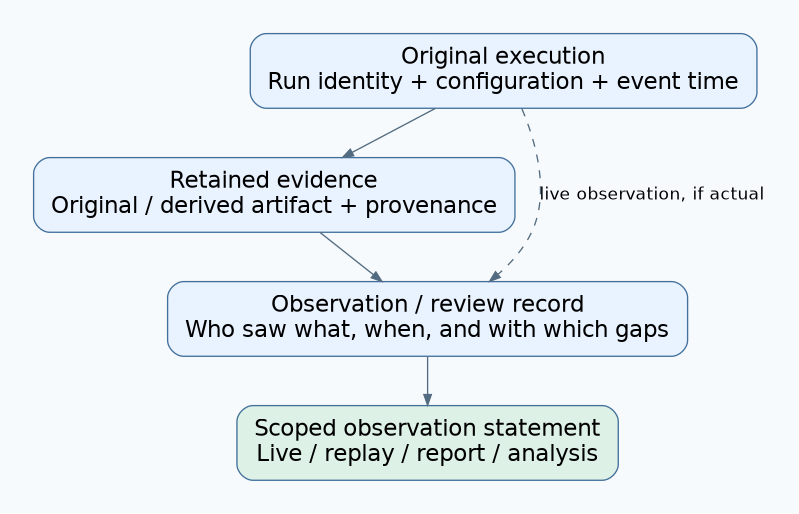
Assign an execution identity to the original run, an artifact identity to its recording/logs and a review identity to the later viewing or analysis. Record execution time, artifact creation or export time and review time without treating them as interchangeable.
If a timestamp is unavailable or its time base is uncertain, say so. A file modification time is not reliable proof of when the hardware event occurred. Preserve relevant clock-source and synchronization limitations where ordering or elapsed time affects the claim.
NASA’s product-integration guidance, section 5.2.1.2.3, recognizes documented or witnessed validation evidence. The register below preserves which route actually occurred rather than treating the words as synonyms.
2. Define observation labels before the meeting
| Label | What occurred | What it does not imply |
|---|---|---|
| Live execution observed | Named participant observed specified portions as the run occurred | Every setup step or channel was visible |
| Recorded execution reviewed | Participant viewed an identified historical recording | Participation in the original run |
| Log/report reviewed | Participant inspected retained records | Direct observation of physical stimulus |
| Derived analysis reviewed | Participant reviewed a transformation or interpretation of evidence | Independent repetition of the experiment |
These are proposed engineering labels, not standardized legal categories. Add the exact observed scope to each entry. “Live” alone is too coarse when the meeting displayed only a terminal window while a separate operator controlled unseen equipment.
3. Map the claim to visible channels
List the channels needed to support the claim: target identity, firmware identity, fixture configuration, stimulus, output, measurement instrument and result evaluation. Mark each as directly observed, supported by a retained artifact or unavailable.
A video of a changing display may show the screen behavior but not establish input amplitude or end-to-end latency. A terminal transcript may show an application response without proving which physical unit supplied it. Combine evidence only when its identities and timing can be linked defensibly.
When a participant joins late, preserve the interval they actually observed. Their presence at the final summary should not be extended backward to setup or earlier cases.
4. Preserve original and edited artifacts separately
Retain the original records under appropriate access control, and identify any derived clip, redacted log or summarized report. Describe the transformation, omitted intervals and purpose. Editing for clarity is compatible with honest evidence when its boundary is visible.
A checksum can help identify the exact retained file and detect later byte changes. It cannot establish that the depicted event occurred, that the clock was correct or that the test setup was valid. Do not promote a file hash into proof of authenticity by itself.
Before sharing, remove secrets and unnecessary private information from the review copy using the approved process. Keep the relationship between that copy and the controlled original without exposing sensitive content merely to demonstrate provenance.
5. Handle interruptions as evidence gaps
| Event | Honest record | Possible next step |
|---|---|---|
| Video disconnects during stimulus | Live observation incomplete for that interval | Review retained evidence or repeat the needed observation |
| Log begins after initialization | Initialization not evidenced by this log | Locate a linked record or leave the claim open |
| Recording is edited | Identify clip boundaries and source recording | Review originals where required |
| Configuration identity disagrees | Applicability unresolved | Resolve identity before using the result |
Do not assume a dropped live feed means the underlying test failed. Equally, do not assume the missing interval passed. The test result and the observation gap are different facts that need separate dispositions.
6. Work through a fictional review session
A fictional supplier performs a bench test on Monday and retains a raw log and video. On Wednesday, an integrator reviews a five-minute excerpt while the supplier explains the result. The integrator asks for a calculation using the retained timestamps.
The register contains three entries: Monday execution, Wednesday recording review and Wednesday derived analysis. The integrator reviewed evidence but did not witness Monday’s live execution. If a separate command is run live during Wednesday’s call, give it its own execution identity.
Suppose the excerpt omits fixture setup. The setup claim must rely on other identified evidence or remain unverified by the reviewed material. A clear explanation during the meeting does not retrospectively create an observed setup record.
7. Obtain precise acknowledgements
Ask participants to confirm the record of what they reviewed, including interruptions and exclusions, through the project’s normal process. Do not translate “I saw the video” into approval of the product or every conclusion in a report.
NASA’s verification-record guidance in section 5.3.1.2.4 retains procedures, environments, outcomes and configuration versions. Attach the observation register to those records so future readers can distinguish experiment evidence from meeting participation.
A good final statement identifies the run, artifacts, reviewer, observed scope, review date and unresolved questions. It allows historical evidence to remain useful without inventing live witnessing, independent execution or an acceptance decision that the receiver never made.